Why Writing by Hand Calms a Busy Mind
Writing by hand engages the brain differently from typing. What the research on memory and learning shows, and how a pen and paper can slow a racing mind.
By Mei Lin
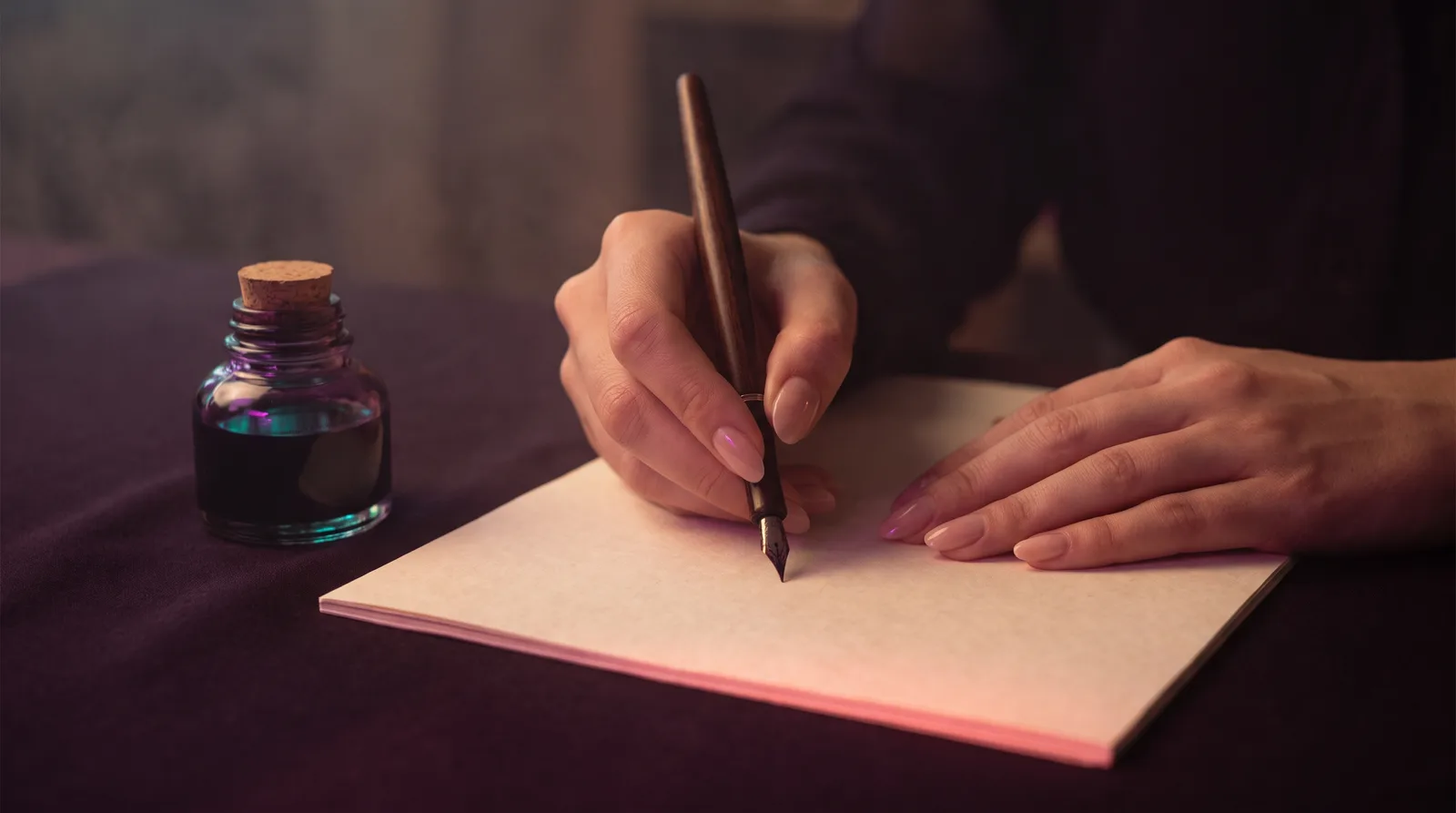
I learned to write twice. Once as a child in Shanghai, with a pencil and grid paper, where each character was a small house that had to be built in the right order, stroke by stroke, or it would not stand. And once more as an adult, when I noticed that everything I typed seemed to evaporate by evening while everything I wrote by hand stayed with me. The pen is slower than the keyboard. That is not its flaw. That is the entire gift.
What the research actually shows
The best-known study on this is from 2014, when Pam Mueller and Daniel Oppenheimer compared students taking lecture notes on laptops with students writing longhand. The laptop note-takers wrote more, but much of it was near-verbatim transcription. The longhand writers, forced by the pen's slowness to compress and choose, performed better on conceptual questions about the material. The paper's title made the finding hard to forget: the pen is mightier than the keyboard.
A decade later, researchers in Norway looked underneath the behavior. In 2024, Van der Weel and Van der Meer recorded high-density EEG from students writing by hand and typing, and found that handwriting produced far more widespread connectivity across brain regions, in frequency patterns associated with memory formation and learning. Typing reduces the hand to small, identical taps; handwriting recruits vision, fine motor control, and the felt position of the body, all cooperating to shape each letter. The movement itself appears to be part of how the learning happens.
The honest caveats: these are findings about learning and memory, not a treatment for anything, and typing fairly wins on speed and volume. Nobody should draft a novel or a legal brief by hand out of principle. The pen's territory is smaller and more deliberate: the things worth remembering, and the minutes you want to slow down.
The hand sets the pace
Handwriting moves at a fraction of typing speed, far behind the pace of thought, and this gap is where its calming effect lives. You cannot transcribe the whole storm, so you must choose from it. Choosing requires standing back slightly, the way you cannot describe a river while being swept down it. People who journal by hand often notice this as a change in the thoughts themselves: sentences arrive shorter, rounder, already half-sorted. Walking does something similar to the mind compared with driving. The slower vehicle shows you a different road.
It is worth noticing how rare the experience has become. Many of us now write by hand only to sign for a package, and entire days pass through our fingers as taps on glass. Nothing is wrong with that, exactly. But a skill the hand practiced daily for most of a lifetime has quietly moved to the occasional, and with it went one of the simplest tools we had for slowing a crowded head. Reclaiming it does not mean renouncing the keyboard. It means keeping one small channel open, a few lines wide, where thought still travels at the speed of the wrist.
The keyboard records your thoughts. The pen makes you choose them.
A ritual for the senses
There is also the plain sensory pleasure, which the research politely ignores. The drag of a nib across paper's grain. The faint smell of ink. The small weight of a good pen, and the shadow of your hand traveling the page. Chinese calligraphy formalized all of this centuries ago: you grind the ink, you settle the posture, you breathe, and only then does the brush move, because the state of the writer enters the stroke. A ballpoint and the back of an envelope carry the same truth at lower ceremony. My grandmother wrote her market lists in beautiful straight columns, and when I asked why she took such care over cabbage and fish, she said the list was for the eggs, but the writing was for her.
Ways to bring the pen back
None of this requires expensive notebooks or an hour a day. Small, regular, and slightly pleasurable beats grand and abandoned:
- Write three sentences by hand in the morning before you touch your phone, about anything at all.
- Keep the day's to-do list on paper, and rewrite it fresh each morning instead of carrying it over.
- Copy out a poem or a paragraph you love, slowly, as calligraphers copy the masters.
- Send one short handwritten card a month to a real person; it will mean more than its postage suggests.
- End the day with a single written line: what happened, and one thing you noticed.
Before the pen touches paper
A page meets you where you are, and a racing mind writes racing lines. When I sit down wound up, I begin with one round of 4-7-8 breathing, the exercise built into Feelsy: inhale for four, hold for seven, exhale for eight, three or four times through. Two minutes of that and the handwriting comes out slower and rounder, and so, reliably, do the thoughts. Breath first, then ink. The order matters more than it should.
Slow ink
Nobody will grade your penmanship again; that examination ended years ago and you passed. What remains is the quieter use of the skill: a technology for thinking at walking pace, requiring no battery, no login, and no update. The research gives us good reasons to keep writing by hand. The better reason is the one you feel three sentences in, when the pen has slowed you to its speed, and the mind, grateful for once to be overtaken, follows.
Feelsy is a wellness product, not medical advice. If stress, anxiety or sleep problems persist, please speak with a qualified professional.
References
- Mueller, P. A., & Oppenheimer, D. M. (2014). The pen is mightier than the keyboard: Advantages of longhand over laptop note taking. Psychological Science, 25(6), 1159-1168.
- Van der Weel, F. R., & Van der Meer, A. L. H. (2024). Handwriting but not typewriting leads to widespread brain connectivity: A high-density EEG study with implications for the classroom. Frontiers in Psychology, 14, 1219945.
Frequently Asked Questions
Is writing by hand better than typing?
For speed and volume, typing wins easily. But for remembering and understanding, research favors the pen: students taking longhand notes performed better on conceptual questions than laptop note-takers, apparently because writing's slowness forces you to compress and choose rather than transcribe. Each tool has its territory.
Does handwriting improve memory?
Research points that way. A 2024 EEG study found handwriting produced far more widespread brain connectivity than typing, in patterns associated with memory formation and learning. The physical act of forming each letter, with its coordination of vision and fine movement, appears to be part of how writing helps things stick.
How can I start writing by hand again?
Start small and regular: three handwritten sentences each morning, a paper to-do list rewritten daily, or one line at night about what you noticed. Copying out a poem you love works too. The goal is not penmanship but pace; a few slow minutes with a pen is enough to feel the difference.
Is journaling by hand good for a racing mind?
Many people find it steadying, and the mechanism is simple: a pen moves far slower than thought, so you must choose what to write rather than transcribe the whole storm. That choosing creates a small distance from your thoughts. Settling your breath for a couple of minutes before writing makes the effect stronger.

About the author
Contributing writer
Mei grew up in Shanghai around tea that could not be hurried and grandmothers who considered stillness a skill. She writes about slow hands and sensory ritual: tea, calligraphy, qigong, and the quiet crafts that taught the world how to pay attention.
Feel it for yourself.
Feelsy turns reading about calm into practising it. Two minutes of a slow texture is often the whole difference.


Related reading
 Visual Meditation
Calligraphy as Meditation: Why Slow Writing Calms a Fast Mind
Why calligraphy calms a racing mind: the science of slow writing and attention, and how to practice mindful handwriting with any pen and ten quiet minutes.
 Ancient Wisdom
How to Start a Gratitude Journal You Will Actually Keep
How to start a gratitude journal that actually helps: what the research found, why most lists go stale, and the very old art of counting blessings.
 Visual Meditation
Zentangle: The Meditative Drawing Practice Anyone Can Learn
Zentangle turns simple repeated pen strokes into a calming ritual. Learn how the method works, why structured drawing soothes anxiety, and how to begin tonight.
 Breath & Body
Time Blocking: The Calendar Trick That Makes Your To-Do List Tell the Truth
Time blocking puts your to-do list on the clock, where it has to be honest about your day. Why the method works, the research behind it, and how to start.
 Breath & Body
The Two-Minute Rule: The Only Productivity Trick I Haven't Quit
The two-minute rule says if a task takes under two minutes, do it now. Why this tiny rule beats fancy systems for procrastination and mental clutter.
 Breath & Body
Why You Work Better Under Pressure (and Why That's Half a Lie)
Deadline pressure really does sharpen focus, and it quietly costs you. The science of arousal, procrastination and borrowing urgency without panic.