Pressure Points for Anxiety: The Quiet Craft of Acupressure
Pressure points for anxiety, explained: where acupressure comes from, which points people press, what research shows so far, and how to try it gently.
By Mei Lin
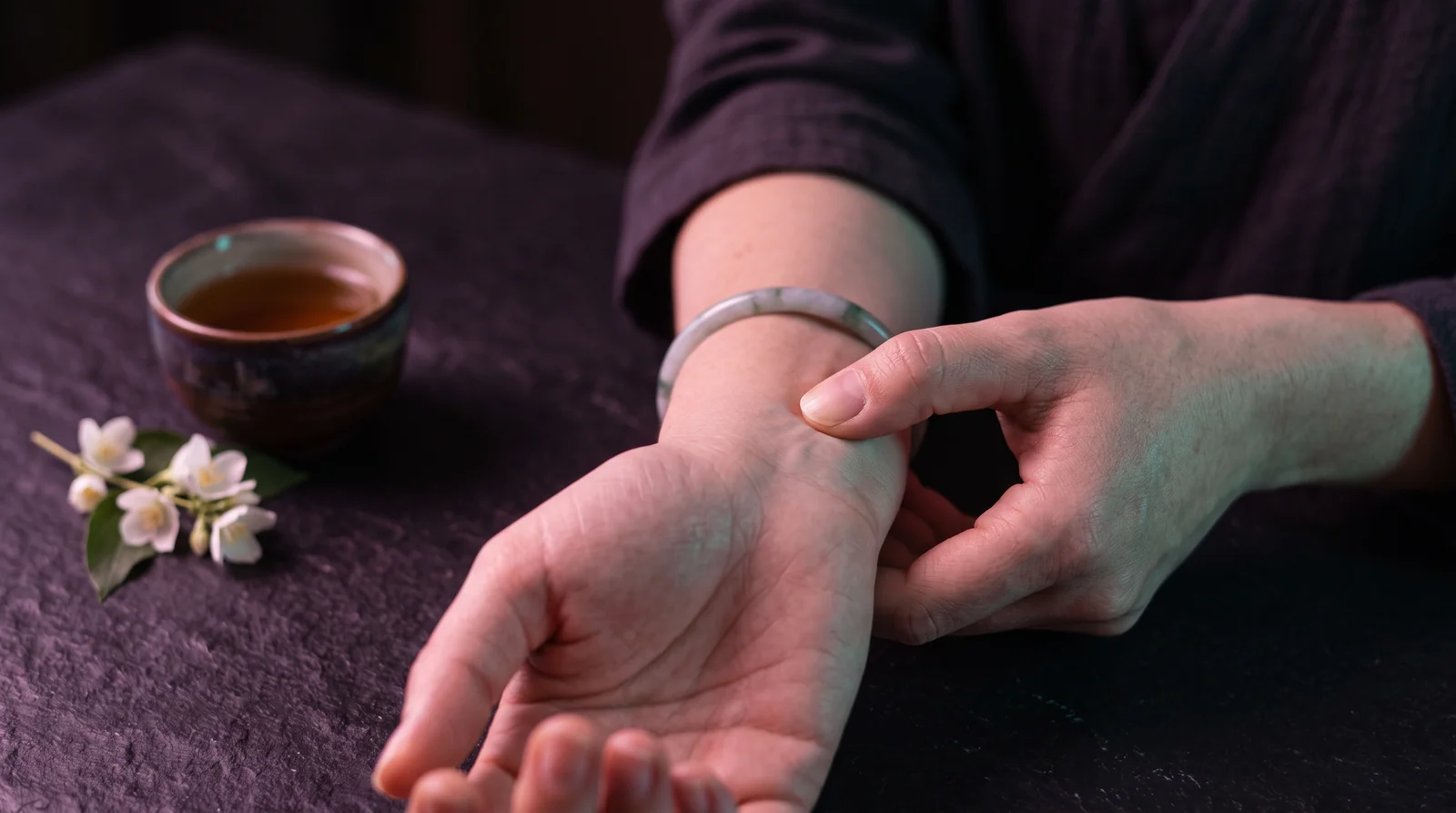
When I was small and could not settle, my grandmother would take my hand as if it were a dumpling she was checking for doneness, find the soft web between my thumb and first finger, and press. Not hard. The way you press a fruit at the market, asking a question of it. Whatever she was asking, my shoulders always answered. It took me thirty years and a move across the world to learn that her habit had a name, a map, and a growing pile of research papers trying to work out whether it does what she never doubted it did.
The habit is acupressure: the practice of pressing specific points on the body with fingers rather than needles. It comes from the same tradition of Chinese medicine that produced acupuncture, which understands the body as crossed by channels of energy, and the points as places where that flow can be reached. You do not have to adopt that cosmology to try the practice; the points also sit, less poetically, where modern hands can describe them, near nerves, between tendons, in the hollows beside bones. What matters for our purposes is simpler: pressing them slowly is one of the oldest self-soothing crafts in the world, it costs nothing, and it can be done in a meeting without anyone noticing.
The points people reach for
Traditions vary, but a handful of points appear again and again wherever anxiety is the complaint. Each is found by feel, not by measurement; you are looking for a spot that is slightly tender, slightly alive, the way my grandmother looked for the answer in the pressing.
- The web of the hand (hegu): the muscled valley between thumb and index finger. Press with the opposite thumb, slow circles, half a minute each side. Tradition advises expectant mothers to skip this one.
- The inner wrist (neiguan): three finger-widths below the wrist crease, in the groove between the two tendons. This is the point motion-sickness bands press, and a favorite for a fluttering chest.
- The wrist crease below the little finger (shenmen, the spirit gate): a small hollow on the crease's inner edge. The name alone is worth the visit.
- Between the eyebrows (yintang): the spot the thumb finds by instinct when a day has been long. Light pressure or slow small circles, eyes closed.
What the evidence actually shows
Honesty is part of the craft, so here is the state of things. A systematic review and meta-analysis of randomized trials found that acupressure was associated with meaningful reductions in anxiety, mostly in clinical settings, in people waiting for surgery or undergoing treatment (Au et al., 2015, Acupuncture in Medicine). The reviewers also noted what careful readers should: many studies are small, blinding is difficult, and pressing a sham point often helps too, which suggests that some of the benefit lives in the pressing itself rather than the postcode. Slow touch, a lowered gaze, a task for the hands, thirty seconds of attention paid to the body instead of the forecast of doom: these are active ingredients by any theory. The map may matter less than the visit.
The map may matter less than the visit.
I find this conclusion freeing rather than deflating. It means the practice cannot really be done wrong. If the point you find is a centimeter from the diagram, the nervous system does not check the diagram. It notices what it always notices: warm pressure, unhurried pace, the signal that someone, even if it is only your other hand, is tending to you.
How to press
The pressure itself has a grammar, and it is gentler than most beginners expect. Use the pad of the thumb, not the nail. Press until you feel a dull, pleasant ache, the sensation Chinese tradition calls suan, somewhere between a stretch and a sigh, and stop well short of pain; this is tending, not tenderizing. Move in slow circles or simply hold, and keep each point company for thirty seconds to a minute while the breath stays long. Let the shoulders drop while you work, since they will try to supervise. And treat the practice as a kettle, not a light switch: it is something you put on and wait beside, and the second minute is usually kinder than the first.
A two-minute practice for a racing evening
Here is how I use it, most nights that need it. Sit anywhere. Take the left hand in the right as if greeting it. Find the web of the hand and press in slow circles while the breath lengthens; I like to pair the pressing with the 4-7-8 exercise in Feelsy, one circle per count of the exhale, and let one of the app's slow warm textures hold my eyes while the hands work, its autoplay drifting to the next scene at about the pace a thumb makes a circle. Then the inner wrist, then the spirit gate, half a minute each, first one hand and then the other. The sequence ends on its own; hands, unlike thoughts, know when they are finished.
Is it the meridians? Is it the ritual, the touch, the breath, the two minutes of doing one small thing with full attention? I no longer need the answer, and my grandmother never asked the question. She pressed the point she knew, at the speed she knew, and the child in front of her settled, which was the entire research program. Some crafts survive because they are true in the laboratory. Others survive because they are true in the kitchen. The best ones, I suspect, are a little of both.
Feelsy is a wellness product, not medical advice. If stress, anxiety or sleep problems persist, please speak with a qualified professional.
References
- Au, D. W. H., Tsang, H. W. H., Ling, P. P. M., Leung, C. H. T., Ip, P. K., & Cheung, W. M. (2015). Effects of acupressure on anxiety: a systematic review and meta-analysis. Acupuncture in Medicine, 33(5), 353–359.
Frequently Asked Questions
What is acupressure and where does it come from?
Acupressure is the practice of pressing specific points on the body with the fingers rather than needles, and it comes from the same tradition of Chinese medicine that produced acupuncture. That tradition understands the points as places where the body's energy flow can be reached, though the same points also sit near nerves, tendons and bone hollows that modern anatomy can describe.
Which pressure points are commonly used for anxiety?
Common points include hegu, the muscled web between the thumb and index finger, and neiguan, three finger-widths below the wrist crease between two tendons, which is also the point motion-sickness bands press. Others include shenmen, a small hollow on the wrist crease below the little finger, and yintang, the spot between the eyebrows.
Does the research actually support acupressure for anxiety?
A systematic review and meta-analysis of randomized trials found acupressure was associated with meaningful reductions in anxiety, mostly in clinical settings like people awaiting surgery or treatment (Au et al., 2015). However, reviewers noted many studies are small, blinding is difficult, and pressing a sham point often helps too, suggesting some benefit comes from the slow touch and attention rather than the exact point location.
How hard should I press on an acupressure point?
Use the pad of your thumb rather than the nail, and press until you feel a dull, pleasant ache, something between a stretch and a sigh, stopping well short of actual pain. Hold or make slow circles for thirty seconds to a minute while keeping the breath long, and let your shoulders relax rather than tense up while you work.
Can I do a quick acupressure routine for anxiety at night?
Yes, a simple two-minute practice is to take one hand in the other, find the web of the hand, and press in slow circles while lengthening the breath, then move to the inner wrist and then the wrist crease below the little finger, spending about half a minute on each spot. Pairing the pressing with slow counted breathing, one circle per exhale, can make the routine feel more complete.

About the author
Contributing writer
Mei grew up in Shanghai around tea that could not be hurried and grandmothers who considered stillness a skill. She writes about slow hands and sensory ritual: tea, calligraphy, qigong, and the quiet crafts that taught the world how to pay attention.
Feel it for yourself.
Feelsy turns reading about calm into practising it. Two minutes of a slow texture is often the whole difference.


Related reading
 Breath & Body
How to Stimulate Your Vagus Nerve (What's Real, What's Not)
The vagus nerve is the internet's favorite calm switch. Here's what it really does, what actually tones it, and which viral hacks are a waste of your time.
 Breath & Body
The 5-4-3-2-1 Grounding Technique: Five Senses Against a Spiral
How the 5-4-3-2-1 grounding technique calms anxiety: what to do with each of the five senses, why it interrupts spirals, and how to practise it well.
 Breath & Body
Progressive Muscle Relaxation: A Complete Guide
Progressive muscle relaxation releases tension you did not know you were holding. A complete beginner's guide to the tense-and-release technique.
 Breath & BodyNew
ADHD Waiting Mode: Why a 3 p.m. Appointment Eats the Whole Day
ADHD waiting mode is when one afternoon appointment freezes your entire day. Here's the science of why waiting feels unbearable, and what actually helps.
 Breath & Body
Do Cold Showers Actually Work? A Skeptic Reads the Evidence
Cold showers are pitched as a cure for everything from low energy to weak character. Here's what the actual research says, and how to try one without the cult.
 Breath & Body
Dopamine Detox: What It Gets Right and What It Gets Wrong
Dopamine detox promises a factory reset for your distracted brain. Here's what the neuroscience actually says, what helps, and what's just rebranded boredom.