Why Birdsong Calms the Mind
Why birdsong calms an anxious mind: the science of soft fascination, what bird sounds do for attention and mood, and how to bring the dawn chorus indoors.
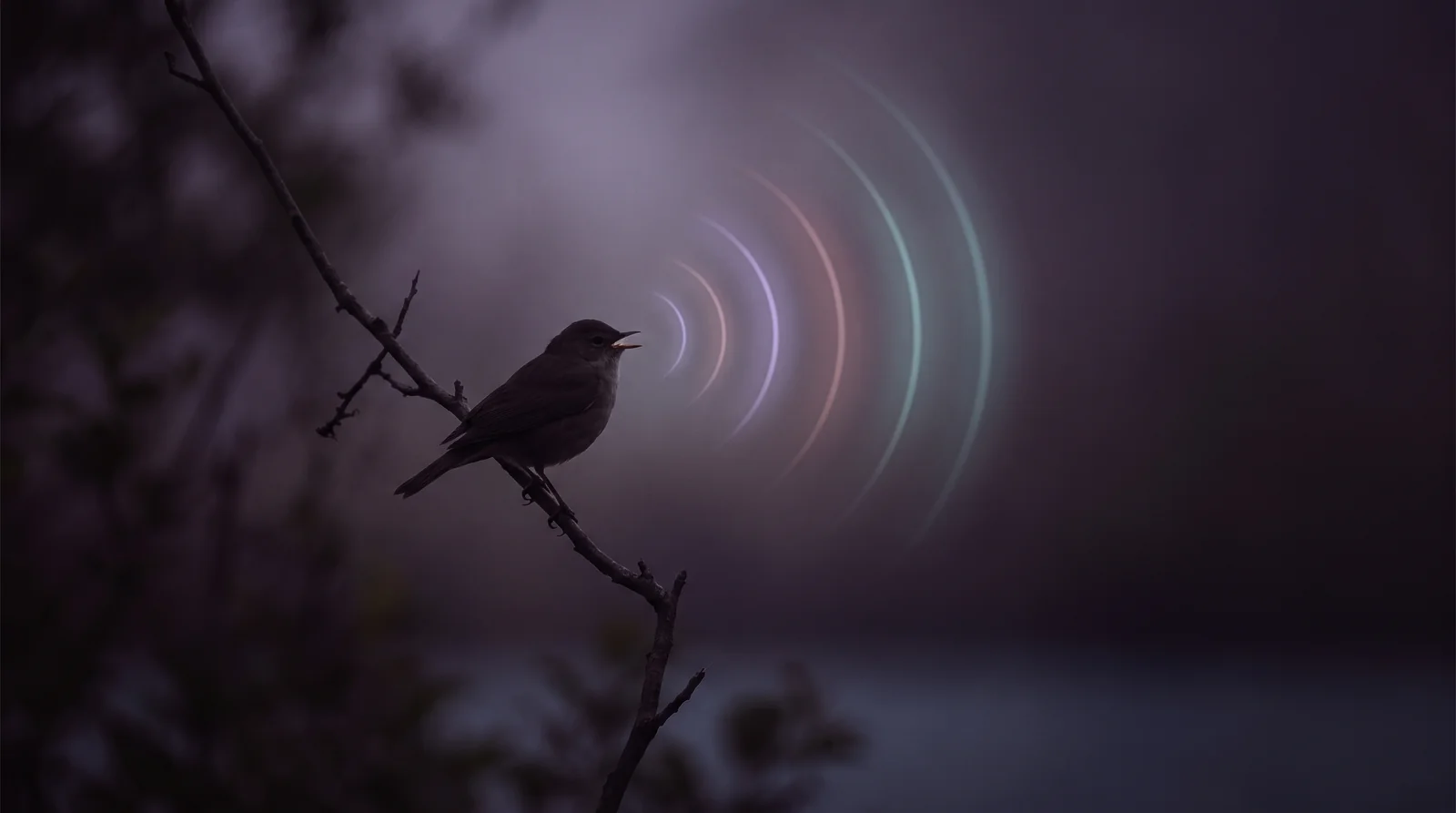
Somewhere near you, most mornings, a very small animal performs a concert nobody asked for. The dawn chorus begins before most of us are conscious enough to resent being awake, and yet almost nobody resents the singers. Traffic at five in the morning is an outrage; a blackbird at five in the morning is somehow a gift. This asymmetry is worth taking seriously. Of all the sounds the world produces without our permission, birdsong is nearly alone in being universally forgiven, and increasingly the research suggests it is more than forgiven: it is one of the most reliably restorative sounds a human being can hear. The question is why a creature with a brain the size of a hazelnut should have such power over ours.
The sound of safety
The oldest explanation is also the most persuasive. For nearly all of human history we lived outdoors among birds, and their voices carried information we depended on. A landscape full of singing birds is, broadly speaking, a landscape at ease: the sentinels are relaxed, no predator is moving through the grass, the ordinary business of the world is proceeding. When birds fall abruptly silent, something is wrong, and every prey animal in earshot knows it. Evolutionary psychologists suggest we inherited this grammar whole. Birdsong functions as an all-clear signal, a broadcast from the environment saying nothing is happening here, and a nervous system marinated in that message for a few hundred thousand years does not stop listening merely because we moved indoors. The song reaches parts of us that predate language, and what it says is: you may stand down.
Soft fascination, feathered
Attention researchers have a lovely term, soft fascination, for things that hold the mind gently without demanding anything from it: moving water, drifting clouds, leaves in wind. Birdsong may be the acoustic version. When Eleanor Ratcliffe and colleagues interviewed people about the natural sounds they found restorative, bird sounds were the type most commonly mentioned, credited with helping attention recover and stress dissolve (Ratcliffe, Gatersleben and Sowden, 2013, Journal of Environmental Psychology). The structure of the sound itself seems to matter. Song is patterned enough to be interesting and unpredictable enough never to loop, it sits high in the frequency range well away from the growl of traffic, and, crucially, it carries no words. A podcast asks to be followed; a colleague's conversation asks to be ignored, which is harder work still. A robin asks nothing at all. The listening mind can rest on the sound the way an eye rests on water, engaged but entirely off duty.
A landscape full of singing birds is a landscape at ease. The song is an all-clear signal older than language, and the body still knows how to read it.
The phantom chorus
For a long time the evidence for all this was mostly people saying so, which is pleasant but not proof. Then researchers in Colorado did something quietly mischievous. Along two stretches of hiking trail they hid small speakers and played recorded songs from a variety of local birds, enriching the real chorus with a phantom one, and interviewed hikers as they emerged. Those who had walked through the augmented soundscape reported greater wellbeing than those who walked the same trail in ordinary conditions, and most never noticed the speakers at all (Ferraro et al., 2020, Proceedings of the Royal Society B). The birdsong itself, not the scenery and not the exercise, was doing measurable work. A second study widened the lens. Using a smartphone app, researchers at King's College London asked over a thousand people about their surroundings and mood at random moments for two weeks, and found that encounters with birds, seen or heard, were associated with a lift in mental wellbeing that was still detectable hours after the encounter, in people with and without depression alike (Hammoud et al., 2022, Scientific Reports). Small birds, it turns out, leave long wakes.
Not every bird is a lullaby
Honesty requires an asterisk, and the research supplies it. In Ratcliffe's interviews, people did not find all bird sounds soothing; they found songbirds soothing. The wren, the blackbird, the thrush: melodic, high, intricate. Harsh calls told a different story. Crows, magpies and gulls were more often associated with tension than release, which makes perfect evolutionary sense, since many corvid and gull calls are alarms, squabbles or threats, and our borrowed grammar reads them accordingly. A seagull at close range is not an all-clear signal; it is a mugging with feathers. So the calming effect is not about birds as a category but about a particular acoustic character: musical, unhurried, without aggression. It is the difference between overhearing a lullaby and overhearing an argument.
Bringing the chorus indoors
What do you do with this if you live four floors above a car park? The encouraging lesson of the phantom chorus is that recorded birdsong works on the body even when you know it is recorded, and the habit is easy to build. A few ways in:
- Give the dawn chorus two minutes. If anything sings near your window in the morning, open it, make your tea, and simply listen before reaching for the phone; treat it as a hearing practice rather than background.
- Use birdsong as a focus bed. Played quietly, song recordings occupy the restless edge of attention the way rain does, without a single word to hijack the verbal mind.
- Pair sound with something for the eyes. In the evening I sometimes let a recorded chorus run alongside one of Feelsy's slow drifting textures on autoplay, ears in a hedgerow and eyes in slow colour, and the combination settles me faster than either alone.
- Let the birds set the tempo of a breath. A leisurely practice such as the 4-7-8 exercise sits naturally over a background of song, one rhythm for the lungs and one for the ears.
None of this requires identifying a single species. The wren does not know it is a wren, and you need not either. What matters is the old message underneath the melody, the one your nervous system has been fluent in far longer than it has known your name: nothing is happening here. You may stand down.
Feelsy is a wellness product, not medical advice. If stress, anxiety or sleep problems persist, please speak with a qualified professional.
References
- Ratcliffe, E., Gatersleben, B., & Sowden, P. T. (2013). Bird sounds and their contributions to perceived attention restoration and stress recovery. Journal of Environmental Psychology, 36, 221-228.
- Ferraro, D. M., Miller, Z. D., Ferguson, L. A., Taff, B. D., Barber, J. R., Newman, P., & Francis, C. D. (2020). The phantom chorus: birdsong boosts human well-being in protected areas. Proceedings of the Royal Society B, 287(1941), 20201811.
- Hammoud, R., Tognin, S., Burgess, L., Bergou, N., Smythe, M., Gibbons, J., Davidson, N., Afifi, A., Bakolis, I., & Mechelli, A. (2022). Smartphone-based ecological momentary assessment reveals mental health benefits of birdlife. Scientific Reports, 12, 17589.
Frequently Asked Questions
Why does birdsong make me feel calm?
The most persuasive explanation is evolutionary: a landscape full of singing birds has historically been a safe landscape, so birdsong functions as an all-clear signal that the nervous system still recognises. The sound is also ideally built for resting attention: patterned but never looping, high in frequency, and free of words, so the mind can settle on it without doing any work.
Does recorded birdsong work as well as real birds?
Recordings do measurable work. In one study, researchers hid speakers along hiking trails and enriched the natural soundscape with recorded song; hikers who walked through the augmented chorus reported greater wellbeing than those who did not, and most never noticed the speakers (Ferraro et al., 2020). Playing song quietly at home or over headphones taps the same effect.
How long does the mood boost from hearing birds last?
Longer than the encounter itself. A smartphone study that sampled over a thousand people's moods at random moments found that seeing or hearing birds was associated with a lift in mental wellbeing still detectable hours afterwards, in people with and without depression (Hammoud et al., 2022).
Are all bird sounds relaxing?
No. Research on restorative sound consistently points to melodic songbirds such as blackbirds, wrens and thrushes, while harsher calls from crows, magpies and gulls are more often linked with tension. Many of those harsh calls are alarms or squabbles, so the body reads them as the opposite of an all-clear.
How can I use birdsong to relax or focus?
Keep it simple: listen to the real dawn chorus for two minutes with the window open, or play quiet song recordings as a background while working. Pairing the sound with a slow visual or an unhurried breathing pattern such as 4-7-8 tends to deepen the effect, giving ears, eyes and lungs one gentle rhythm each.

About the author
Contributing writer
Eleonor writes about contemplative traditions, attention and the cultural history of calm. She has spent two decades collecting the rituals humans use to slow down, from zazen halls to hammams, and translating them for modern, screen-lit lives.
Feel it for yourself.
Feelsy turns reading about calm into practising it. Two minutes of a slow texture is often the whole difference.


Related reading
 ASMR
ASMRWhy the Sound of Rain Is So Calming (and So Good for Sleep)
Why rain sounds help you sleep: the acoustics of rainfall, what research says about natural sound and stress, and how to use rain well at bedtime.
 Ancient Wisdom
Shinrin-Yoku: Why Forests Calm the Human Mind
Japan turned a walk in the woods into preventive medicine. The research behind forest bathing, what it does to stress physiology, and how to practise it without a forest.
 ASMR
ASMRUnintentional ASMR: Why a Stranger Folding Towels Puts You to Sleep
The calmest videos online were never trying to relax you. Here's what unintentional ASMR is, why old how-to footage works so well, and how to find your triggers.
 ASMRNew
Why Is Bob Ross So Relaxing? The Science of Happy Little Brushstrokes
Bob Ross has been putting people to sleep for four decades, and he'd take that as a compliment. Here's the science of why his painting videos work like ASMR.
 ASMRNew
What Is 8D Audio? The Science Behind the Spinning Sound
8D audio pans music around your head using binaural tricks. Here's how the illusion works, why it feels immersive, and whether it helps you relax or focus.
 ASMR
ASMRWhy Paint Mixing Videos Are So Satisfying
Why paint mixing videos feel so satisfying: the slow science of swirls and folds, what ASMR research suggests, and how to watch them as a mini meditation.