Sound Masking: Why Adding Noise Makes a Room Quieter
Sound masking doesn't block noise, it buries it. How steady background sound hides sirens, neighbors and snoring, and how to set it up for sleep and focus.
By Kurt Woleret
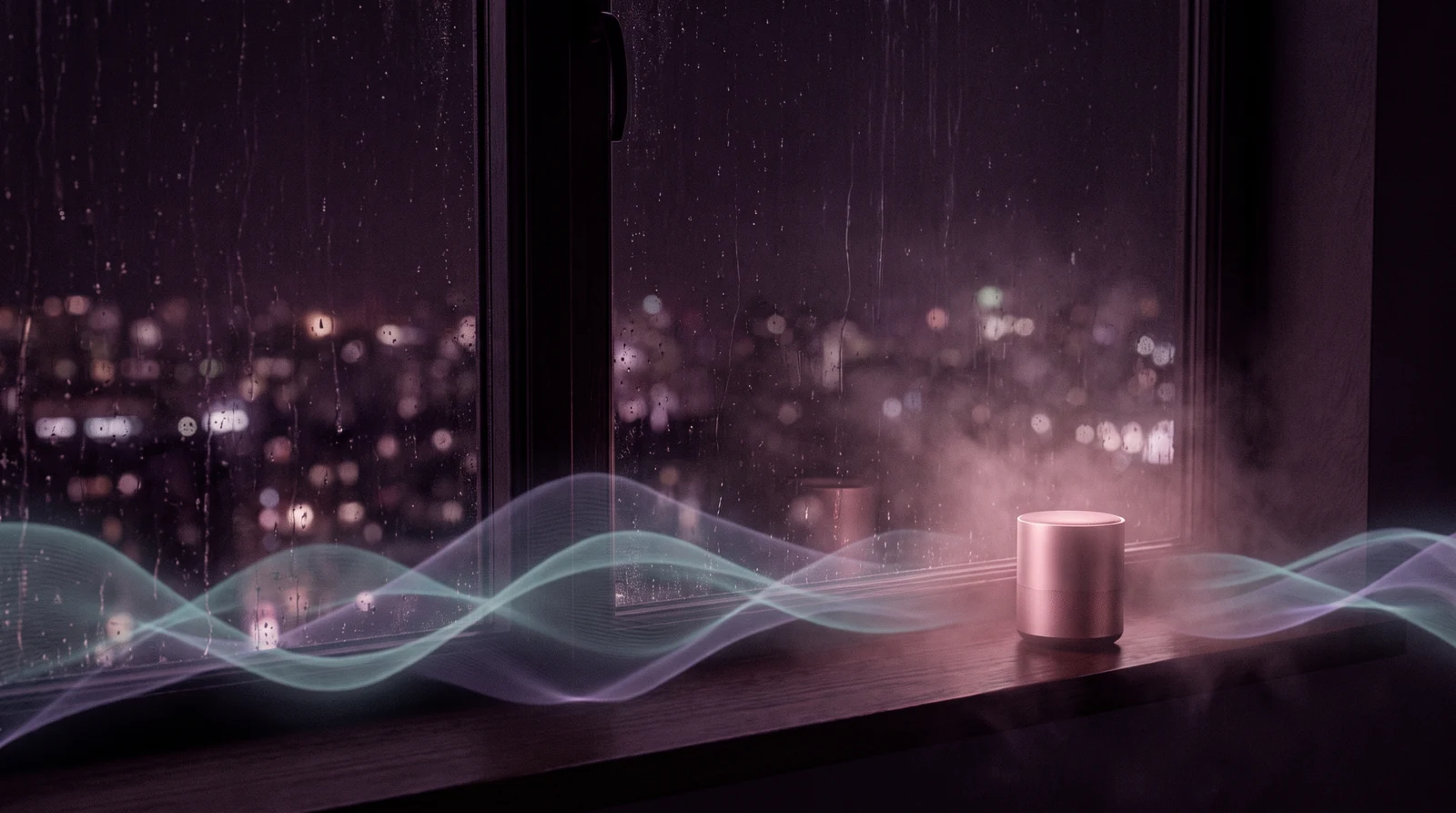
There's a paradox every city sleeper eventually discovers: the quietest nights come from adding sound. Not removing the upstairs neighbor, not soundproofing the window, not moving upstate. Turning something on. A fan, a hum, a steady wash of noise, and suddenly the building's whole percussion section fades into the wallpaper. This trick has a name, sound masking, and it's less about volume than about math. Once you get how it works, you can stop buying gadgets at random and set it up properly in about five minutes.
You can't block sound. You can bury it.
First, the bad news. Earplugs aside, you mostly can't subtract sound from a room. What you can do is change what your brain notices, and your brain doesn't hear absolute volume, it hears contrast. A door slam in a silent apartment is a cliff: the background is near zero and the slam towers over it. The same slam over a steady fan is a bump on a plateau. Masking works by raising the floor so the peaks stop being peaks.
This matters because of what actually wakes you or breaks your focus. It isn't steady loudness, it's change. Your auditory system is a threat detector that never fully clocks out, and it's tuned to onsets: the new sound, the sudden gap, the voice that just started. A consistent 45-decibel hum is ignorable in a way that unpredictable 30-decibel footsteps never will be. Masking doesn't make the room quieter in any measurable sense. It makes the room less eventful, and eventfulness is what your brain is screening for.
Your brain doesn't wake up for loud. It wakes up for different. Masking makes everything the same.
Does it actually work? The Manhattan test
Fair question, and there's a usefully blunt study on it. Researchers took people living near a noisy Manhattan thoroughfare, the kind of ambient chaos this city considers a lullaby, and had them sleep with and without a white noise machine. With the masking on, participants fell asleep faster and their sleep improved compared with sleeping in the raw street noise (Ebben, Yan, & Krieger, 2021, Sleep Medicine). Small study, but it tested the exact scenario masking is for: not a quiet suburb, but an environment where the offending noise can't be turned off.
The honest caveat: masking is a tool for noisy environments, not a universal sleep upgrade. If your bedroom is already silent, adding noise buys you little except insurance against the occasional siren. The win is proportional to how chaotic your nights currently are. Mine were very chaotic. The win was large.
Setting it up without overthinking it
A decent masking setup has three properties, and none of them require a $300 machine:
- Steady, not looping. The sound should have no events in it: no melody, no birds, no wave that crashes on a cycle your brain can learn. Smooth noise, a fan, or steady rain all qualify.
- Just loud enough, no louder. Set it at the lowest level that swallows the problem noise. If you have to raise your voice over it, it's too loud and becomes its own sleep fragmenter.
- All night, not on a timer. If the masking shuts off at 2am, the floor drops and every noise after that is a cliff again. Continuity is the entire point.
One more mechanical detail worth knowing: masking has a direction. It's much easier to hide a sound with noise that sits in the same frequency neighborhood, which is why a low rumbly fan does little against a high-pitched beeping and why hissy noise won't soften a bass-heavy party downstairs. If one flavor of noise isn't touching your particular nemesis, don't crank the volume. Change the color.
On flavor: white noise is all frequencies at equal energy and reads as hissy. Pink and brown noise tilt the energy toward low frequencies and sound more like rain or a distant waterfall, which most people tolerate better for eight hours. Low frequencies also do more work against the common enemies, traffic rumble, HVAC, upstairs footsteps. There's no medal for enduring white noise you hate. Pick the one you stop noticing fastest, because the whole goal is to stop noticing it.
Masking for focus, and a note on texture
The same trick works at a desk. Open offices figured this out decades ago and pipe engineered background sound through ceiling speakers, because conversation is the most distracting sound there is and a raised noise floor blurs other people's words into mush. At home, the problem is the same: it's rarely silence you need, it's the absence of intelligible events. Steady noise, rain, or a low ambient wash all beat a quiet room where you can hear every word of the hallway phone call.
Personally I run Feelsy's ambient sound textures for this, rain or a soft slime loop, on autoplay so there's no event when a track would end, low enough that I forget it's on. That forgetting is the test. Masking that works is masking you can't remember hearing. If you finish the night, or the spreadsheet, and can't recall what the room sounded like, the math did its job.
Feelsy is a wellness product, not medical advice. If stress, anxiety or sleep problems persist, please speak with a qualified professional.
References
- Ebben, M. R., Yan, P., & Krieger, A. C. (2021). The effects of white noise on sleep and duration in individuals living in a high noise environment in New York City. Sleep Medicine, 83, 256–259.
Frequently Asked Questions
What is sound masking?
Sound masking is adding a steady background sound, like a fan or smooth noise, to raise a room's noise floor so that disruptive sounds stand out less. It doesn't reduce the actual volume of sirens or footsteps; it reduces the contrast between them and the background, which is what your brain responds to. With less contrast, those sounds stop registering as events.
Does white noise actually help you sleep in a noisy place?
There's direct evidence for it. A study of people living near a loud Manhattan street found they fell asleep faster and slept better with a white noise machine than without one. The benefit is biggest in genuinely noisy environments; in an already quiet bedroom, masking adds little beyond insurance against occasional disruptions.
How loud should sound masking be?
As quiet as possible while still swallowing the problem noise. The right level is the lowest one where the footsteps or traffic no longer stand out; if you'd need to raise your voice over it, it's too loud and can fragment sleep itself. It should also run all night, because masking that switches off at 2am leaves every later noise sounding like a cliff.
What's the difference between white, pink and brown noise for masking?
White noise spreads energy evenly across all frequencies and sounds hissy. Pink and brown noise shift energy toward lower frequencies, sounding more like rain or a distant waterfall, which most people find easier to live with for hours. Low-frequency noise also masks common problems like traffic rumble and footsteps better. The best choice is whichever one you stop noticing fastest.
Why do small sounds wake me up but steady noise doesn't?
Your auditory system stays on duty during sleep as a change detector, tuned to new sounds and sudden silences rather than constant levels. A steady hum contains no changes, so the brain files it as background and ignores it. An unpredictable small sound is an event, and events are exactly what the system is screening for, which is why it can wake you while something louder but constant doesn't.

About the author
Contributing writer
Kurt is a New York based writer covering the practical science of stress, sleep and focus. He is the resident sceptic of the Journal: if a technique cannot survive a crowded subway commute and a deadline week, he is not interested in it.
Feel it for yourself.
Feelsy turns reading about calm into practising it. Two minutes of a slow texture is often the whole difference.


Related reading
 Sleep
White Noise for Sleep: What Works and What Does Not
White, pink and brown noise all promise better sleep. Here is what the evidence actually supports, how to choose, and how to set up sound for a quieter night.
 Sleep
How to Block Out Noise at Night: A Field Guide From a Loud Apartment
Thin walls, loud street, 2 a.m. sirens: what actually blocks noise at night, from earplugs to sound masking, ranked by evidence instead of marketing.
 Sleep
Brown Noise for Sleep and Focus: What It Is and Why It Works
Brown noise is the internet's favorite sleep and focus sound. What it actually is, how it differs from white and pink noise, and what research really shows.
 ASMR
The Mozart Effect: How One Small Study Launched a Thousand Baby CDs
One 1993 study convinced the world that Mozart raises IQ. What the research actually found, what the meta-analysis says, and what music really does for focus.
 ASMR
The Cocktail Party Effect: How You Hear One Voice in a Crowd
The cocktail party effect lets your brain tune into one voice in a noisy room, and snap to your own name across it. The science of auditory attention.
 ASMR
Scratching ASMR: Why Fingernails on Fabric Put the Internet to Sleep
Scratching is one of ASMR's biggest trigger families: fabric, wood, mic covers. Why dragging fingernails across texture calms so many brains, explained.