Worry Stones: Why Rubbing a Smooth Stone Calms the Mind
A worry stone is a smooth pebble you rub with your thumb when tense. Why this tiny ritual calms the nervous system, and how to choose and use one well.
By Mei Lin
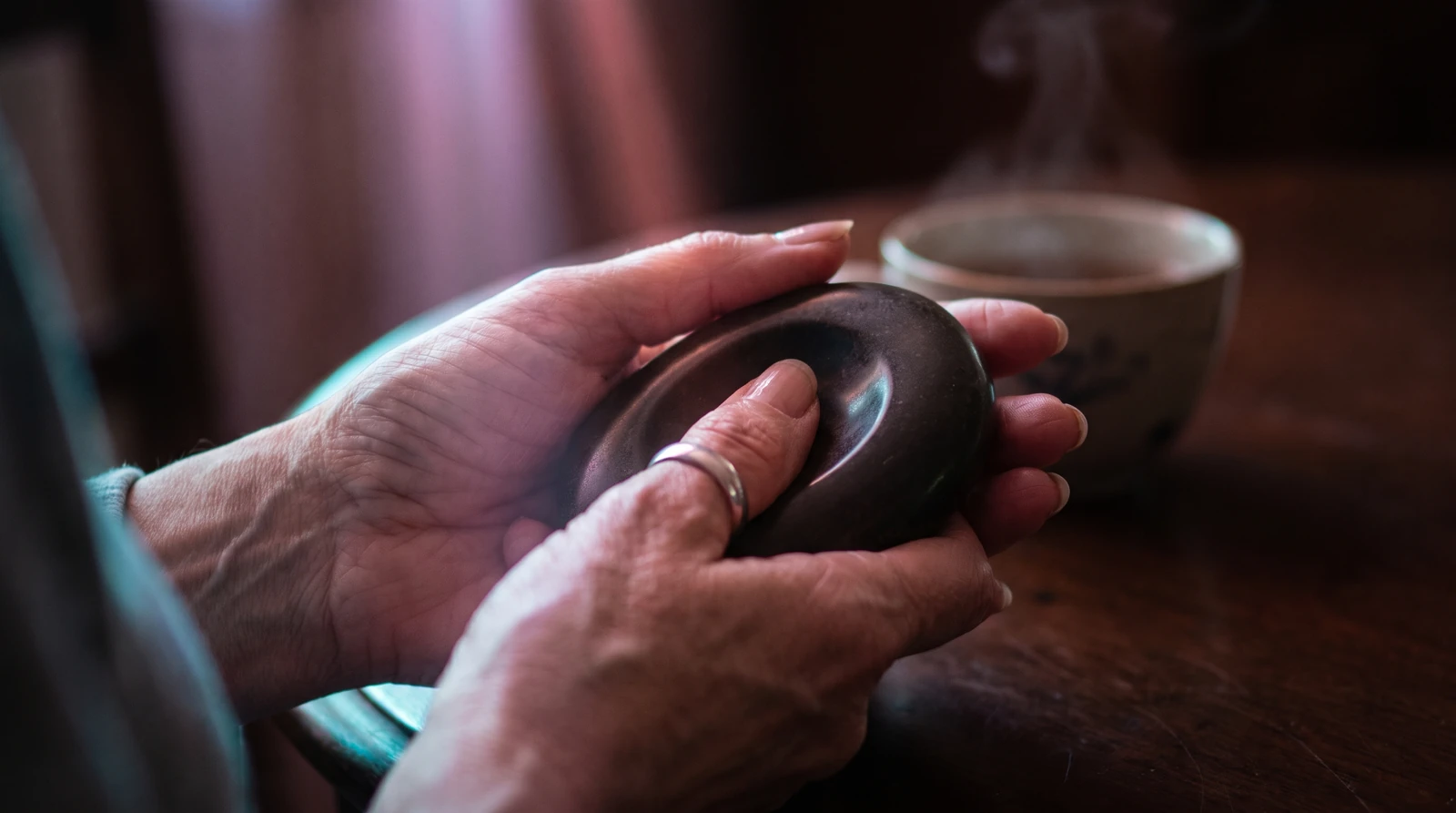
In the drawer of my grandmother's sewing table there lived a small jade pebble, flat, oval, with a shallow dip worn into one face. I assumed for years that the dip had been carved. It had not. It was the print of her thumb, laid down pass by pass over decades, the way water writes on rock. She called it nothing at all; it was simply the stone, reached for during long waits and hard news, turned over quietly while the rest of her went on serving tea. The English name for this object is blunt and honest: a worry stone.
Versions of it appear almost everywhere people have had pockets and troubles. Greek komboloi beads clicking through fingers, Victorian thumb stones, the river pebbles carried by soldiers and emigrants, the smooth netsuke rubbed shiny in Japan. Mala beads serve prayer first, but every tradition that counts beads knows the counting soothes as much as the praying. The worry stone is this instinct stripped to its simplest form: one stone, one thumb, one slow circuit, repeated.
Why touch quiets the alarm
The hand is extravagantly represented in the brain; drawn to the scale of its sensory wiring, the body would be mostly thumbs and fingertips and lips. Slow, pleasant, repetitive touch is therefore one of the loudest safe signals a person can send inward, and the body appears to listen even when the touch is self-administered. In one study, people facing a stressful task who practiced twenty seconds of self-soothing touch showed lower cortisol responses than those who did nothing, comparable in direction to being hugged (Dreisoerner et al., 2021, Comprehensive Psychoneuroendocrinology). The ancient habit and the laboratory point the same way: calming contact does not have to come from someone else's hands.
The stone adds its own qualities to the touch. It is cool at first, then slowly takes your warmth, a tiny arc of change that gives the fingers something to track. It is smooth, and smoothness reads as safety to skin that evolved to flinch from splinters and edges. It is heavy for its size, and small weights anchor. And the gesture it invites, a slow ellipse of the thumb, is rhythmic, which matters most of all: rhythm is the body's oldest language for all is well, the rocked cradle, the patted back, the stroked hand.
A worry stone is a sentence of comfort written in the body's first language: slow, warm, repeated touch.
A fidget with the volume turned down
The worry stone also earns its place as an anchor for a scattered mind. When anxiety runs, it runs forward and backward in time, rehearsing and replaying; the senses, meanwhile, only ever operate now. A stone in the hand is a small door back into the present, the same principle grounding techniques use when they ask you to name things you can feel. And unlike a phone, which offers the restless hand a thousand bright exits from the moment, the stone offers exactly one thing, and that thing is here. It is a fidget with the volume turned down: busy enough to absorb the static, quiet enough to leave the rest of you in the room.
There is honest fine print. The stone is a companion for ordinary tension, not a treatment for serious anxiety, and like any soothing habit it works best held lightly; if rubbing becomes a compulsion that must happen, something larger is asking for attention. Used simply, though, it is among the gentlest tools there are: silent, free, pocket-sized, and impossible to run out of battery.
Choosing and using one well
Choose by hand, not by eye. The right stone sits in the curl of your fingers with a little weight, has one face your thumb settles into naturally, and feels cool and dense when picked up. A riverbank or beach will offer you one for free, worn smooth by the original patient hands, which are water's. Polished palm stones from a shop work just as well; the mineral matters less than the fit. Then give it a post: a coat pocket, a desk, the bowl by the door, somewhere your hand will find it without being sent.
To use it, slow down on purpose. Let the thumb travel its ellipse at about the pace of a calm breath, and if you like, yoke the two together: one slow circuit per exhale, which turns the stone into a breathing pacer you can use invisibly in any meeting or queue. In the evening I pair mine with a slow Feelsy texture on the screen and its 4-7-8 breathing exercise, stone circling on each long exhale, eyes resting on the drift: hands, breath and gaze all given one unhurried job each. My grandmother had no screen and needed none; the principle is hers either way. Give the restless part of you something smooth to do, and do it slowly, and the rest begins to follow.
Feelsy is a wellness product, not medical advice. If stress, anxiety or sleep problems persist, please speak with a qualified professional.
References
- Dreisoerner, A., Junker, N. M., Schlotz, W., et al. (2021). Self-soothing touch and being hugged reduce cortisol responses to stress: A randomized controlled trial on stress, physical touch, and social identity. Comprehensive Psychoneuroendocrinology, 8, 100091.
Frequently Asked Questions
What is a worry stone?
A worry stone is a small, smooth stone, often oval with a shallow thumb-sized dip, that you rub slowly with your thumb when tense, waiting or thinking. Versions of the habit appear across many cultures, from Greek komboloi beads to Victorian thumb stones, and it survives because slow repetitive touch is genuinely settling.
Do worry stones actually work?
They can, for ordinary tension. Slow, pleasant, repetitive touch is a strong safety signal to the nervous system, and research has found that even brief self-soothing touch lowered cortisol responses to a stressful task. A worry stone packages that touch into a silent, pocket-sized ritual, though it is a companion for everyday stress, not a treatment for an anxiety disorder.
How do you use a worry stone?
Hold it in the curl of your fingers and move your thumb in a slow ellipse across its face, roughly at the pace of a calm breath. Many people pair one circuit of the thumb with each long exhale, which quietly turns the stone into a breathing pacer usable in meetings, queues or transit without anyone noticing.
What kind of stone makes a good worry stone?
Choose by feel rather than appearance: it should sit comfortably in your curled fingers, carry a little weight, feel cool and dense when picked up, and offer one smooth face where your thumb settles naturally. A beach or river pebble works as well as a polished palm stone from a shop; the fit matters more than the mineral.
Why does rubbing something smooth feel calming?
Fingertips are among the most richly wired parts of the body, so gentle touch speaks loudly to the brain. Smoothness reads as safe to skin built to flinch from edges, the stone's coolness turning to warmth gives the senses a gentle arc to follow, and the repeated rhythmic motion echoes the body's oldest comfort signals, like rocking and a patted back.

About the author
Contributing writer
Mei grew up in Shanghai around tea that could not be hurried and grandmothers who considered stillness a skill. She writes about slow hands and sensory ritual: tea, calligraphy, qigong, and the quiet crafts that taught the world how to pay attention.
Feel it for yourself.
Feelsy turns reading about calm into practising it. Two minutes of a slow texture is often the whole difference.


Related reading
 Ancient Wisdom
Baoding Balls: The Chinese Meditation You Hold in Your Hand
Baoding balls, the chiming iron spheres of Chinese tradition, turn a restless hand into an anchor for attention. Their history, technique and quiet appeal.
 Ancient Wisdom
How to Use Mala Beads: A Beginner's Guide to Meditating With 108 Beads
Mala beads give restless hands a job and wandering minds an anchor. Learn what the 108 beads mean and how to use a mala for breath or mantra meditation.
 Breath & Body
The 5-4-3-2-1 Grounding Technique: Five Senses Against a Spiral
How the 5-4-3-2-1 grounding technique calms anxiety: what to do with each of the five senses, why it interrupts spirals, and how to practise it well.
 Breath & Body
Time Blocking: The Calendar Trick That Makes Your To-Do List Tell the Truth
Time blocking puts your to-do list on the clock, where it has to be honest about your day. Why the method works, the research behind it, and how to start.
 Breath & Body
The Two-Minute Rule: The Only Productivity Trick I Haven't Quit
The two-minute rule says if a task takes under two minutes, do it now. Why this tiny rule beats fancy systems for procrastination and mental clutter.
 Breath & Body
Why You Work Better Under Pressure (and Why That's Half a Lie)
Deadline pressure really does sharpen focus, and it quietly costs you. The science of arousal, procrastination and borrowing urgency without panic.