ADHD and Sleep: Why Your Brain Clocks In at Midnight
ADHD brains are famously wide awake at bedtime. Here's why sleep problems and ADHD travel together, and what helps when your mind boots up at midnight.
By Kurt Woleret
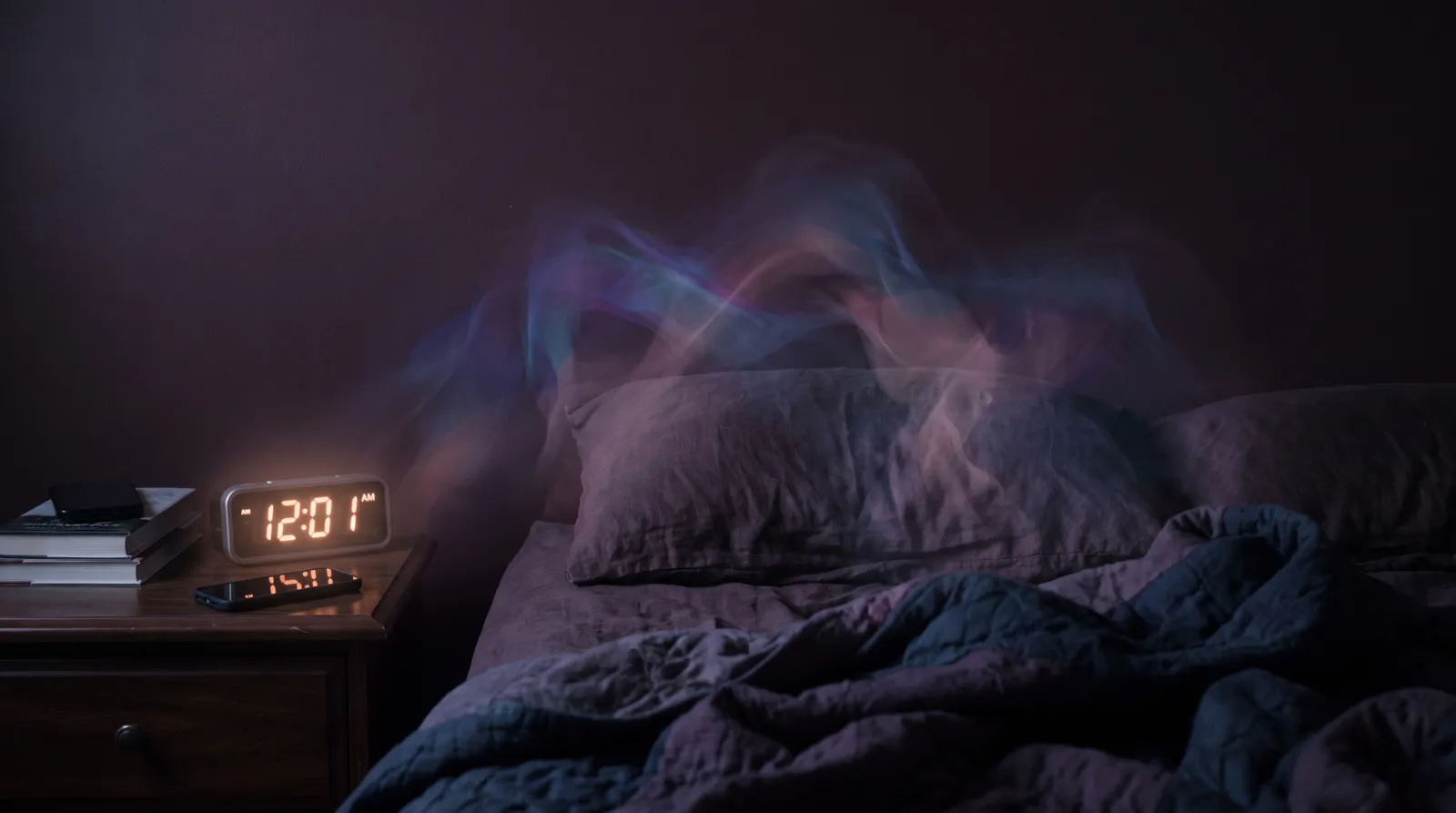
There's a specific flavor of wide-awake that people with ADHD know intimately: it's 12:40 a.m., the apartment is finally quiet, and your brain, which spent the entire workday buffering, suddenly loads every tab at once. Great ideas. Old arguments. A sudden need to research a thing. Meanwhile the rest of the city is asleep and you're lying there like the only lit window on the block. If that's you, the first useful thing I can tell you is that it's not a character flaw or bad discipline. The sleep problems travel with the ADHD, and the research on that is unusually consistent.
This is a pattern, not a personal failing
When researchers pooled the available studies comparing adults with ADHD to adults without it, the ADHD group reported worse sleep across the board: longer to fall asleep, more awakenings, poorer sleep quality, more daytime sleepiness (Díaz-Román, Mitchell, & Cortese, 2018). That's a meta-analysis, meaning it's not one lab's lucky result; it's the trend across the pile. The subjective complaints showed up more strongly than the lab measurements, which is its own interesting detail: part of what's going on happens in how an ADHD brain experiences the night, not just in what a sleep sensor records.
Mechanically, a few things stack up. ADHD is at its core a regulation problem, and falling asleep is a regulation task: you have to downshift arousal on schedule, voluntarily, with no deadline pressure to help. Many people with ADHD also run on a delayed body clock, naturally drifting later, so the sleepiness signal shows up well after the alarm math says it should. Add the famous bedtime phenomenon where the quiet of night finally delivers the stimulation-free focus the day never did, and midnight becomes the best your brain has felt since breakfast. Of course you don't want to turn it off.
The revenge bedtime trap
Then there's the behavioral layer, and I say this with love and personal guilt: a lot of ADHD sleep loss is revenge bedtime procrastination with executive dysfunction as an accelerant. The day got eaten by obligations, so the night feels like the only time that's yours, and 'one episode' has never once meant one episode. The usual advice is 'just go to bed,' which is advice on par with 'just focus.' The transitions are the real problem. An ADHD brain doesn't switch tasks on command, and 'being on the couch with my phone' to 'being in bed with my eyes closed' is a task switch with zero dopamine on the far side. You don't drift to bed; you have to land the plane manually, every night.
Midnight is the best your brain has felt since breakfast. Of course you don't want to turn it off.
What actually helps (field-tested, no lectures)
I'm not going to tell you to have perfect sleep hygiene, because you've read that list and so have I. Here's the version adapted for a brain that negotiates everything.
Make the wake time the anchor, not the bedtime. A consistent wake time, even after a bad night, is the single strongest lever on a drifting body clock, and it's enforceable in a way 'feel sleepy at 11' isn't. Morning light on your actual face, not through a window while scrolling, pulls the clock earlier too.
Script the landing. Don't rely on deciding to go to bed; decide once, earlier, and automate the rest. An alarm that means 'start the shutdown,' not 'be asleep.' Same three or four steps in the same order, so the sequence runs on rails instead of willpower: lights down, teeth, charger across the room, bed. Boring is the point. Boring is what rails feel like.
Give the restless channel something to hold. Lying in silent darkness hands your attention zero input, and an understimulated ADHD brain will generate its own content, usually a highlight reel of everything embarrassing since middle school. A steady low sound, rain, brown noise, a slow soundscape, gives the scanning part of your mind a handrail. This is honestly the niche where I use Feelsy most: a slow texture drifting with a quiet sound bed, autoplay on, phone face-down so it can't offer me a next thing to tap. Stimulation-shaped, but with nowhere to go.
Park the open loops. The midnight idea factory is real, and arguing with it doesn't work. A notepad by the bed, paper, deliberately, lets you capture the thought and credibly promise your brain it'll still exist tomorrow. Half the time the brilliant 1 a.m. idea is 'look up whether eels sleep,' but writing it down still closes the tab.
And the breathing thing, with a caveat. Slow exhale-weighted breathing, like the 4-7-8 pattern, downshifts arousal for a lot of people; Feelsy has a guided version if counting in your head goes sideways. The ADHD caveat: if focusing on breath makes you more alert and itchy, that's common with this neurotype and not a moral failure. Use the external sound instead and let your lungs freelance.
When it's more than a scheduling problem
Two honest flags. First, stimulant medication timing matters for sleep, and that's a conversation for your prescriber, not a blog, and definitely not a reason to improvise your own dosing schedule. Second, ADHD overlaps with genuine sleep disorders, including restless legs and sleep apnea, more than chance would predict. If you're doing everything right and still waking up wrecked, or you snore like the radiator in my first apartment, get assessed properly. Fixing an actual disorder beats optimizing around it.
The goal here isn't to become a person who loves going to bed. It's to stop treating every night as a fresh negotiation. Anchor the morning, script the landing, give the restless channel a handrail, and let the system carry what discipline was never going to.
Feelsy is a wellness product, not medical advice. If stress, anxiety or sleep problems persist, please speak with a qualified professional.
References
- Díaz-Román, A., Mitchell, R., & Cortese, S. (2018). Sleep in adults with ADHD: Systematic review and meta-analysis of subjective and objective studies. Neuroscience & Biobehavioral Reviews, 89, 61-71.
Frequently Asked Questions
Why is it so hard to sleep with ADHD?
Several things stack up. ADHD makes self-regulation harder, and falling asleep is a regulation task: you have to downshift on schedule with no external pressure. Many people with ADHD also run on a delayed body clock, so sleepiness arrives later than the alarm math requires. And the quiet of night often delivers the first distraction-free focus of the day, which makes switching off genuinely unappealing.
Are sleep problems actually more common in adults with ADHD?
Yes. A meta-analysis pooling studies of adults with ADHD found they reported longer times to fall asleep, more night awakenings, worse sleep quality, and more daytime sleepiness than adults without ADHD. It's a consistent pattern across studies, not an individual discipline problem.
What helps an ADHD brain fall asleep faster?
Anchor a consistent wake time rather than fighting over bedtime, get real morning light, and script a short fixed wind-down sequence so going to bed runs on routine instead of willpower. At lights-out, give your attention a low-effort handrail such as rain, brown noise, or a slow visual-plus-sound app, and keep a paper notepad nearby to park midnight ideas.
When should ADHD sleep problems be checked by a professional?
If your sleep stays bad despite a consistent schedule and wind-down routine, if you snore heavily or wake unrefreshed every day, or if restless legs keep you up, it's worth a proper assessment. Sleep disorders like apnea and restless legs overlap with ADHD more than chance, and medication timing questions belong with your prescriber.

About the author
Contributing writer
Kurt is a New York based writer covering the practical science of stress, sleep and focus. He is the resident sceptic of the Journal: if a technique cannot survive a crowded subway commute and a deadline week, he is not interested in it.
Feel it for yourself.
Feelsy turns reading about calm into practising it. Two minutes of a slow texture is often the whole difference.


Related reading
 Sleep
SleepHow to Stop Racing Thoughts at Night
Racing thoughts at night are a habit the brain can unlearn. Here is why minds speed up at bedtime and the techniques that quiet them, step by step.
 Sleep
SleepRevenge Bedtime Procrastination: Why You Won't Go to Sleep
Revenge bedtime procrastination is staying up late to steal back your day. Here's why exhausted people do it, and how to stop without giving up your evening.
 Visual Meditation
Meditation for ADHD: What Actually Works
Meditation advice usually assumes a brain that sits still on command. Here's how ADHD brains can actually meditate: open eyes, moving anchors, short sessions.
 SleepNew
How to Block Out Noise at Night: A Field Guide From a Loud Apartment
Thin walls, loud street, 2 a.m. sirens: what actually blocks noise at night, from earplugs to sound masking, ranked by evidence instead of marketing.
 Sleep
SleepChamomile Tea Before Bed: An Old Remedy, Gently Examined
Does chamomile tea really help you sleep? What the research actually shows, what the evening ritual itself does, and how to brew a cup worth slowing down for.
 Sleep
SleepSleep Divorce: Why Sleeping Apart Might Save Your Nights
More than a third of Americans have tried a sleep divorce. What sleeping apart actually does for rest and relationships, and how to trial it without drama.