Revenge Bedtime Procrastination: Why You Won't Go to Sleep
Revenge bedtime procrastination is staying up late to steal back your day. Here's why exhausted people do it, and how to stop without giving up your evening.
By Kurt Woleret
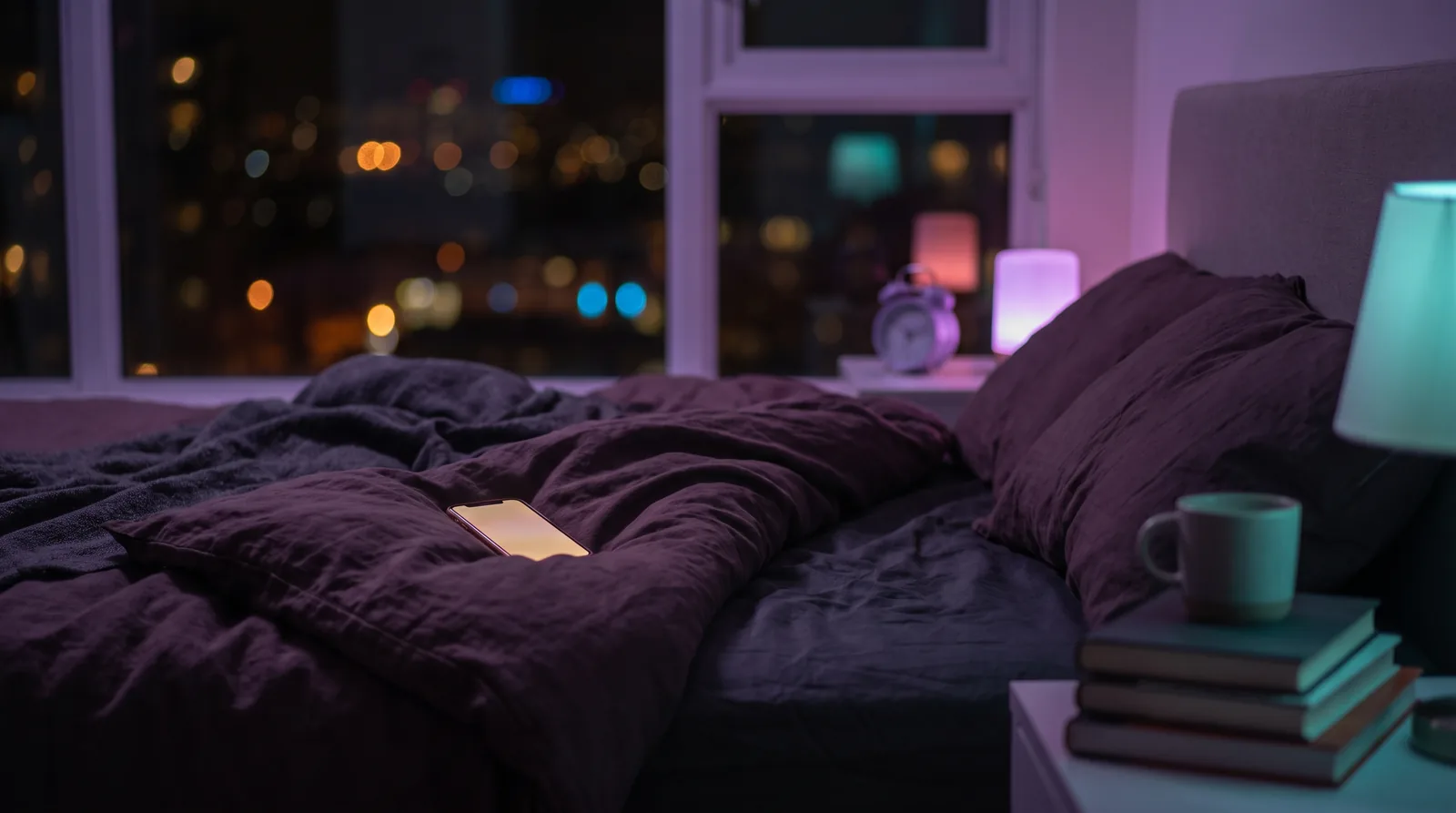
It's 12:47 a.m. I have a meeting at nine. I am, by any medical definition, exhausted. And I am watching a man I will never meet restore a rusted cleaver he found in a river. I don't care about cleavers. I don't own a river. But bed means tomorrow, and tomorrow means the meeting, so here I am, awake out of spite. There's a name for this and it's a great one: revenge bedtime procrastination. If you've ever been too tired to stay up and done it anyway, this is your article.
What revenge bedtime procrastination is
Researchers had already given the polite version a name: bedtime procrastination, going to bed later than you intended with no external reason stopping you, no crying baby, no night shift, just you, a couch, and a decision you keep not making (Kroese et al., 2014, Frontiers in Psychology). The 'revenge' part came later, from Chinese social media, where young office workers described staying up late as revenge against workdays so long they contained no hours of their own. The phrase traveled because the feeling is universal. The day took everything; the night is the only territory left to reclaim, so you burn sleep like it's someone else's money.
The defining feature is that it isn't insomnia. You can sleep. You're often desperate to. You just won't, because sleep feels like agreeing to fast-forward into tomorrow's obligations, and the doomscroll, the extra episode, the river cleaver, feels like the only part of the day that's actually yours.
You're not staying up because you're not tired. You're staying up because it's the only hour that belongs to you.
Why exhausted people sabotage their own sleep
The research frame here is self-regulation, which is a clinical way of saying willpower has a battery and yours is at two percent by 11 p.m. Kroese and colleagues found that people who score low on self-regulation are far more likely to procrastinate their bedtime, and that this behavior meaningfully predicts sleeping less and feeling more tired during the day (Kroese et al., 2016, Journal of Health Psychology). Going to bed on time is, weirdly, effortful. It means abandoning something pleasant for a sequence of small chores: stopping the show, brushing, flossing, plugging things in. After a day of deadlines and other people's demands, you have no discipline left for any of it, so the couch wins by forfeit.
Stack the autonomy piece on top and the trap fully assembles. If your waking hours are wall-to-wall obligation, the late-night hour isn't laziness, it's the only unsupervised room in the house of your life. That's why lectures about sleep hygiene bounce off this problem. Nobody in the history of exhaustion has doomscrolled less because a chart told them to. The staying up is meeting a real need. It's just billing it to the wrong account.
The part where it backfires
The revenge, of course, lands on you. Short sleep makes the next workday feel worse, which makes the next evening feel more stolen, which makes the next night's reclamation feel more justified. Run that loop for a few weeks and you're chronically underslept, foggier at work, and needing the midnight hour more than ever precisely because you keep taking it. It's the rare act of rebellion where the government you're rebelling against is also you, and specifically you at 9 a.m.
How to actually stop (without surrendering your evening)
The fix isn't to cancel your one free hour. It's to stop paying for it with tomorrow. What's worked for me, and what lines up with how the researchers think about it:
- Put the free hour earlier. Take your leisure on purpose at 9 instead of by theft at midnight. Same show, same scroll, radically different Tuesday.
- Pre-pay the bedtime chores. Brush your teeth and set up the bedroom at 9:30, while the battery still has charge. Later, bed is one decision instead of six.
- Give the night a closing time, not a bedtime. 'Screens dark at 12' feels like a rule you set; 'go to sleep' feels like a rule set for you. Autonomy matters here.
- Make the last stop something with an ending. Episodes end. Chapters end. Feeds never do, which is exactly why the feed is where midnight goes to die.
A softer landing strip
A lot of revenge scrolling isn't even fun; it's just the cheapest available feeling of 'mine.' Something has to fill that slot or the feed will. This is where I'll admit the thing that works embarrassingly well on me: replacing the algorithm with something slow and pointless in the best sense. Ten minutes of Feelsy's slime textures in autoplay mode gives your hands-free brain the same soft, unproductive, nobody-needs-anything-from-me quality as the scroll, except it dims with you instead of escalating, and there's no next video engineered to cost you another forty minutes. Run the 4-7-8 exercise at the end and you've built an off-ramp that still feels like yours, because it is.
The bottom line
Revenge bedtime procrastination is a reasonable response to an unreasonable day, aimed at the wrong target. The need underneath it, an hour of autonomy, is legitimate; the 1 a.m. invoice is not. Claim the hour earlier, shrink bedtime to one decision, end the night with something that ends. You don't have to give back the evening. You just have to stop letting the day's revenge be served at your own expense, cold, at 12:47, over a cleaver.
Feelsy is a wellness product, not medical advice. If stress, anxiety or sleep problems persist, please speak with a qualified professional.
References
- Kroese, F. M., De Ridder, D. T. D., Evers, C., & Adriaanse, M. A. (2014). Bedtime procrastination: introducing a new area of procrastination. Frontiers in Psychology, 5, 611.
- Kroese, F. M., Evers, C., Adriaanse, M. A., & de Ridder, D. T. D. (2016). Bedtime procrastination: A self-regulation perspective on sleep insufficiency in the general population. Journal of Health Psychology, 21(5), 853-862.
Frequently Asked Questions
What is revenge bedtime procrastination?
It's staying up later than intended, with no external reason stopping you from sleeping, as a way of reclaiming personal time after a day that felt entirely consumed by obligations. The phrase originated from Chinese social media workers describing staying up late as revenge against workdays that contained no hours of their own.
Why do exhausted people stay up late even when they desperately want to sleep?
Research frames this around self-regulation: people who score low on self-regulation are far more likely to procrastinate bedtime, and this predicts sleeping less and feeling more tired the next day (Kroese et al., 2016). Going to bed on time is effortful, requiring you to abandon something pleasant for chores like brushing and plugging things in, and after a demanding day there's little discipline left for that.
How does revenge bedtime procrastination become a repeating cycle?
Short sleep makes the next workday feel worse, which makes the next evening feel more stolen, which makes reclaiming the next night's hour feel more justified. Running that loop for weeks leaves you chronically underslept and needing the midnight hour more than ever.
How can you stop revenge bedtime procrastination without giving up your free time?
Take your leisure on purpose earlier, such as at 9pm instead of by theft at midnight, and pre-pay bedtime chores like brushing teeth while you still have energy. Give the night a closing time rather than a bedtime, and choose a last activity that has a natural ending, like an episode or chapter, rather than an endless feed.

About the author
Contributing writer
Kurt is a New York based writer covering the practical science of stress, sleep and focus. He is the resident sceptic of the Journal: if a technique cannot survive a crowded subway commute and a deadline week, he is not interested in it.
Feel it for yourself.
Feelsy turns reading about calm into practising it. Two minutes of a slow texture is often the whole difference.


Related reading
 Sleep
SleepDoes Screen Time Before Bed Really Wreck Your Sleep?
Phones before bed: sleep villain or overblown? What the research on screens, blue light and melatonin actually shows, and what to do that isn't 'never look at a screen.'
 Sleep
SleepHow to Fall Asleep Faster: Sound, Light and Ritual
Falling asleep is a skill, not a stroke of luck. Here is how sound, light and a 15-minute ritual can quiet a racing mind and shorten the trip to sleep.
 Sleep
SleepWhy You Wake Up at 3 AM (and How to Get Back to Sleep)
Waking at 3 AM isn't a curse or a sign something's broken. Here's the sleep science behind those small-hours wake-ups, and what actually gets you back down.
 SleepNew
Night Owl vs Early Bird: The Science of Chronotypes
Night owl or early bird isn't a personality flaw or a virtue. It's a chronotype. Here's what the science says about your body clock and how to work with it.
 SleepNew
How to Wake Up Early (Without Hating Your Life)
Want to become a morning person? Here's how to wake up early using light, timing and consistency, based on what circadian science actually shows.
 Sleep
SleepCan't Sleep? Why Getting Out of Bed Is the Counterintuitive Fix
Lying awake trying harder is the one thing that makes insomnia worse. Here's the 20-minute rule, the science of stimulus control, and how to use it.