How to Block Out Noise at Night: A Field Guide From a Loud Apartment
Thin walls, loud street, 2 a.m. sirens: what actually blocks noise at night, from earplugs to sound masking, ranked by evidence instead of marketing.
By Kurt Woleret
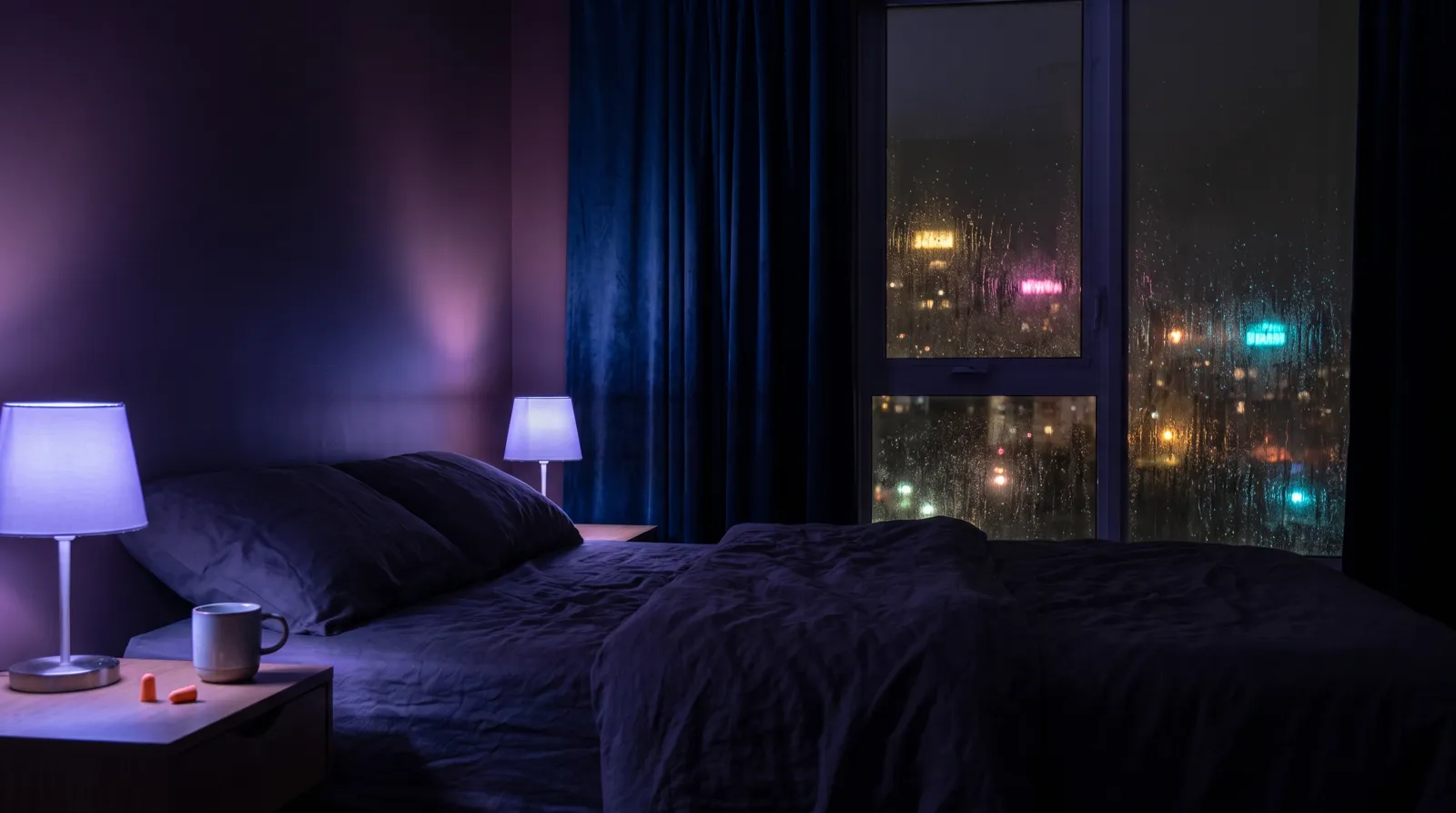
My first New York apartment came with a radiator that clanked like someone was trapped inside it, an upstairs neighbor on an apparent bowling league schedule, and a street-level bar with opinions about closing time. I learned more about blocking noise in that one lease than most people learn in a lifetime, mostly by spending money on things that didn't work. So consider this the guide I wish someone had handed me: what actually keeps noise from wrecking your sleep, roughly in order of how much evidence and physics are on its side.
First, understand what wakes you (it's not loudness)
Here's the part most people get backwards. Your sleeping brain doesn't wake up because the night is loud; it wakes up because something changed. The auditory system stays on duty all night, running a kind of security screening on everything that comes in, and what gets flagged is contrast: the slammed door against the quiet hallway, the single motorcycle on the empty street. A steady 50 decibels of hum is easier to sleep through than 35 decibels of silence punctuated by a cat knocking one (1) glass off a counter. This is why people sleep fine next to oceans and terribly next to intermittent elevators. Once you accept that change is the enemy, the whole strategy reorganizes: you're not trying to make the night silent, you're trying to make it boring.
Strategy one: masking, the cheap trick that actually works
Sound masking means adding a steady background sound so that the gap between 'quiet room' and 'sudden noise' shrinks. The siren still happens; it just lands softer relative to the hum, so your brain files it under 'nothing new' instead of escalating. A fan, a white noise machine, an air purifier, a sleep sounds app: mechanically they're all doing the same job, raising the floor.
This isn't just folk wisdom from people with box fans. Researchers took sleepers in high-noise parts of New York City, exactly my demographic, and added continuous white noise to their bedrooms. Sleep improved compared with the ambient city racket alone (Ebben, Yan, & Krieger, 2021). Small study, but it tested the realistic scenario: not a lab, an actual loud bedroom. The practical notes: keep the volume moderate, around the level of a soft shower, not a jet engine; pick a sound with no structure you can follow, which is why rain and brown noise beat playlists; and keep it running all night, because a sound that shuts off at 3 a.m. just created the exact contrast you were trying to avoid.
If you want the screen to earn its keep too, this is where I'll admit how I use Feelsy on bad nights: one of its low steady soundscapes under a slow dark texture, autoplay on, phone face-down across the room. The sound does the masking; the face-down part keeps me from turning a sleep aid into a browsing session.
You're not trying to make the night silent. You're trying to make it boring.
Strategy two: earplugs, the unglamorous heavyweight
Earplugs are the only item on this list that physically reduces the sound reaching your eardrum, and a well-fitted foam plug can knock 20 to 30 decibels off the night. That's the difference between the bar downstairs and a library. The catch is the phrase 'well-fitted': most people stuff foam plugs in like they're plugging a leak and get maybe half the rated protection. The actual technique is roll, pull, hold. Roll the plug into a thin cylinder, pull the top of your ear up and back to straighten the canal, insert, and hold it for thirty seconds while the foam expands. Done right, the world goes satisfyingly dull.
The complaints are real but solvable. If foam makes your ears ache, silicone putty plugs sit in the entrance of the canal instead of inside it. If you need to hear your alarm, test it once: most alarms get through fine, because earplugs cut volume rather than deleting sound. And if you're a side sleeper, low-profile plugs exist specifically so you're not grinding a foam cylinder into your ear canal all night. Plugs plus masking is the power combo: the plugs cut the peaks, the masking smooths what's left.
Strategy three: treat the room, not just your ears
Physics does some of its best work before the sound reaches you, and you don't need a renovation budget. Noise is lazy; it takes the easiest path in, and in most bedrooms that path is a gap. The usual suspects, in the order I'd attack them:
- The gap under the door. A cheap door sweep or even a rolled towel closes what is effectively a mail slot for hallway noise.
- Window seals. Weatherstripping tape costs a few dollars and quiets the whistle and rattle that makes street noise feel sharper than it is.
- Hard bare surfaces. A rug, lined curtains, even a full bookshelf against the shared wall soak up the echo that makes every sound ring twice.
- The bed's position. Moving the headboard off the wall you share with the elevator, the pipes, or the neighbor's TV is free and routinely underrated.
None of this makes a room soundproof; actual soundproofing involves mass, air gaps, and money. But each fix shaves the edges off, and the edges are what wake you.
What I'd skip
A few things earn their reputation less than their price tags suggest. 'Soundproof' foam panels do almost nothing for noise coming through walls; they tame echo inside a room, which is why they live in podcast studios and not bedrooms. Noise-cancelling earbuds are great on the subway, but active cancellation works best on low steady rumble, not voices or clatter, and sleeping with hard plastic in your ear is its own project. And white noise played loud enough to bury everything is just trading one problem for another; your ears put in a full shift at high volume all night, and they'll file a complaint eventually. Moderate volume, every night, wins.
The order of operations
If your nights are loud, run the sequence like this. Tonight: steady masking sound at moderate volume, all night. This week: learn the earplug technique, buy a door sweep, roll out weatherstripping. This month: rug, curtains, rearrange the bed if a wall is the culprit. That stack handles the overwhelming majority of real-world bedroom noise, from radiators to roommates, for less than the cost of one fancy gadget. The city will keep being the city. Your job isn't to silence it; your job is to make it so uneventful that your brain stops taking attendance.
Feelsy is a wellness product, not medical advice. If stress, anxiety or sleep problems persist, please speak with a qualified professional.
References
- Ebben, M. R., Yan, P., & Krieger, A. C. (2021). The effects of white noise on sleep and duration in individuals living in a high noise environment in New York City. Sleep Medicine, 83, 256-259.
Frequently Asked Questions
What is the best way to block out noise while sleeping?
Combine two approaches: a steady masking sound such as white noise, rain, or a fan to smooth over sudden changes, and well-fitted foam earplugs to physically cut 20 to 30 decibels. Masking handles the background; earplugs handle the peaks. Cheap room fixes like a door sweep, weatherstripping, and a rug shave off the rest.
Does white noise really help you sleep in a noisy place?
Yes, there's direct evidence. A study of people sleeping in high-noise areas of New York City found that adding continuous white noise to their bedrooms improved sleep compared with the ambient noise alone. It works by shrinking the contrast between the background and sudden sounds, so interruptions stand out less to your sleeping brain.
How do you insert earplugs correctly for sleep?
Use the roll, pull, hold method. Roll the foam plug into a thin cylinder, pull the top of your ear up and back to straighten the ear canal, insert the plug, and hold it in place for about thirty seconds while the foam expands. Fitted this way, foam plugs can reduce noise by 20 to 30 decibels; stuffed in loosely, you get far less.
Do soundproof foam panels stop noise from neighbors?
No. Acoustic foam panels absorb echo inside a room, which is why they're used in recording studios, but they do almost nothing against sound coming through a wall. Blocking neighbor noise requires mass and sealed gaps. For a renter, the realistic moves are sealing the door and window gaps, adding soft surfaces, moving the bed, masking, and earplugs.

About the author
Contributing writer
Kurt is a New York based writer covering the practical science of stress, sleep and focus. He is the resident sceptic of the Journal: if a technique cannot survive a crowded subway commute and a deadline week, he is not interested in it.
Feel it for yourself.
Feelsy turns reading about calm into practising it. Two minutes of a slow texture is often the whole difference.


Related reading
 Sleep
SleepWhite Noise for Sleep: What Works and What Does Not
White, pink and brown noise all promise better sleep. Here is what the evidence actually supports, how to choose, and how to set up sound for a quieter night.
 Sleep
SleepWhy You Can't Sleep Without Your Fan (It's Not Just the Breeze)
Millions can't fall asleep without a fan running. The science of why fan noise and moving air knock you out, plus when the habit works against you.
 Sleep
SleepBrown Noise for Sleep and Focus: What It Is and Why It Works
Brown noise is the internet's favorite sleep and focus sound. What it actually is, how it differs from white and pink noise, and what research really shows.
 SleepNew
ADHD and Sleep: Why Your Brain Clocks In at Midnight
ADHD brains are famously wide awake at bedtime. Here's why sleep problems and ADHD travel together, and what helps when your mind boots up at midnight.
 Sleep
SleepChamomile Tea Before Bed: An Old Remedy, Gently Examined
Does chamomile tea really help you sleep? What the research actually shows, what the evening ritual itself does, and how to brew a cup worth slowing down for.
 Sleep
SleepSleep Divorce: Why Sleeping Apart Might Save Your Nights
More than a third of Americans have tried a sleep divorce. What sleeping apart actually does for rest and relationships, and how to trial it without drama.