ASMR for Studying: Can Tingles Actually Help You Focus?
Can ASMR help you study, or is it strictly a sleep thing? Here's what research says about focusing with tingles, and how to set it up without zoning out.
By Kurt Woleret
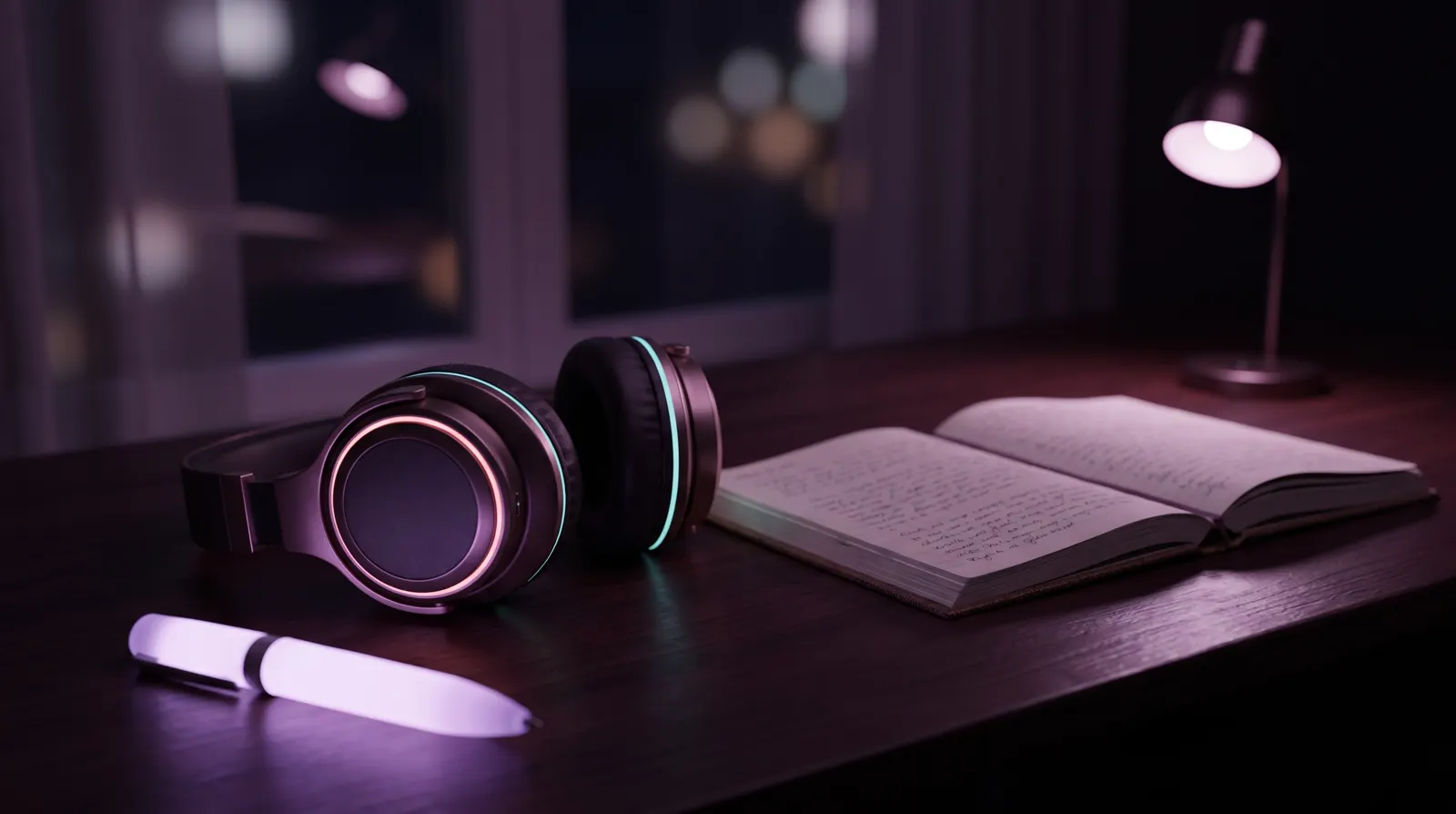
I wrote half of this article with someone tapping on a wooden box in my ears. That's not a cry for help. It's ASMR, and if you've only ever heard of it as the whispering-videos-for-sleep thing, the idea of studying to it sounds backwards. Why would you play relaxation sounds while trying to concentrate? Isn't that like doing your taxes in a bubble bath? Fair question. Let's look at what the evidence actually supports, because the answer is more interesting than a yes or a no.
What ASMR does to your body
Quick recap for the uninitiated. ASMR is that pleasant static-like tingling some people get from soft triggers: whispering, tapping, crinkling, slow hands doing careful work. Not everyone gets it, and that's fine. The interesting part for our purposes is what it does below the neck. A study by Poerio and colleagues in PLOS One measured people watching ASMR videos in a lab and found that those who experience ASMR showed reliably reduced heart rates while watching, along with increased calm. That's a real physiological downshift, in the same direction as what you get from slow breathing or other relaxation techniques.
So ASMR isn't focus fuel. It's a brake. And that's exactly why it can help with studying, because for a lot of us the thing standing between our brain and the textbook isn't low energy. It's too much of the wrong kind. Restlessness, background anxiety, the itch to check your phone every ninety seconds. If your problem is an over-revved nervous system, a gentle brake is precisely what lets attention settle.
ASMR is a dimmer switch for arousal. Studying needs some light. Aim for dimmed, not dark.
Can you actually study while tingling?
Here's where it gets nuanced. The first academic survey of ASMR, by Barratt and Davis in PeerJ, asked hundreds of people who experience it when and why they used it. Sleep and stress relief topped the list, but a meaningful chunk of respondents also described using ASMR in a flow-like way, as an accompaniment to other activities. The researchers explicitly compared aspects of the state to flow, that absorbed mode where distractions fall away and work feels frictionless.
But, and this matters, not all triggers are equal for this job. Whispered roleplay where someone gives you a virtual eye exam demands your attention. That's the point of it. Try to read a chapter while someone whispers directly at you and your comprehension will lose the fight. The triggers that work for studying are the ones with no language and no plot: tapping, rain on a window, page turning, slow textures being pressed and folded. Sound without semantics. Your language circuits stay free for the actual reading.
How to set it up
If you want to try this during your next study block, here's the setup that works, learned through trial and error in a Brooklyn apartment with paper-thin walls:
- Pick voiceless triggers only. Tapping, crinkles, rain, textures. Save the whisper roleplays for bedtime.
- Keep the volume lower than feels natural. ASMR should sit under your thoughts, not on top of them.
- Use something that loops without decisions. Feelsy's autoplay mode exists for this: slow textures and soft sound that keep going so you never touch your phone, which is the whole battle.
- Time-box it. Pair the sound with a 25-minute focus block, then take a real break.
- If the tingles get strong enough to notice, let the wave pass before diving back in. Enjoyable, but it's not a reading state.
A word on how this compares to the other study soundtracks. Lofi beats and brown noise are steady-state: they set a floor under your attention and hold it there. ASMR triggers are event-based: each tap and crinkle is a tiny discrete happening, which some brains find pleasantly grounding and others find like being poked. There's no universal winner here, just a fit question. If steady hums make you feel wrapped in static, try the event-based stuff. If tapping makes you count the taps, go back to the hum. The research on both is young enough that your own two-week experiment beats anyone's blanket claim, mine included.
Environment matters as much as the audio. Closed-back headphones if you share walls or a table. Phone face down and out of reach, because the setup only works if the sound replaces checking, not accompanies it. And treat the first five minutes as a calibration window: if you're rereading sentences, the trigger is too interesting. Swap it, don't push through.
When it won't work
Honesty corner. If you don't experience ASMR, the tingle side of this does nothing for you, and the measured relaxation effects in the research showed up in people who do. You might still find gentle repetitive sound useful as a masking layer, the way rain or brown noise masks a noisy roommate, but that's a different mechanism. If certain mouth sounds or crinkles make your skin crawl, respect that. Misophonia and ASMR are strange neighbors, and no study block is worth listening to sounds you hate.
And if you're genuinely sleepy rather than restless, ASMR will do what it does best and escort you straight toward a nap. A brake doesn't help a car that's already stalling. Know which problem you have before you pick the tool.
The bottom line
ASMR won't make you smarter, and anyone selling it as a focus hack is overreaching. What the evidence supports is humbler and more useful: for people who experience it, ASMR reliably calms the body, and a calmer body is a better place to concentrate from. Used with the right triggers at the right volume, it turns the background of a study session from static into something soft. Sometimes that's all focus needed.
Feelsy is a wellness product, not medical advice. If stress, anxiety or sleep problems persist, please speak with a qualified professional.
References
- Barratt, E. L., & Davis, N. J. (2015). Autonomous Sensory Meridian Response (ASMR): a flow-like mental state. PeerJ, 3, e851.
- Poerio, G. L., Blakey, E., Hostler, T. J., & Veltri, T. (2018). More than a feeling: Autonomous sensory meridian response (ASMR) is characterized by reliable changes in affect and physiology. PLOS One, 13(6), e0196645.
Frequently Asked Questions
Does ASMR help with studying and focus?
It can, indirectly. Research shows that people who experience ASMR get a reliable physiological calming effect, including reduced heart rate, while watching or listening to triggers. If your focus problem is restlessness or background anxiety, that downshift can make it easier to settle into work. It's a brake for an over-revved nervous system, not a stimulant.
What are the best ASMR triggers for studying?
Choose triggers with no language and no storyline: tapping, rain, page turning, crinkling, or slow visual textures. Whispered roleplays demand attention and will compete with reading comprehension. Keep the volume low enough that the sound sits underneath your thoughts, and use an autoplay setup so you're not touching your phone between tracks.
Why does ASMR relax you?
A lab study by Poerio and colleagues found that people who experience ASMR showed reduced heart rates and increased feelings of calm while watching ASMR videos, a shift in the same direction as established relaxation techniques. An earlier survey by Barratt and Davis found many people describe the state as flow-like, with distractions falling away. The effect is strongest in people who genuinely experience the tingles.
Can ASMR help me focus if I don't get tingles?
The measured relaxation effects in research showed up in people who do experience ASMR, so the tingle benefits won't transfer. That said, gentle repetitive sound can still work for you as a masking layer, covering distracting noise the way rain or brown noise does. That's a different mechanism, but for noisy environments it's still a real one.
Will ASMR make me fall asleep while studying?
It might, if you're already sleep-deprived. ASMR moves your body toward calm, and a body that's running on empty will take that invitation all the way to a nap. Use it when you're restless but rested. If you're genuinely sleepy, the evidence-backed move is a short nap or an earlier night, not a soundtrack.

About the author
Contributing writer
Kurt is a New York based writer covering the practical science of stress, sleep and focus. He is the resident sceptic of the Journal: if a technique cannot survive a crowded subway commute and a deadline week, he is not interested in it.
Feel it for yourself.
Feelsy turns reading about calm into practising it. Two minutes of a slow texture is often the whole difference.


Related reading
 ASMR
ASMRASMR Triggers: A Field Guide to the Tingles
From whispers and tapping to slime and slow hands: the most common ASMR triggers, how to find yours, and why some people never feel tingles at all.
 ASMR
ASMRWhy Lo-Fi Music Helps You Focus (It's Not the Vinyl Crackle)
Millions study to lo-fi beats, but why does it work? The research on background music, lyrics and attention, and how to build a focus soundtrack that helps.
 Sleep
SleepBrown Noise for Sleep and Focus: What It Is and Why It Works
Brown noise is the internet's favorite sleep and focus sound. What it actually is, how it differs from white and pink noise, and what research really shows.
 ASMRNew
Why Is Bob Ross So Relaxing? The Science of Happy Little Brushstrokes
Bob Ross has been putting people to sleep for four decades, and he'd take that as a compliment. Here's the science of why his painting videos work like ASMR.
 ASMRNew
What Is 8D Audio? The Science Behind the Spinning Sound
8D audio pans music around your head using binaural tricks. Here's how the illusion works, why it feels immersive, and whether it helps you relax or focus.
 ASMR
ASMRWhy Paint Mixing Videos Are So Satisfying
Why paint mixing videos feel so satisfying: the slow science of swirls and folds, what ASMR research suggests, and how to watch them as a mini meditation.