Why Lo-Fi Music Helps You Focus (It's Not the Vinyl Crackle)
Millions study to lo-fi beats, but why does it work? The research on background music, lyrics and attention, and how to build a focus soundtrack that helps.
By Kurt Woleret
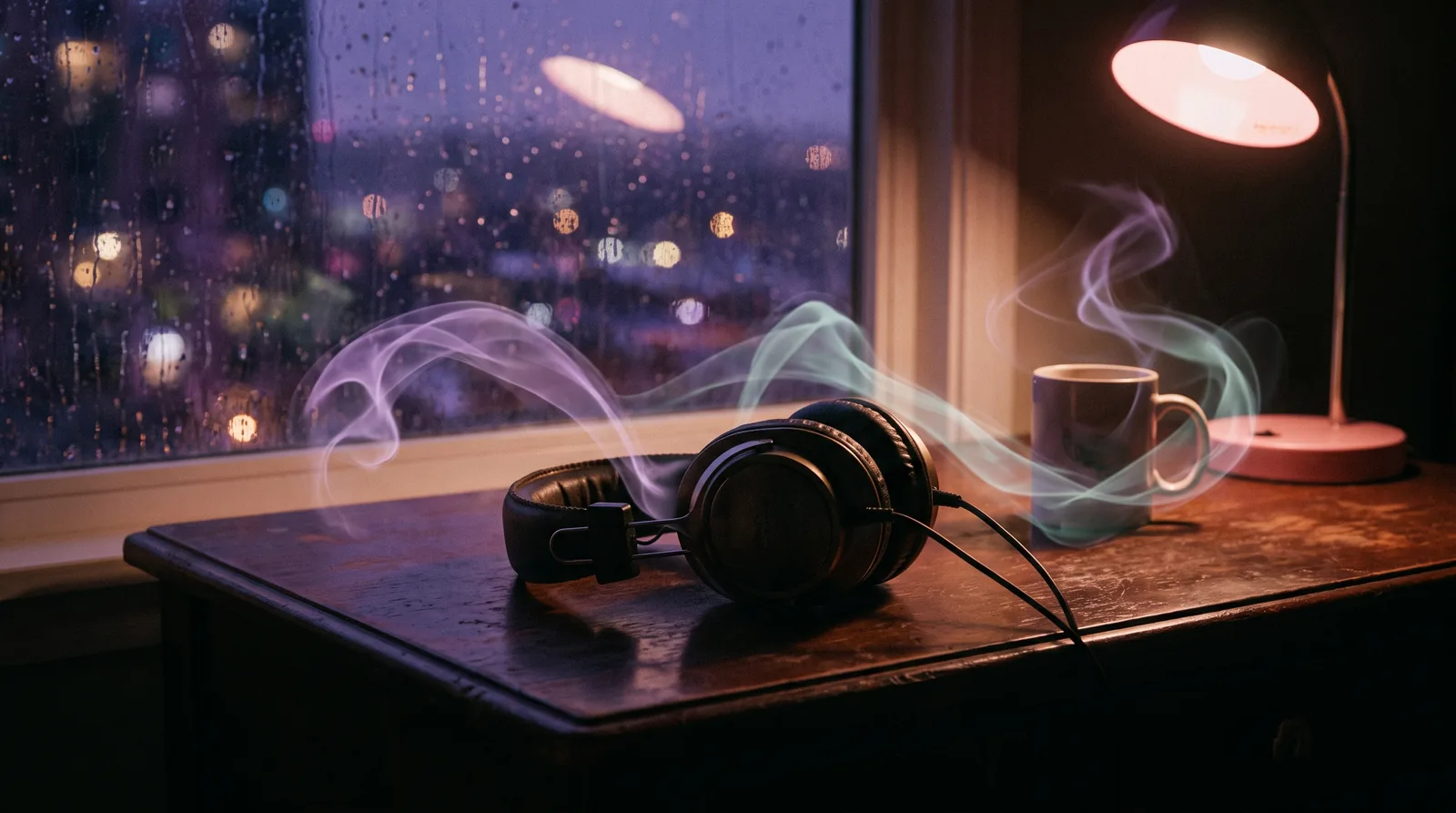
Somewhere right now, several hundred thousand people are working to the same soft, slightly dusty beat: a loop of muted piano, a drum pattern with the energy of a nap, and tape hiss lovingly added on purpose. Lo-fi hip hop, the genre built for studying, is one of the great unplanned experiments in attention. Nobody prescribed it. A hundred million students and deadline workers just converged on it, the way New Yorkers converge on the one subway car with working air conditioning. As the resident skeptic, my job is to ask the annoying question: is there anything real here, or did we all just agree on a vibe? The answer, for once, is that the crowd got the science mostly right.
What lo-fi actually is, acoustically
Strip the aesthetic and lo-fi has a consistent engineering spec: slow-to-moderate tempo, no vocals or buried ones, repetitive chord loops with few surprises, softened high frequencies, and a deliberately imperfect texture of crackle and hiss. Every one of those choices lowers the music's demand on your attention. There are no lyrics to parse, no drop to anticipate, no dynamic swings yanking your alertness around. It is music engineered to be almost ignorable, and that's not an insult. Almost ignorable is precisely the job description for a focus soundtrack: present enough to occupy the restless part of the brain, boring enough to never win the competition for the spotlight.
The lyrics finding, which is the important one
The clearest result in this literature is about words. A study in the Journal of Cognition had people perform memory and reading tasks in silence, with instrumental music, or with music containing lyrics, and the pattern was blunt: music with lyrics reliably impaired performance on verbal tasks like reading comprehension and remembering words, while instrumental music produced little to no measurable harm (Souza & Barbosa, 2023). This makes mechanical sense. Language processing is not a parallel system with infinite lanes; when your ears deliver a stream of words, it draws on the same machinery you're using to read the report or write the email. Lyrics are a denial-of-service attack on your verbal workspace. Lo-fi's founding decision, deleting the vocals, turns out to be the single most evidence-aligned thing about it.
Lyrics compete for the exact machinery you write and read with. Lo-fi's best feature is everything it leaves out.
Why it beats silence for some brains
If instrumental music is merely not harmful, why does lo-fi feel actively helpful to so many people? A few unglamorous reasons. First, masking: most of us don't get to choose between lo-fi and silence, we choose between lo-fi and a coworker's speakerphone, and a steady predictable soundscape swallows unpredictable interruptions, the same trick that makes brown noise so popular. Second, arousal: attention has a sweet spot between sluggish and jittery, and for an understimulated brain, an ADHD brain especially, a gentle beat supplies just enough stimulation to keep the restless channel occupied while the main channel works. Third, ritual: if the same playlist accompanies every work session, pressing play becomes a cue that reliably precedes focus, and nervous systems love a reliable cue. None of this requires the music to be magic. It requires it to be predictable, wordless, and yours.
Building a soundtrack that actually helps
The practical spec falls out of the evidence. Keep it instrumental when the work is verbal; save anything with lyrics for spreadsheets, chores, or the gym. Keep the volume low, a bed under the work rather than a performance over it. Prefer long seamless mixes to playlists that lurch between moods, because every transition is a tiny bid for your attention. And consider giving your eyes the same treatment as your ears. The visual equivalent of lo-fi exists: slow, repetitive, pleasantly unremarkable motion. On heavy writing days I sometimes park a Feelsy texture on autoplay at the edge of my desk, sound off, one slow loop folding into the next, and let my gaze land there between paragraphs instead of on a browser tab. Same principle, different sense: somewhere soft for the restless channel to sit.
Lo-fi versus noise: picking your tool
People often treat lo-fi, white noise, brown noise and rain sounds as one interchangeable blob of 'focus audio,' but they're different tools. Pure noise colors are texture without event: nothing ever happens in brown noise, which makes it the strongest masker and the least interesting companion. Lo-fi has just enough musical event, a chord change here, a bar of melody there, to feed an understimulated brain, at the cost of being slightly more distracting than pure static. Rain and cafe ambience sit between them. The selection logic is about your state, not the audio's specs. Overstimulated, jittery, too much noise in the environment: reach for the noise end of the shelf, where nothing competes. Understimulated, restless, procrastinating on something dull: reach for lo-fi, where the gentle beat gives the bored circuits a snack. Plenty of people ride the shelf across a single day, noise for the morning sprint, lo-fi for the afternoon slump. The only wrong answer is the playlist with lyrics you love, which is a karaoke session wearing a productivity costume.
When silence still wins
Honesty clause: the same research tradition finds plenty of people, especially introverts and folks doing genuinely hard verbal work, who perform best in quiet. If you notice you keep rewinding the same paragraph, or you can suddenly name the song, the soundtrack is taxing you and silence, or earplugs, is the better tool that hour. The test is cheap and takes one afternoon: same task, with and without. Lo-fi isn't a law of nature. It's a well-designed default that a hundred million people beta-tested for free, and unlike most things the internet agrees on, this one mostly survives contact with the evidence.
Feelsy is a wellness product, not medical advice. If stress, anxiety or sleep problems persist, please speak with a qualified professional.
References
- Souza, A. S., & Barbosa, L. C. L. (2023). Should We Turn off the Music? Music with Lyrics Interferes with Cognitive Tasks. Journal of Cognition, 6(1), 24.
Frequently Asked Questions
Why does lo-fi music help you focus?
Lo-fi is engineered to demand almost nothing from your attention: slow tempo, no lyrics, repetitive loops, and softened frequencies with no surprises. That lets it occupy the restless part of your brain, mask unpredictable background noise, and act as a reliable start-work cue, all without competing for the mental machinery your actual task needs.
Is it better to study with music or in silence?
It depends on the music and the person. Research in the Journal of Cognition found music with lyrics reliably impaired verbal tasks like reading comprehension, while instrumental music caused little to no measurable harm. Some people, especially those doing hard verbal work, still perform best in silence, so the practical test is to try the same task with and without music and notice which version needs less rereading.
Why is music with lyrics bad for concentration?
Language processing is a shared resource: when your ears deliver a stream of words, they draw on the same verbal machinery you use to read and write. That is why lyrics measurably hurt performance on verbal tasks while purely instrumental music generally does not. Lo-fi's defining choice, removing the vocals, is its most evidence-aligned feature.
What is the best way to set up a focus soundtrack?
Keep it instrumental for verbal work, keep the volume low so the music sits under the task rather than over it, and prefer long seamless mixes to playlists that jump between moods, since every transition is a small bid for your attention. Using the same soundtrack for every session also turns pressing play into a cue your nervous system learns to associate with focus.
Is there a visual equivalent of lo-fi music?
Yes: slow, repetitive, pleasantly unremarkable motion, like watching a texture fold in a steady loop, works on the eyes the way lo-fi works on the ears. Parking something slow and dim at the edge of your workspace gives your gaze a soft place to land between thoughts instead of a browser tab.

About the author
Contributing writer
Kurt is a New York based writer covering the practical science of stress, sleep and focus. He is the resident sceptic of the Journal: if a technique cannot survive a crowded subway commute and a deadline week, he is not interested in it.
Feel it for yourself.
Feelsy turns reading about calm into practising it. Two minutes of a slow texture is often the whole difference.


Related reading
 Sleep
SleepBrown Noise for Sleep and Focus: What It Is and Why It Works
Brown noise is the internet's favorite sleep and focus sound. What it actually is, how it differs from white and pink noise, and what research really shows.
 ASMR
ASMRBinaural Beats: Do They Actually Work?
Binaural beats promise focus, calm, and better sleep through plain headphones. A skeptical look at what the research and meta-analyses actually found.
 Breath & Body
Fidgeting Isn't a Bad Habit: The Case for Stimming
Fidget toys, foot-tapping, doodling: focus problem or focus tool? What research on ADHD hyperactivity and stimming actually says about the wisdom of restless hands.
 ASMRNew
Why Is Bob Ross So Relaxing? The Science of Happy Little Brushstrokes
Bob Ross has been putting people to sleep for four decades, and he'd take that as a compliment. Here's the science of why his painting videos work like ASMR.
 ASMRNew
What Is 8D Audio? The Science Behind the Spinning Sound
8D audio pans music around your head using binaural tricks. Here's how the illusion works, why it feels immersive, and whether it helps you relax or focus.
 ASMR
ASMRWhy Paint Mixing Videos Are So Satisfying
Why paint mixing videos feel so satisfying: the slow science of swirls and folds, what ASMR research suggests, and how to watch them as a mini meditation.