Brushing ASMR: Why a Soft Brush on a Microphone Melts Your Brain
Brushing ASMR turns a soft brush on a microphone into deep calm. Here's why your brain reads brushing as care, and how to use it for sleep and focus.
By Kurt Woleret
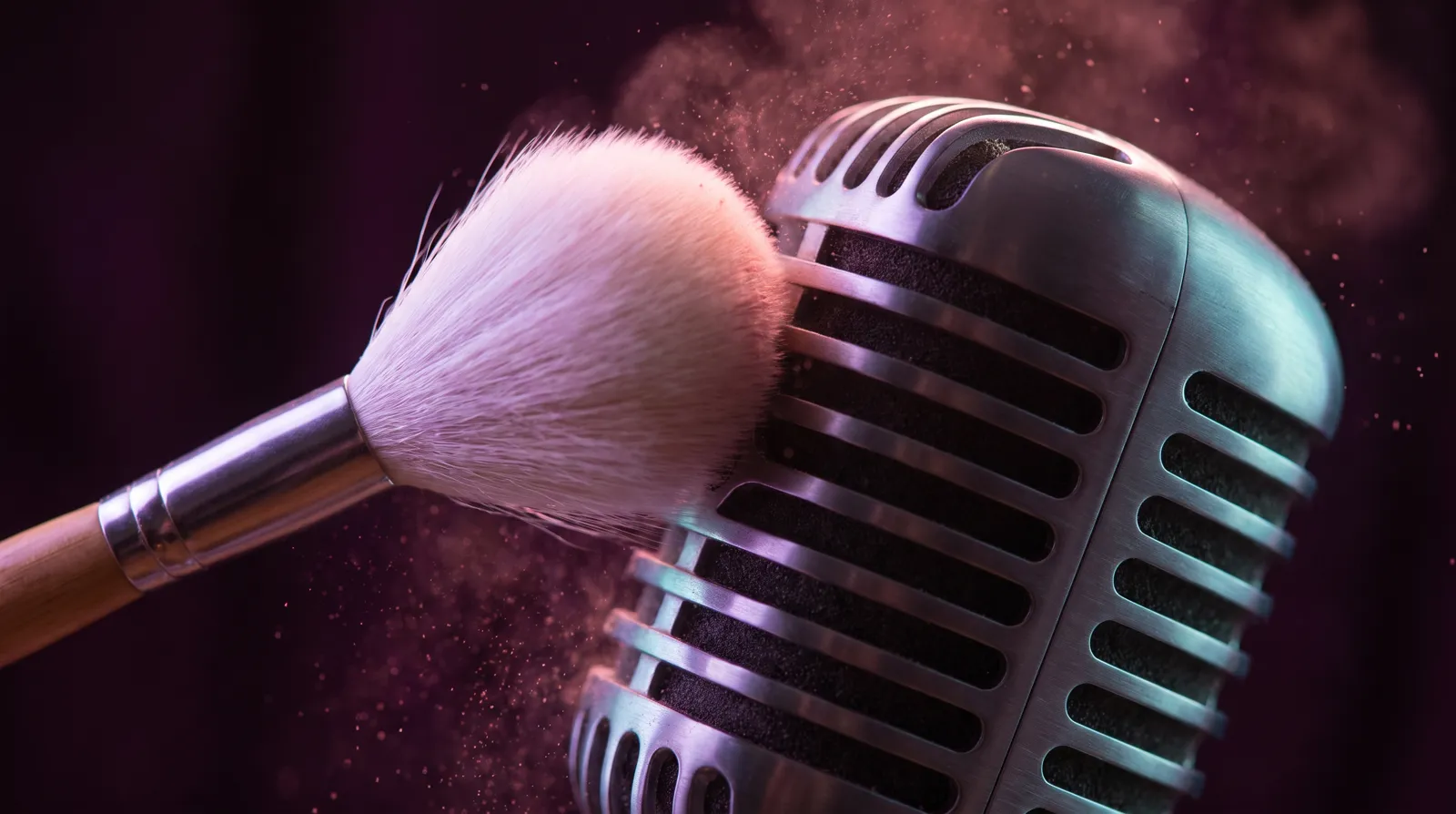
Of all the things I've watched a grown adult do to a microphone, slowly dragging a makeup brush across it for 45 minutes is the one I least expected to defend in print. And yet here we are. Brushing is one of the pillars of ASMR, up there with whispering and tapping, and it's the one that most reliably works on me, a person who once fell asleep during a brushing video while sitting upright on the C train, which I do not recommend for either safety or dignity. The interesting question isn't whether soft bristle sounds are pleasant. It's why a brush on a mic, or on a hairbrush, or on the fake ear of a 3D microphone, downshifts the nervous system so fast. There's a real answer, and it's better than 'it just does.'
What counts as brushing ASMR
The genre is broader than it sounds. Mic brushing is the classic: soft makeup or paint brushes swept directly over the microphone, producing a dense, close, static-like wash. Then there's hair brushing, camera brushing where the artist 'brushes your face,' fabric brushing, and the roleplay versions where the brush is incidental to a haircut or a makeover you're pretending to receive. The common ingredients: a soft repeated stroke, a rich broadband sound with no sharp edges, slow hands, and the unmistakable framing of being tended to. Hold that last one; it's doing more work than the audio.
Your brain files brushing under grooming
When researchers first surveyed ASMR responders about what set off their tingles, the winning triggers were whispering, personal attention, and crisp sounds, with slow, deliberate movements close behind (Barratt & Davis, 2015, PeerJ). Brushing manages to be three of those at once: it's a crisp-soft sound, delivered slowly, in a format that mimics one human carefully grooming another. That's probably not a coincidence. In primates, grooming is the original social glue, a behavior wired to calm, bonding and safety. A brush moving gently near your ears is a first-class impersonation of that signal. Your rational brain knows it's a stranger with a Blue Yeti. The older machinery underneath files it as someone I trust is taking care of me, and adjusts your physiology accordingly.
And the physiology does adjust. When researchers measured people watching ASMR videos in the lab, the ones who experience ASMR showed reliable reductions in heart rate while watching, alongside self-reported calm and, interestingly, heightened skin conductance, an alertness signal (Poerio et al., 2018, PLOS ONE). That combination, slowed heart, gently elevated engagement, is a decent physiological sketch of what brushing fans describe: deeply relaxed but pleasantly absorbed, not sedated. It's the same profile you'd hope to get from a good massage or, frankly, from being a well-loved cat.
Your rational brain knows it's a stranger with a microphone. The older machinery files it as being groomed by someone who cares.
Why brushing works when tapping doesn't (or vice versa)
ASMR triggers are weirdly personal. Some people need the crisp attack of tapping; brushing strikes them as static. Others, me included, find tapping too eventful for sleep and want brushing's continuous wash, which sits somewhere between white noise and touch. There's a decent logic to the split: tapping is rhythmic and predictable in discrete events, which suits brains that relax by counting along, while brushing is textural and continuous, which suits brains that relax by dissolving into a surface. Neither is more correct. If brushing does nothing for you, that's not a defect; trigger profiles vary enormously, and some people get the relaxation without ever getting tingles at all.
Two practical notes from the trenches. First, headphones matter more for brushing than for almost any other trigger: the close, ear-to-ear movement is the point, and a phone speaker flattens it into hiss. Second, volume should be lower than you think. Brushing at high volume stops being grooming and starts being sandpaper.
Using it on purpose
Brushing earns a spot in the practical toolkit in three places. For sleep, it's a strong candidate for the last 20 minutes before lights out: continuous, eventless, no narrative to follow, no reason to stay awake for what happens next. For focus, quiet brushing under instrumental music makes a surprisingly good concentration bed, the auditory equivalent of a weighted blanket. And for the wired-but-fried evening state, the after-work hour when your nervous system is still commuting, a brushing track plus something slow to look at is a reliable descent. That pairing is exactly how I use Feelsy: one of the soft, slow-moving textures on screen, a gentle sound bed underneath, autoplay on so the whole thing runs without me managing it. The visual gives your eyes the same continuous, edgeless input the brush gives your ears, and the two channels together work faster than either alone. On nights when the upstairs neighbor is rediscovering his passion for furniture rearrangement, I'll add a round of the 4-7-8 breathing exercise on top.
The sceptic's verdict
I came to ASMR expecting to write it off and left with a nightly routine, which is the most embarrassing possible outcome for a sceptic. Brushing in particular holds up: the trigger profile matches what the survey research says works, the calming effect shows up in lab physiology rather than just testimonials, and the grooming explanation gives it a plausible evolutionary spine. It won't fix a bad sleep schedule and it isn't therapy. It's a soft, cheap, side-effect-free way to convince an overstimulated nervous system that someone is taking care of it. Sometimes that someone is a stranger with a brush collection. Your brainstem isn't picky.
Feelsy is a wellness product, not medical advice. If stress, anxiety or sleep problems persist, please speak with a qualified professional.
References
- Barratt, E. L., & Davis, N. J. (2015). Autonomous Sensory Meridian Response (ASMR): a flow-like mental state. PeerJ, 3, e851.
- Poerio, G. L., et al. (2018). More than a feeling: Autonomous sensory meridian response (ASMR) is characterized by reliable changes in affect and physiology. PLOS ONE, 13(6), e0196645.
Frequently Asked Questions
What is brushing ASMR?
Brushing ASMR is a family of ASMR content built around soft, repeated brush strokes: makeup brushes swept directly over a microphone, hair brushing, fabric brushing, and roleplays where you're the one being brushed. The result is a dense, continuous, edgeless sound that many people find deeply calming, with or without tingles.
Why does brushing ASMR feel so relaxing?
Brushing combines several of the most commonly reported ASMR triggers at once: a crisp-soft sound, slow deliberate movement, and the framing of personal attention. It also closely mimics grooming, a behavior associated with calm and social bonding in primates, so the nervous system tends to read it as a signal of safety and care.
Does ASMR actually change your body, or is it just in your head?
Lab research found that people who experience ASMR showed reliable reductions in heart rate while watching ASMR videos, along with increased calm and a mild rise in skin conductance, a marker of engagement. That profile, relaxed but pleasantly absorbed, matches how fans describe the experience.
Do I need headphones for brushing ASMR?
They help more here than with almost any other trigger. The close, ear-to-ear movement of the brush is central to the effect, and phone or laptop speakers flatten it into generic hiss. Keep the volume low; brushing works as a soft, near-field sound, not a loud one.
What if brushing ASMR does nothing for me?
That's common and completely normal. Trigger profiles vary a lot from person to person; some people respond to tapping, whispering or personal attention instead, and some get relaxation without ever feeling tingles. It's worth sampling a few different trigger types before deciding ASMR isn't for you.

About the author
Contributing writer
Kurt is a New York based writer covering the practical science of stress, sleep and focus. He is the resident sceptic of the Journal: if a technique cannot survive a crowded subway commute and a deadline week, he is not interested in it.
Feel it for yourself.
Feelsy turns reading about calm into practising it. Two minutes of a slow texture is often the whole difference.


Related reading
 ASMR
ASMRTapping ASMR: Why Fingernails on a Glass Jar Can Outperform a Lullaby
Tapping is one of the most popular ASMR triggers on earth. Here's why rhythmic little sounds calm your brain, and how to find the taps that work for you.
 ASMR
ASMRASMR Triggers: A Field Guide to the Tingles
From whispers and tapping to slime and slow hands: the most common ASMR triggers, how to find yours, and why some people never feel tingles at all.
 ASMR
ASMRBinaural ASMR: Why Headphones Change Everything
Why ASMR feels flat from speakers and electric in headphones: how binaural recording works, what it does to your nervous system, and how to set it up right.
 ASMRNew
Why Is Bob Ross So Relaxing? The Science of Happy Little Brushstrokes
Bob Ross has been putting people to sleep for four decades, and he'd take that as a compliment. Here's the science of why his painting videos work like ASMR.
 ASMR
ASMRWhat Is 8D Audio? The Science Behind the Spinning Sound
8D audio pans music around your head using binaural tricks. Here's how the illusion works, why it feels immersive, and whether it helps you relax or focus.
 ASMR
ASMRWhy Paint Mixing Videos Are So Satisfying
Why paint mixing videos feel so satisfying: the slow science of swirls and folds, what ASMR research suggests, and how to watch them as a mini meditation.