Falling Back: A Survival Guide for the End of Daylight Saving Time
Clocks fall back this weekend, and the free hour is slightly fake. What the end of daylight saving time really does to your sleep, and how to land it well.
By Kurt Woleret
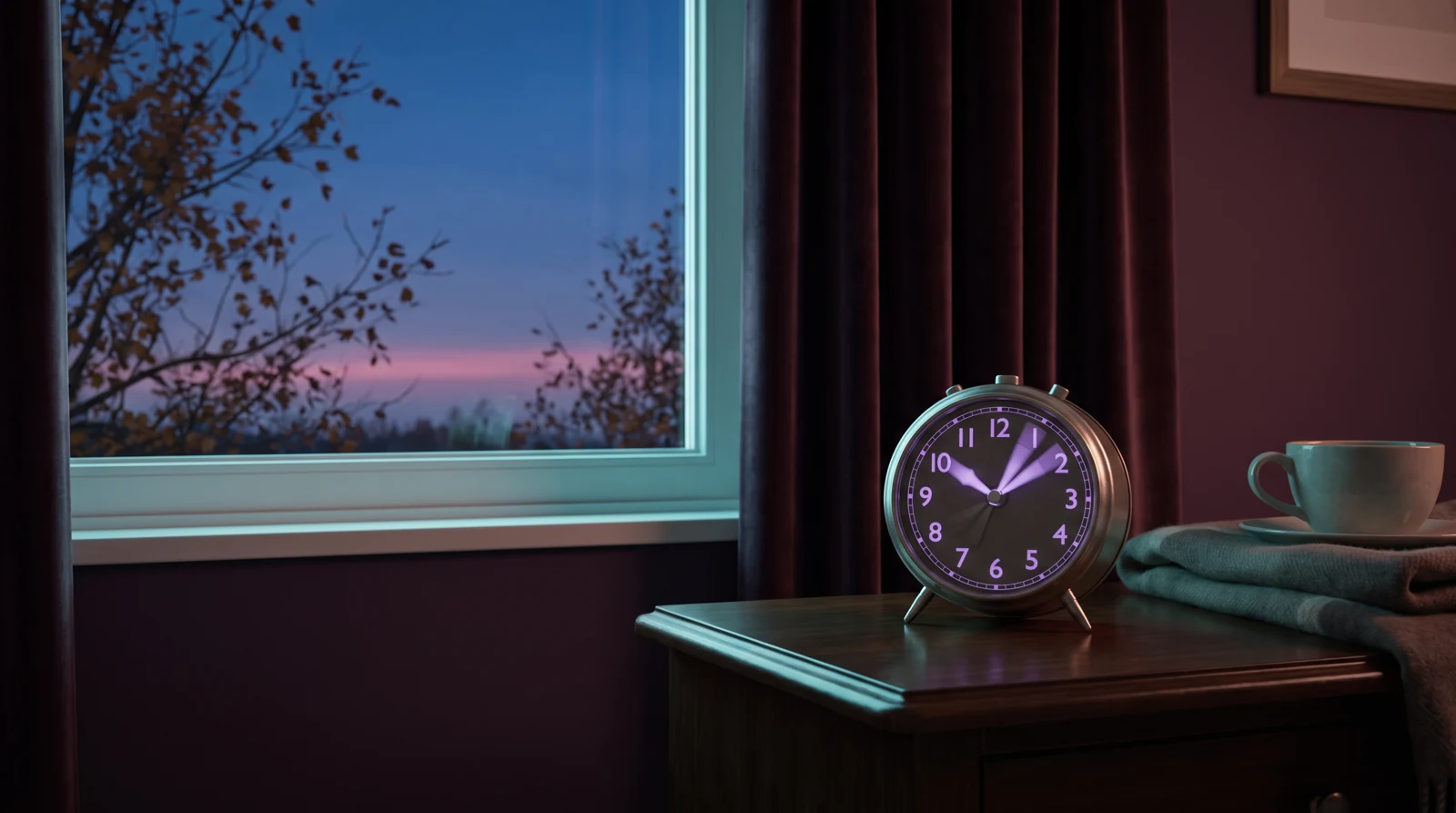
This Sunday at 2 a.m., America performs its strangest annual ritual: we collectively agree that an hour never happened. Daylight saving time ends, clocks fall back, and everyone you know will tell you to enjoy the free hour of sleep. I'd love to. But I've been writing about sleep long enough to read the fine print, and the fine print says the hour is a loan. Your body clock didn't sign the paperwork, and the interest gets collected over the following week, mostly in the form of 4:45 p.m. darkness and a bedtime that suddenly feels negotiable. Here's what's actually happening to you this weekend, and how to come out the other side a functioning person.
The free hour is slightly fake
Your circadian rhythm, the internal clock that schedules sleepiness, alertness, hunger and about a thousand other things, does not read calendars. It runs on roughly a 24-hour cycle and takes its cues from light, not from legislation. So when the wall clock jumps back an hour, your internal clock stays exactly where it was. On Sunday morning you'll wake at what your phone insists is 6 a.m. while your body files it as 7. Dinner will arrive an hour before you're hungry. Bedtime will show up before you're sleepy, which is precisely when most people decide to stay up later, because the clock seems to give permission. That's the first leak in the free hour: surveys of the transition consistently find that a lot of people don't bank it. They spend it awake, then wake early anyway, and start the week with the same sleep and a scrambled schedule.
The good news is that falling back is the gentler of the two shifts. The body clock finds it easier to delay, staying up and waking later, than to advance, which is why the spring transition is the one associated with the ugliest statistics. But gentler is not free. Sleep in the nights after the fall change tends to get fragmented, early waking is common for most of a week, and the sudden loss of evening light lands hard on anyone whose mood already dips in winter.
Sleep scientists are not fans of any of this
It's worth knowing that the people who study this for a living would like the whole ritual abolished. The American Academy of Sleep Medicine published a position statement calling for an end to seasonal time changes, and, notably, it argued the fixed clock we keep should be permanent standard time, not permanent daylight time (Rishi et al., 2020, Journal of Clinical Sleep Medicine). The reasoning is unsexy and solid: standard time lines up morning light with the human circadian system, and morning light is the strongest lever we have for keeping the internal clock on schedule. Permanent daylight time, which polls better because everyone likes bright evenings, was actually tried in the United States in the 1970s and abandoned within a year, in part because nobody enjoyed pitch-black school runs. So if you spend Sunday feeling vaguely wronged by clock policy: the experts agree, just probably not in the direction you'd guess.
The hour is a loan. Your body clock didn't sign the paperwork.
How to land the fall back
You can't opt out of the time change, but you can control how your week absorbs it. The playbook is short:
- Keep your wake time. Get up Sunday at your usual body-clock hour, even though the wall clock says it's early. A Sunday lie-in is how a one-hour shift becomes a three-day hangover.
- Take the hour as sleep, not as scrolling. If you do stay on your old schedule, go to bed at your usual internal time and let the clock hand you the extra hour in the morning.
- Front-load light. Get outside, or at least to a bright window, early on Sunday and Monday. Morning light is what re-pins your internal clock to the new schedule.
- Dim the evenings. With sunset arriving an hour earlier, your evening is longer and darker. Keep the lights warm and low in the last hour before bed so your body still gets a clear dusk signal.
- Shift the dependents gradually. Kids, dogs and anyone who eats dinner at a fixed hour will be running on the old clock for a few days. Move meals and bedtimes in 15-minute steps instead of all at once.
The real problem is the week after
Honestly, the clock change itself is a speed bump. The thing that flattens people is what it reveals: winter. On Monday it will be dark before you leave work, and for a lot of us that early blackout reads, somewhere deep in the brain, as 'the day is over, why are you still doing things.' The fix is to give the new dark evenings a shape instead of letting them sag into the couch. Cook something slow. Take the walk at lunch instead of after work, when the light is actually available. And build a proper wind-down for the earlier dusk rather than treating 9 p.m. like a waiting room. In my apartment the lamp situation is grim by November, so I've taken to running a slow Feelsy texture on the nightstand while I read, sound low, a small window of drifting color against the 5 o'clock blackout. It doesn't change the sunset. It does change the room. One slow 4-7-8 breathing cycle at the new, earlier-feeling bedtime helps too, mostly by convincing your body that the schedule change was its idea.
The verdict
Fall back is the easy half of a bad system. Treat the hour as actual sleep, hold your wake time, chase morning light for a few days, and you'll absorb the shift by midweek while everyone else is still showing up early to meetings that no longer exist. And when the 5 p.m. darkness gets philosophical, remember it's not you. It's the clocks. The sleep scientists have the receipts.
Feelsy is a wellness product, not medical advice. If stress, anxiety or sleep problems persist, please speak with a qualified professional.
References
- Rishi, M. A., et al. (2020). Daylight saving time: an American Academy of Sleep Medicine position statement. Journal of Clinical Sleep Medicine, 16(10), 1781-1784.
Frequently Asked Questions
Do you really gain an hour of sleep when the clocks fall back?
Only if you take it. Your internal clock stays on the old schedule, so many people stay up later because the wall clock seems to allow it, then wake at their usual internal time anyway and bank nothing. To actually gain the hour, go to bed at your usual body-clock time and let the clock hand you the hour in the morning.
Why am I still tired after the end of daylight saving time?
Your circadian rhythm takes cues from light, not from the clock change, so for several days your body runs an hour ahead of the wall clock. Sleep tends to be more fragmented and early waking is common for most of a week. Keeping a consistent wake time and getting bright morning light speeds up the adjustment.
How long does it take to adjust to the fall time change?
Most people re-align within a few days to a week. Falling back is easier than springing forward because the body clock delays more readily than it advances. You can shorten the adjustment by holding your usual wake time, getting outside early in the day, and dimming lights in the hour before bed.
Is permanent standard time better than permanent daylight saving time?
Sleep scientists generally say yes. The American Academy of Sleep Medicine's position statement calls for ending seasonal changes in favor of permanent standard time, because it keeps morning light aligned with human circadian biology. Permanent daylight time was tried in the US in the 1970s and abandoned within a year, partly over dark winter mornings.

About the author
Contributing writer
Kurt is a New York based writer covering the practical science of stress, sleep and focus. He is the resident sceptic of the Journal: if a technique cannot survive a crowded subway commute and a deadline week, he is not interested in it.
Feel it for yourself.
Feelsy turns reading about calm into practising it. Two minutes of a slow texture is often the whole difference.


Related reading
 Sleep
How to Fix Your Sleep Schedule (Without Wrecking a Whole Week)
Your sleep schedule drifted and now bedtime is a rumor. Here's how to reset your body clock with light, timing, and patience instead of willpower.
 Sleep
Morning Sunlight: The Cheapest Sleep Aid You're Not Using
Morning sunlight is the strongest signal your body clock gets all day. What the camping study showed, why window light falls short, and how to use it right.
 Sleep
Your Circadian Rhythm, Explained Without the Jargon
What your circadian rhythm actually is, how light sets the clock, why it drifts off schedule, and the evidence-backed ways to nudge it back in line.
 Sleep
The Best Alarm Sound to Wake Up To, According to Research
Harsh beeping may be making your mornings worse. What research says about the best alarm sound to wake up to, and how to choose one your brain won't fight.
 Sleep
Can You Learn While You Sleep? What the Science Actually Says
Sleep learning is an old dream and mostly a myth, but not entirely. What research really shows about learning, memory and your sleeping brain.
 Sleep
Does Counting Sheep Actually Work? Science Counted, and No
Counting sheep is the oldest sleep trick in the book, and research suggests it barely works. Here's why it fails busy minds and what to do instead.