Morning Sunlight: The Cheapest Sleep Aid You're Not Using
Morning sunlight is the strongest signal your body clock gets all day. What the camping study showed, why window light falls short, and how to use it right.
By Kurt Woleret
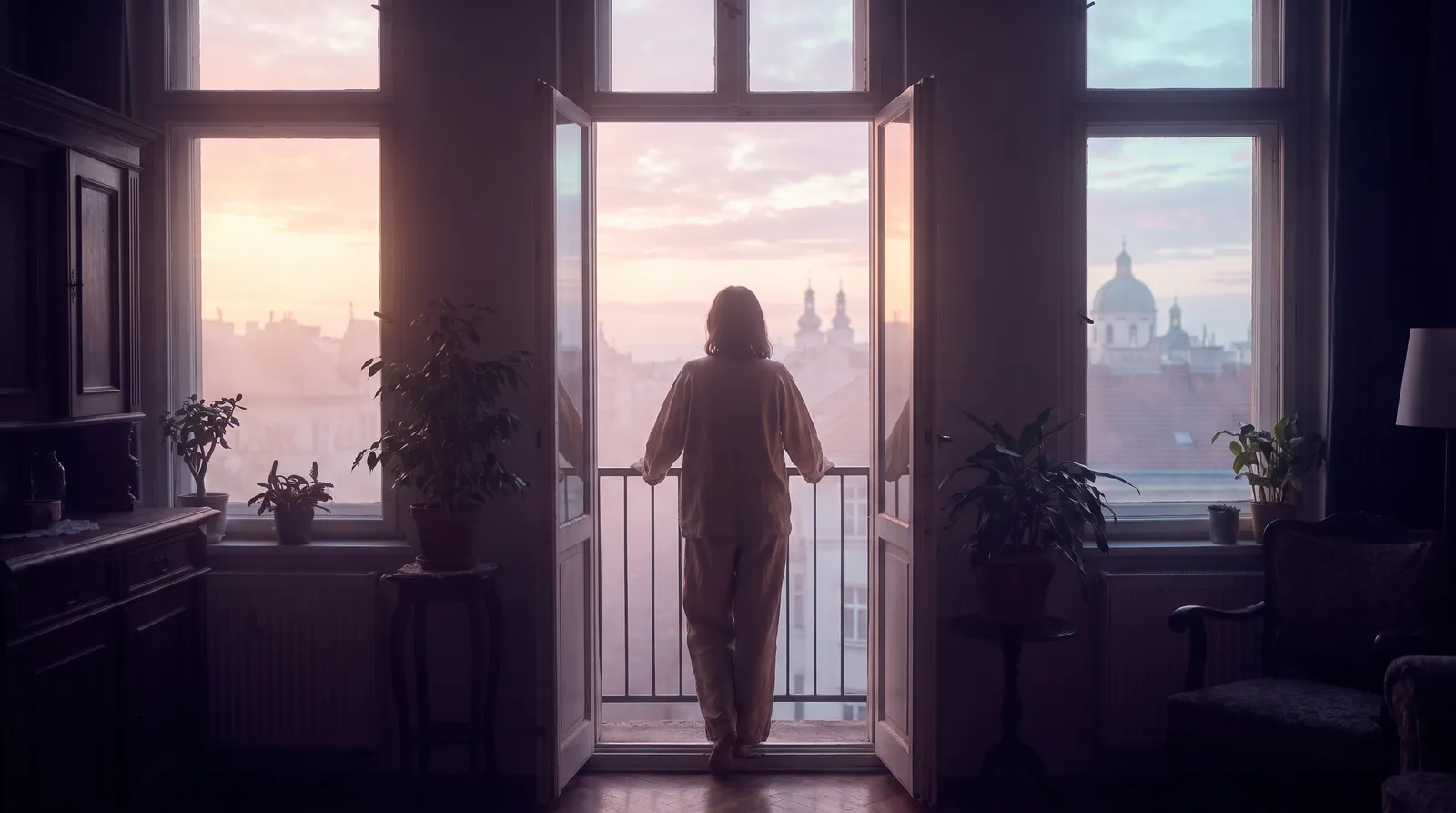
The sleep industry would love to sell you something. A smarter mattress, a ring that grades you, a supplement stack with a subscription. Meanwhile the most powerful circadian tool known to science rises over Brooklyn every morning, free of charge, and most of us experience it as a glare on the phone screen while we check email in bed. Let's talk about morning light: what it actually does, why your apartment's version doesn't count, and how ten minutes outside can quietly move your bedtime.
Your body clock needs a daily time check
Your internal clock doesn't run at exactly 24 hours; for most people it runs slightly longer. Left alone in a cave, your schedule would drift later and later, which, if you've ever been on vacation for a week, you have personally confirmed. What keeps the clock honest is a daily correction, and far and away the strongest correcting signal is light hitting your eyes, especially in the hours after waking. Morning light nudges the clock earlier; light late at night shoves it later. Every day your schedule is basically an argument between those two signals, and modern life rigs the argument: dim mornings indoors, bright screens at midnight.
The camping study
The cleanest demonstration of what light does to us is a small 2013 study from Kenneth Wright's lab at the University of Colorado, published in Current Biology. Researchers measured people's melatonin rhythms during a normal week of indoor life with artificial light, then sent them camping in the Rockies for a week: sunlight and campfires only, no flashlights, no phones. After one week outdoors, participants' internal clocks had shifted about two hours earlier and locked onto the actual sunrise and sunset. Night owls shifted the most; the gap between early birds and night owls shrank. Same humans, different light, dramatically different clocks.
Your bedroom lamp is a rounding error. The sky is the signal.
The study also measured ordinary indoor life and found what you'd expect: we marinate in light that's far too dim by day and too bright at night. Even a gloomy, overcast sky outdoors delivers vastly more light to your eyes than a well-lit room; outdoor light is measured in tens of thousands of lux while typical indoor lighting limps along in the hundreds. Your eyes adapt so smoothly that the difference is invisible to you. Your circadian clock, which counts photons rather than vibes, notices every bit of it.
Why the window doesn't cut it
The obvious workaround, drinking coffee by a bright window, is better than a dark kitchen but worse than you'd hope. Glass cuts the intensity substantially, you're usually sitting at an angle to the sky, and indoor positioning puts you farther from the light than it feels. Outside wins by an order of magnitude, which is why the advice is annoyingly literal: not 'get some light' but 'put your body outdoors.' Balcony, stoop, sidewalk, anywhere under open sky. I take my coffee to the fire escape like a pigeon with a deadline, and it counts.
How to actually do it
- Get outside within an hour or so of waking, for ten to twenty minutes; stretch it longer on heavily overcast days, since clouds dim the signal but don't erase it.
- Skip the sunglasses for this particular ritual so your eyes get the full signal, but never look directly at the sun; the sky itself is bright enough.
- Stack it on something you already do: coffee on the stoop, walking the dog, getting off the subway one stop early.
- Stay consistent, because the clock is corrected daily; one heroic Saturday hike doesn't carry a week of dim mornings.
- Honor the other half of the deal by dimming your evenings, since morning light earned back can be re-lost to a bright screen at midnight.
Who gets the most out of it
If your schedule already runs early and steady, morning light is maintenance: cheap insurance that keeps the clock pinned where you want it. The people with the most to gain are the ones drifting late. Night owls shifted the most in the camping study, which tracks with the mechanism: the later your clock sits, the more a strong morning signal has to pull against. Same story if your bedtime slides an hour later every week, if you work from home and some days never actually go outside, or if winter has compressed your daylight into the hours you spend at a desk. Those are precisely the lives where the clock is running on fumes, and ten deliberate minutes of sky in the morning is the biggest single correction available.
What it won't do
Honesty section. Morning light is a timing signal, not a sedative. It helps your bedtime drift earlier and your mornings feel less like exhumation, and the camping data shows the clock responds within days. But it won't overpower a 5 p.m. cold brew, an anxiety spiral, or a bedroom that's 78 degrees. It's one lever, the cheapest and arguably the strongest one, and it works best when the evening side cooperates: lights low, screens boring, a slow off-ramp. My own off-ramp most nights is a few quiet minutes of Feelsy textures with the brightness turned way down, which is about as close as a screen gets to candlelight. Sun in the morning, dimness at night; the clock mostly takes care of the rest.
It's a strange feature of modern life that the free, ancient, abundantly available intervention is the one we skip. You don't need equipment. You need a door, ten minutes, and the willingness to look slightly underdressed in front of your neighbors. The mattress industry will survive without you.
Feelsy is a wellness product, not medical advice. If stress, anxiety or sleep problems persist, please speak with a qualified professional.
References
- Wright, K. P., Jr., McHill, A. W., Birks, B. R., Griffin, B. R., Rusterholz, T., & Chinoy, E. D. (2013). Entrainment of the human circadian clock to the natural light-dark cycle. Current Biology, 23(16), 1554-1558.
Frequently Asked Questions
What time should I get morning sunlight?
Within an hour or so of waking, for ten to twenty minutes outdoors. That early-day window is when light most strongly nudges your body clock earlier, which makes it easier to fall asleep at a reasonable hour that night. On heavily overcast days, stay out longer; clouds dim the signal but don't erase it.
Does sunlight through a window count?
Only partially. Glass cuts the light's intensity substantially, and sitting indoors usually puts you at an angle and distance that weaken it further. Being outdoors under open sky delivers vastly more light to your eyes, so a stoop, balcony, or sidewalk beats even a bright window by a wide margin.
Does morning light work on cloudy days?
Yes. Even an overcast sky outdoors delivers far more light than typical indoor rooms, which measure in the hundreds of lux while outdoor light reaches tens of thousands. Your eyes adapt so well that the difference is hard to perceive, but your circadian clock registers it. Just extend your time outside when it's gray.
Can morning sunlight help me fall asleep earlier?
That's exactly what the evidence suggests. In a 2013 study, a week of natural light while camping shifted participants' internal clocks about two hours earlier, with night owls shifting most. Daily morning light outdoors, paired with dim evenings, moves your melatonin timing earlier so sleepiness arrives at a more civilized hour.

About the author
Contributing writer
Kurt is a New York based writer covering the practical science of stress, sleep and focus. He is the resident sceptic of the Journal: if a technique cannot survive a crowded subway commute and a deadline week, he is not interested in it.
Feel it for yourself.
Feelsy turns reading about calm into practising it. Two minutes of a slow texture is often the whole difference.


Related reading
 Sleep
Your Circadian Rhythm, Explained Without the Jargon
What your circadian rhythm actually is, how light sets the clock, why it drifts off schedule, and the evidence-backed ways to nudge it back in line.
 Sleep
How to Wake Up Early (Without Hating Your Life)
Want to become a morning person? Here's how to wake up early using light, timing and consistency, based on what circadian science actually shows.
 Sleep
Does Screen Time Before Bed Really Wreck Your Sleep?
Phones before bed: sleep villain or overblown? What the research on screens, blue light and melatonin actually shows, and what to do that isn't 'never look at a screen.'
 Sleep
Falling Back: A Survival Guide for the End of Daylight Saving Time
Clocks fall back this weekend, and the free hour is slightly fake. What the end of daylight saving time really does to your sleep, and how to land it well.
 Sleep
The Best Alarm Sound to Wake Up To, According to Research
Harsh beeping may be making your mornings worse. What research says about the best alarm sound to wake up to, and how to choose one your brain won't fight.
 Sleep
Can You Learn While You Sleep? What the Science Actually Says
Sleep learning is an old dream and mostly a myth, but not entirely. What research really shows about learning, memory and your sleeping brain.