Mudras Explained: Why Meditation Gives Your Hands a Job
What mudras mean, where the hand gestures of meditation come from, and how to use gyan, dhyana and anjali mudra to steady attention in your own practice.
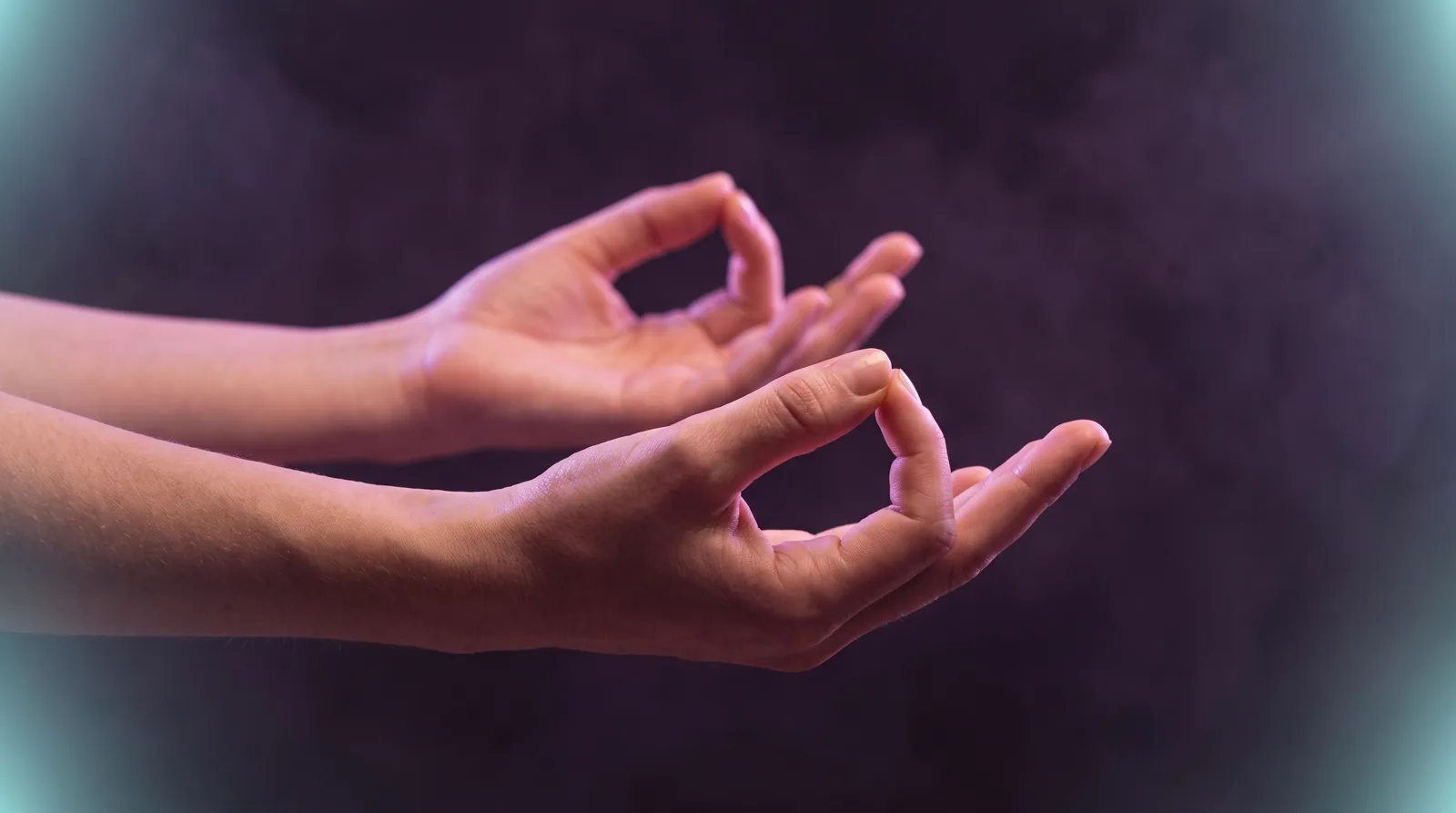
Sit down to meditate for the first time and a small, unglamorous question presents itself almost immediately: what on earth do I do with my hands? The breath has its instructions, the spine has its posture, but the hands simply dangle, fidget, or clutch at the knees like passengers unsure of their seats. The contemplative traditions of India and Asia noticed this problem several thousand years before we did, and their answer was not to ignore the hands but to give them a job. That job is the mudra: a deliberate, symbolic position of the fingers and palms, held gently for the length of a practice. The word is Sanskrit, usually translated as seal or gesture, and once you begin looking for mudras you find them everywhere: in the poised fingers of a bronze Buddha, in the sweeping hand language of classical Indian dance, in the folded palms of greeting still exchanged daily across South Asia.
What a mudra actually is
A mudra is best understood as a gesture with intention attached. In yoga and Buddhist practice, the hasta mudras, the hand gestures, are the most familiar family: precise arrangements of fingers held during meditation or breathing exercises. Tradition assigns each one a meaning and a quality. Some are said to settle the mind, some to lift energy, some to signal openness or resolve. Whether one takes those correspondences literally or reads them as a rich symbolic vocabulary, the practical effect is the same and is not mysterious at all: the hands are given something definite to do, and a restless part of the body becomes an anchor instead of a distraction.
It helps to remember that mudras were never confined to the meditation cushion. In Buddhist and Hindu iconography, the position of a statue's hands tells you what the figure is doing: teaching, meditating, granting reassurance, touching the earth as witness. In Bharatanatyam and other classical dance forms, dozens of codified hand shapes carry entire narratives. The meditation mudras belong to this same old conviction: that the hands speak, and that what they say, the mind tends to follow.
The mudras you will meet first
Most practitioners begin with a small repertoire, and there is no need to collect more than a few. These are the gestures you are most likely to encounter in classes, apps and books.
- Gyan mudra, sometimes called chin mudra: the tip of the index finger touches the tip or base of the thumb, the remaining fingers relaxed, palms resting on the knees. It is the classic gesture of study and stillness, traditionally associated with knowledge, and it is the default resting position in much of modern yoga.
- Dhyana mudra: the hands rest in the lap, right upon left, palms upward, thumb tips lightly touching to form an oval. This is the meditation gesture of countless Buddha images, and its symmetry makes it especially settling for longer sits.
- Anjali mudra: the palms pressed together at the centre of the chest, the familiar gesture of greeting and gratitude. Bringing the palms together at the heart is one of the quickest ways to signal to yourself that ordinary business has paused.
- Shuni mudra: the tip of the middle finger to the thumb, traditionally linked with patience and discipline, and a pleasant alternative when gyan mudra has grown automatic.
The hands are given something definite to do, and a restless part of the body becomes an anchor instead of a distraction.
Why the hands matter so much to the mind
You do not need to accept any metaphysical claim to notice that the hands are extravagantly well represented in our attention. A great deal of the brain's sensory and motor machinery is devoted to the fingers, which is why they are so eloquent, and also why they are so restless. Idle hands drum tables, spin rings, and reach for phones. A mudra takes this liveliness and quiets it, the way holding a worry stone or a string of beads does: the light pressure of fingertip on thumb gives attention a small, steady home in the body. When the mind wanders off during meditation, as it will, the faint sensation of the mudra is still there to return to, closer and more immediate even than the breath.
There is also the matter of ritual. A gesture repeated at the start of every practice becomes a threshold. Settle the hands into dhyana mudra a few hundred times and the shape itself begins to carry the memory of every previous sitting; the body recognises the posture and begins to quieten before the mind has issued any instruction. This is the same trick by which an old song summons an old summer. The mudra becomes a key that turns a familiar lock.
How to practise with a mudra
Begin simply. Sit comfortably, let the shoulders drop, and rest the backs of the hands on the thighs. Bring index finger and thumb together in gyan mudra with the lightest possible contact: this is a touch, not a pinch. Then carry on with whatever practice you already keep, whether that is watching the breath, a body scan, or a few rounds of slow counted breathing. I often pair a mudra with the 4-7-8 breathing exercise in Feelsy, letting the fingertips rest together while the app paces the exhale; the gesture holds the body still while the breath does its slow work, and the two habits reinforce one another pleasantly.
Hold the gesture for as long as it remains comfortable, and let it go when it becomes a preoccupation. Nothing is lost by releasing it. Over weeks, you may find the mudra begins to work outside formal practice: two fingertips brought quietly together under a desk in a tense meeting is an invisible act, and yet it can carry a surprising amount of the cushion's calm into the room.
A small language, still spoken
It is easy to dismiss mudras as decoration, the costume jewellery of meditation. I think that misreads them. They are a very old technology for a very modern problem: a body that will not settle, and hands that always want employment. The traditions that developed them understood that attention is not commanded from the head down but coaxed from the body up, and that the fingers, of all things, make excellent ushers. Give the hands their quiet job, and the mind, noticing that everything seems to be in order, is far more willing to sit down as well.
Feelsy is a wellness product, not medical advice. If stress, anxiety or sleep problems persist, please speak with a qualified professional.
Frequently Asked Questions
What is a mudra in meditation?
A mudra is a deliberate, symbolic position of the hands and fingers held during meditation or breathing practice. The word is Sanskrit and is usually translated as seal or gesture. Traditions in yoga and Buddhism assign each mudra a meaning, but the practical effect is simple: the hands are given something definite to do, so they become an anchor for attention rather than a source of fidgeting.
What is gyan mudra and how do I do it?
Gyan mudra, sometimes called chin mudra, is the most common meditation gesture: the tip of the index finger touches the tip or base of the thumb while the other fingers stay relaxed, with the hands resting on the knees or thighs. It is traditionally associated with knowledge and study. The contact should be feather-light, a touch rather than a pinch.
Do mudras actually do anything?
You do not need to accept any metaphysical claim for mudras to be useful. The fingers are richly represented in the brain's sensory machinery, which is why idle hands fidget, and a mudra quiets that restlessness by giving the fingertips a small, steady point of contact to rest on. Repeated at every practice, the gesture also becomes a ritual threshold that signals to the body that it is time to settle.
Which mudra is best for beginners?
Start with gyan mudra, index fingertip to thumb, because it is comfortable, unobtrusive and easy to hold for a whole sitting. Dhyana mudra, with the hands cupped in the lap and thumb tips touching, is a settling alternative for longer meditations, and anjali mudra, palms together at the chest, makes a natural opening gesture. A repertoire of two or three is plenty.
How long should I hold a mudra?
Hold it for as long as it stays comfortable and release it the moment it becomes a preoccupation. Nothing is lost by letting go. Many people keep a mudra for the length of a breathing exercise or a short meditation, and with practice the gesture can also be used briefly during the day, such as touching two fingertips together quietly during a stressful moment.

About the author
Contributing writer
Eleonor writes about contemplative traditions, attention and the cultural history of calm. She has spent two decades collecting the rituals humans use to slow down, from zazen halls to hammams, and translating them for modern, screen-lit lives.
Feel it for yourself.
Feelsy turns reading about calm into practising it. Two minutes of a slow texture is often the whole difference.


Related reading
 Ancient Wisdom
Mantra Meditation: Why Repeating One Word Quiets the Mind
What a mantra actually does to a busy mind: the science of repetition, how to choose a word, and a simple way to practise mantra meditation tonight.
 Breath & Body
Pranayama for Beginners: Ancient Breathing, Modern Calm
A gentle introduction to pranayama: what yogic breath control means, three beginner-friendly techniques to try tonight, and what slow-breathing research shows.
 Visual Meditation
How to Meditate: A Beginner's Guide to the First Ten Minutes
Learn how to meditate as a complete beginner: what to actually do with your mind, how long to sit, why wandering is normal, and a kind ten-minute plan.
 Ancient Wisdom
Döstädning: The Gentle Swedish Art of Death Cleaning
What Swedish death cleaning really means: the calm philosophy of döstädning, how it differs from ordinary decluttering, and how to begin at any age.
 Ancient Wisdom
How to Start a Gratitude Journal You Will Actually Keep
How to start a gratitude journal that actually helps: what the research found, why most lists go stale, and the very old art of counting blessings.
 Ancient Wisdom
Haiku as Meditation: Seventeen Syllables of Attention
How writing haiku trains attention: why the tiny form works like meditation, what noticing small moments does for wellbeing, and how to write your first.