Origami as Meditation: What a Square of Paper Teaches a Restless Mind
Origami turns a single square of paper into a quiet attention practice. Why folding calms a busy mind, and how to begin a paper meditation with one crane.
By Mei Lin
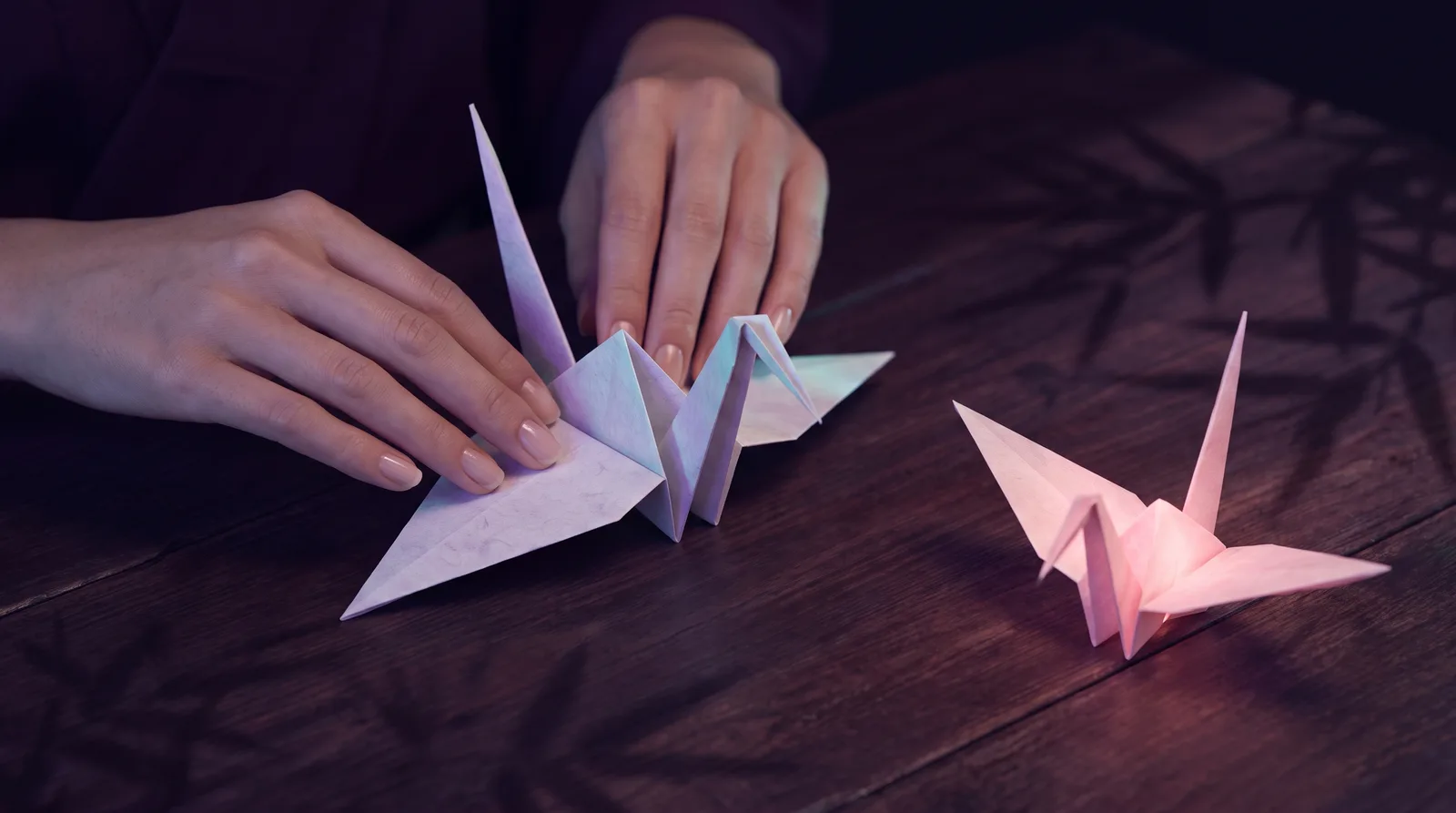
Paper was born in China, but it learned to fold in Japan. I like to think of origami as what happens when a material is loved long enough to be given rules. One square. No scissors, no glue. Whatever the paper becomes, it becomes through folding alone, and it could, in principle, be unfolded back to a blank square. Nothing is added and nothing is lost. For a mind that spends its days adding and losing, this is a strangely comforting arithmetic.
My grandmother did not fold cranes. She folded ingots, the little paper boats of gold burned at Qingming for the ancestors, and she folded them in the unhurried way she did everything, talking, not looking at her hands. The hands knew. That is the secret of every folding tradition, Chinese zhezhi or Japanese origami: the practice lives in the fingers, and the fingers are very good at quieting the head.
The discipline of the crease
A fold is a commitment. Run your thumbnail along a crease and the paper is changed; it will remember that line forever, faintly, no matter what else it becomes. Because of this, origami asks for a kind of attention that is rare in daily life: complete, but calm. Rush a fold and the corners miss; hesitate forever and nothing is made. The paper teaches the middle path with every crease, the same lesson calligraphy teaches with ink that cannot be erased. Care, then commit.
This is why folding occupies the mind so fully. Each step is small, exact and absorbing: align the corners, hold the edge, press from the center out. There is no room left over for the argument you had at work. Attention has been given a task the size of a fingertip.
Nothing is added and nothing is lost. The whole crane was always in the square.
Why hands calm the head
Origami belongs to a family of practices this blog keeps returning to: kneading dough, knitting, whipping a bowl of tea. In all of them, the hands take the lead and the mind, for once, follows. Handwork of this kind gives restlessness somewhere honest to go. The fingers are busy, so the body feels purposeful; the movements repeat, so the nervous system finds a rhythm; the object grows, so the evening leaves a small proof behind. A finished crane is fifteen minutes of attention you can hold in your palm.
Paper adds its own quiet pleasures. It whispers. The dry slide of a fold, the crisp bite of a fresh crease, these small sounds sit close to the tapping and page-turning beloved of ASMR listeners. Fold near a microphone and you will find whole audiences online who play paper sounds to fall asleep. Fold at your own desk and you get the concert for free.
A beginner's paper meditation
You do not need special paper to begin, though true origami paper, thin and crisp, is inexpensive and folds more kindly than printer stock. Choose a simple model: the classic crane if you have folded before, a boat or a box if you have not. Then let the practice be about how you fold, not what.
- Clear a small space on the table, the way you would clear it for tea. Clutter tugs at the eyes.
- Before the first fold, turn the square over once in your hands. Notice its color and its grain. This is the whole material; there will be no more.
- Make each crease slowly: align, hold, then press once, firmly, from the center outward. One confident pass beats five anxious ones.
- When a step confuses you, stop and breathe rather than forcing the paper. Confusion folded in stays folded in.
- When the model is finished, set it where you will see it tomorrow, and unfold your shoulders too.
Fifteen minutes is enough. Like any sitting practice, folding rewards regularity over heroics: one small model in the evening, a paper boat while the rice cooks, a crane at the end of a hard day.
Japan keeps a beautiful proof of what regularity can amount to: senbazuru, the thousand paper cranes folded one by one and strung together as a wish for recovery or good fortune. Nobody folds a thousand cranes in a weekend. The senbazuru is a calendar of small sittings, weeks of ten-minute attentions knotted onto a string, and the wish it carries is really the practice itself, made visible. You do not need a thousand. But it is worth knowing that a tradition exists in which patience has a shape, and the shape is a flock.
A square of paper, a spare mind
I fold most often in the evening, when the day's screens have left my eyes tired and my hands empty. Sometimes I set a slow Feelsy texture drifting on the table beside me with the sound low, folding to its pace the way my grandmother folded to the pace of conversation. When the crane is done I let the screen rest too. The apartment is quiet. On the table stands a small white bird that did not exist twenty minutes ago, made of nothing but attention and one square of paper. Most nights, that is enough.
Feelsy is a wellness product, not medical advice. If stress, anxiety or sleep problems persist, please speak with a qualified professional.
Frequently Asked Questions
Is origami a form of meditation?
Folding paper can work as a genuine attention practice. Each crease demands complete but calm focus: align the corners, hold the edge, press from the center out. The steps are small and exact enough that there is no room left for rumination, and the repeating movements give the nervous system a rhythm to settle into, much like knitting or kneading dough.
Why does folding paper feel so calming?
Origami puts the hands in charge and lets the mind follow. Restlessness gets somewhere honest to go: the fingers stay busy, the movements repeat, and a small object grows as proof of the time spent. Paper also whispers as it folds, and those dry, crisp sounds sit close to the gentle triggers many people use to relax or fall asleep.
How should a beginner start folding for relaxation?
Choose a simple model such as a boat, a box, or the classic crane, and use thin, crisp paper if you can. Clear a small space, turn the square over once in your hands before you begin, and make each crease with one slow, confident pass rather than several anxious ones. Fifteen minutes of unhurried folding in the evening is enough; regularity matters more than difficulty.
What makes origami different from other crafts?
The rules are unusually pure: one square of paper, no scissors, no glue. Whatever the paper becomes, it becomes through folding alone, and nothing is added or taken away. A fold is also a commitment, since paper remembers every crease, so the practice quietly teaches you to care first and then commit, the same lesson ink teaches in calligraphy.

About the author
Contributing writer
Mei grew up in Shanghai around tea that could not be hurried and grandmothers who considered stillness a skill. She writes about slow hands and sensory ritual: tea, calligraphy, qigong, and the quiet crafts that taught the world how to pay attention.
Feel it for yourself.
Feelsy turns reading about calm into practising it. Two minutes of a slow texture is often the whole difference.


Related reading
 Visual Meditation
Calligraphy as Meditation: Why Slow Writing Calms a Fast Mind
Why calligraphy calms a racing mind: the science of slow writing and attention, and how to practice mindful handwriting with any pen and ten quiet minutes.
 Breath & Body
Kneading Dough: Why Baking Bread Quiets the Mind
Baking as therapy is real: kneading dough gives restless hands rhythm, warmth and patience. Why bread calms the mind, plus a simple kneading meditation.
 Ancient Wisdom
Ikebana: The Meditation Hidden in Arranging Flowers
Ikebana turns arranging flowers into a meditation. The history of Japan's way of flowers, why it stills a busy mind, and how to begin with one branch.
 Breath & BodyNew
Do Cold Showers Actually Work? A Skeptic Reads the Evidence
Cold showers are pitched as a cure for everything from low energy to weak character. Here's what the actual research says, and how to try one without the cult.
 Breath & BodyNew
Dopamine Detox: What It Gets Right and What It Gets Wrong
Dopamine detox promises a factory reset for your distracted brain. Here's what the neuroscience actually says, what helps, and what's just rebranded boredom.
 Breath & Body
How to Stop Overthinking: Quieting a Mind That Will Not Move On
Why overthinking loops and how to interrupt it: what rumination research shows, why you cannot argue with a spiral, and gentler ways to change the channel.