Ikebana: The Meditation Hidden in Arranging Flowers
Ikebana turns arranging flowers into a meditation. The history of Japan's way of flowers, why it stills a busy mind, and how to begin with one branch.
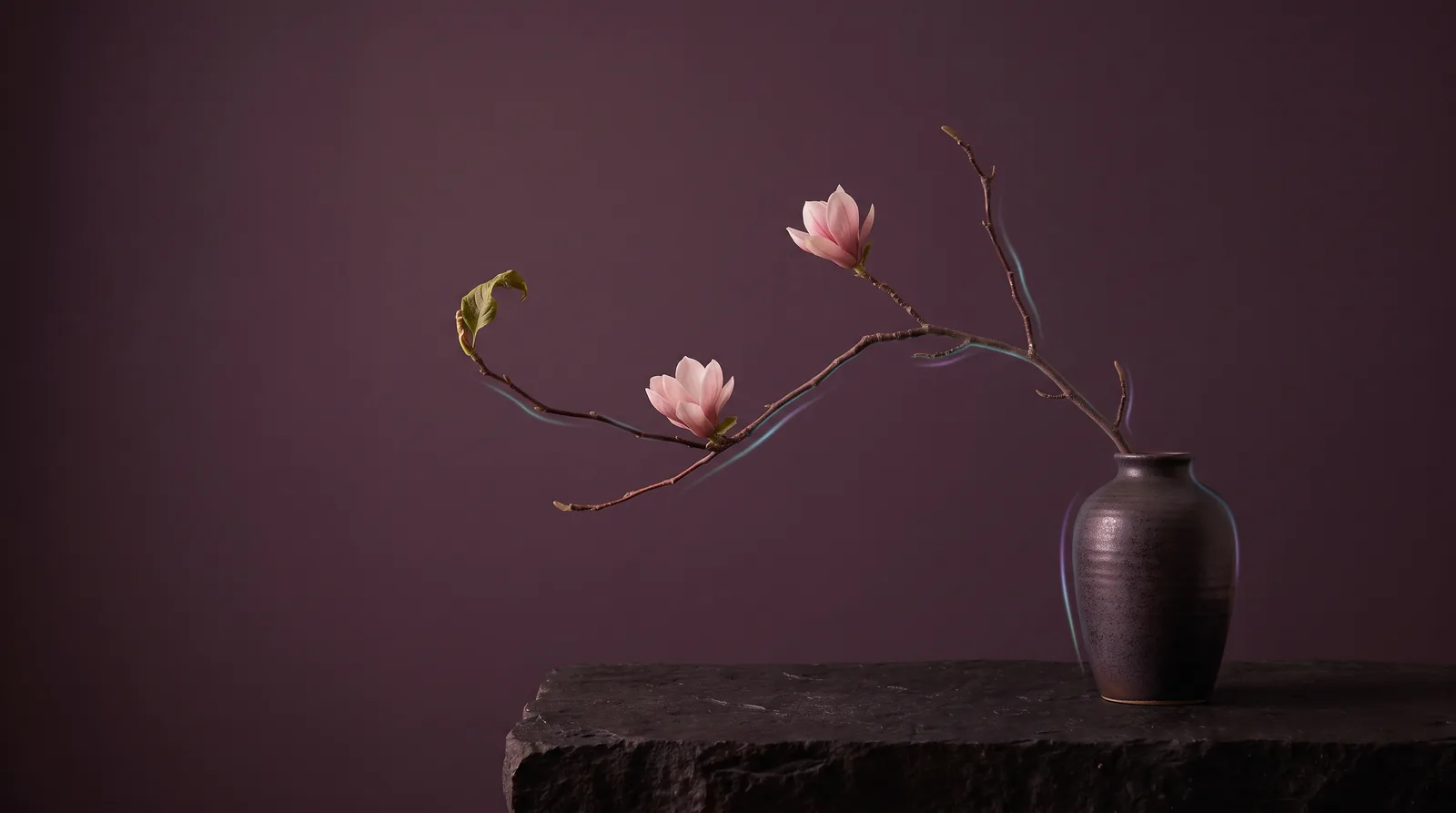
There is a story told in various forms in ikebana schools, and its furniture hardly matters because its lesson never changes. A student presents an arrangement of ten stems, generous and abundant, the way we are all taught that flowers should be. The teacher looks for a long moment, removes one stem, then another, and goes on removing until three remain: a branch, a leaf, a single bloom. Now, the teacher says, you can see the flower. The student has just met the central discovery of five centuries of Japanese floral art: that attention is a narrow vessel, and abundance overflows it. Where the Western bouquet asks how much beauty can be gathered into a vase, ikebana asks how little is needed before beauty becomes visible at all.
From altar offering to way of flowers
The practice began, as so many contemplative arts did, at an altar. Flowers accompanied Buddhist offerings in Japan from roughly the sixth century, when the tradition arrived from China and Korea, and for centuries they were arranged by temple priests as acts of devotion rather than decoration. The pivotal address is a small hexagonal temple in Kyoto called Rokkakudo, whose priests, the Ikenobo family line, began in the fifteenth century to codify how stems should stand: not crammed in a vessel but composed, with principles, proportions and meaning. From that codification grew the oldest school, Ikenobo, and eventually hundreds of others, including Ohara in the nineteenth century and the modernist Sogetsu in the twentieth. The art acquired the name kado, the way of flowers, placing it beside chado, the way of tea, and shodo, the way of writing: a do, a path, something practised for life rather than mastered for show.
The grammar of almost nothing
Classical arrangements are built on a triad of principal stems, commonly taught as shin, soe and tai and often glossed as heaven, human and earth: the tallest reaching upward, the middle leaning in accompaniment, the lowest grounding the whole. Around this scaffold, everything is asymmetry and interval. Ikebana composes not only with stems but with the space between them, the charged emptiness Japanese aesthetics calls ma, and a good arrangement is often described as mostly air. Season is grammar too: a spare winter branch is not a poor substitute for June's abundance but a subject in its own right, honoured precisely for its bareness. None of this is decoration in the Western sense. It is closer to drawing a breath in three strokes.
The Western bouquet asks how much beauty can fit in a vase. Ikebana asks how little is needed before beauty becomes visible.
Why it stills the mind
Traditional instruction is conducted largely in silence, and the silence is not etiquette but method. The practice occupies the hands with slow, consequential work: turning a branch to find its face, trimming a stem by a centimetre, placing it, stepping back, looking. Each decision is small, physical and reversible, which makes ikebana a near-perfect vehicle for single-pointed attention; the mind cannot compose an email while judging the angle of a camellia. And the material itself appears to help. In a series of experiments at Rutgers University, researchers found that receiving flowers reliably produced genuine, involuntary smiles in every woman studied, with lifts in mood still measurable days later; the authors argued flowers have earned a rare, direct purchase on human positive emotion (Haviland-Jones et al., 2005, Evolutionary Psychology). Ikebana takes that raw material and slows it down: not flowers glimpsed on a table but flowers attended to, stem by stem, for half an hour of wordless looking. The arrangement wilts within the week. Practitioners will tell you this is not a flaw but the final lesson: you were not building an object, you were practising a way of seeing.
One arrangement a week
Like tea ceremony or calligraphy, ikebana rewards rhythm more than intensity, and the most sustainable home version I know is a weekly appointment rather than a daily obligation. Tie it to something that already recurs: market day, Sunday morning, the changing of the bin liners if honesty demands it. Each week, one arrangement, made slowly, and a moment's attention to what the season is currently offering, which is a quiet education in itself; you begin to notice when the blossom turns to leaf, when the seed heads arrive, when the florist's buckets change their contents. Some practitioners keep a small diary, a line or a photograph per week, and find after a year that they have accidentally recorded not only fifty-two arrangements but the shape of the year and their own weather moving through it. The flowers were the excuse. The noticing was the practice.
Begin with one branch
You do not need a school, a kenzan or a lesson in Latin plant names to begin; you need one vessel, one branch and ten unhurried minutes. Walk your street or garden and cut, or buy, no more than three elements: perhaps a branch with a bend in it, one flower, one leaf. Before touching the vase, look at each: where it curves, where it faces, which side seems to be its front. Place the tallest first, let the second lean toward it, let the third sit low. Then step back and remove something, which is the step Western habits resist and the step that teaches most. Set the finished arrangement somewhere you will pass often, and let noticing it be part of the practice. On days when there are no flowers to be had, I confess I sometimes borrow the mood digitally: one of Feelsy's slow botanical textures drifting on autoplay while the kettle boils, petals and stems rearranging themselves with no scissors required. It is not ikebana. But it keeps the eye in training for the real thing: few stems, much space, and attention as the true material.
Feelsy is a wellness product, not medical advice. If stress, anxiety or sleep problems persist, please speak with a qualified professional.
References
- Haviland-Jones, J., Rosario, H. H., Wilson, P., & McGuire, T. R. (2005). An environmental approach to positive emotion: Flowers. Evolutionary Psychology, 3(1), 104-132.
Frequently Asked Questions
What is ikebana?
Ikebana is the Japanese art of flower arrangement, also called kado, the way of flowers. It grew from Buddhist altar offerings into a codified contemplative practice from the fifteenth century onward, beginning with the Ikenobo school at the Rokkakudo temple in Kyoto. Unlike a Western bouquet, it composes with very few stems and treats the empty space between them as part of the arrangement.
What do the three main stems in ikebana represent?
Classical arrangements are built on three principal stems, commonly taught as shin, soe and tai and often glossed as heaven, human and earth. The tallest reaches upward, the middle leans in accompaniment, and the lowest grounds the composition. Around this triad, ikebana works through asymmetry, seasonality and deliberate emptiness rather than abundance.
Why is ikebana considered a meditation?
Traditional practice is conducted largely in silence, and the work occupies the hands with slow, physical, reversible decisions: turning a branch, trimming a stem, placing it, stepping back. This makes it a natural vehicle for single-pointed attention, since the mind cannot wander far while judging the angle of a single stem. The arrangement's short life is part of the teaching: the practice is a way of seeing, not an object.
Do flowers actually improve your mood?
There is research suggesting they do. In experiments at Rutgers University, receiving flowers reliably produced genuine, involuntary smiles in every woman studied, with improvements in mood still measurable days later (Haviland-Jones et al., 2005). Ikebana slows that effect down, replacing a glance at a vase with half an hour of close attention to stems, angles and space.
How do I start ikebana at home without lessons?
Begin with one vessel and no more than three elements: a branch with a bend in it, one flower, one leaf. Look at each before placing it, set the tallest first, let the second lean toward it and the third sit low, then step back and remove something. Even a bare seasonal branch is a legitimate subject; few stems and much space is the whole grammar.

About the author
Contributing writer
Eleonor writes about contemplative traditions, attention and the cultural history of calm. She has spent two decades collecting the rituals humans use to slow down, from zazen halls to hammams, and translating them for modern, screen-lit lives.
Feel it for yourself.
Feelsy turns reading about calm into practising it. Two minutes of a slow texture is often the whole difference.


Related reading
 Ancient Wisdom
Wabi-Sabi: The Japanese Art of Finding Calm in Imperfection
What wabi-sabi really means: the Japanese aesthetic of imperfect, impermanent beauty, and how its quiet philosophy softens perfectionism and stress.
 Visual Meditation
Calligraphy as Meditation: Why Slow Writing Calms a Fast Mind
Why calligraphy calms a racing mind: the science of slow writing and attention, and how to practice mindful handwriting with any pen and ten quiet minutes.
 Ancient Wisdom
Bonsai and Penjing: The Slow Art of Growing Patience
Bonsai began as Chinese penjing: a landscape grown in a tray over decades. Why tending a miniature tree calms the mind, and how to begin without owning one.
 Ancient Wisdom
Döstädning: The Gentle Swedish Art of Death Cleaning
What Swedish death cleaning really means: the calm philosophy of döstädning, how it differs from ordinary decluttering, and how to begin at any age.
 Ancient Wisdom
How to Start a Gratitude Journal You Will Actually Keep
How to start a gratitude journal that actually helps: what the research found, why most lists go stale, and the very old art of counting blessings.
 Ancient Wisdom
Haiku as Meditation: Seventeen Syllables of Attention
How writing haiku trains attention: why the tiny form works like meditation, what noticing small moments does for wellbeing, and how to write your first.