Petrichor: Why Rain Smells So Good, and Why That Scent Settles the Mind
Petrichor is the earthy scent of rain on dry ground. Here is where the word comes from, the chemistry behind the smell, and why it feels like relief itself.
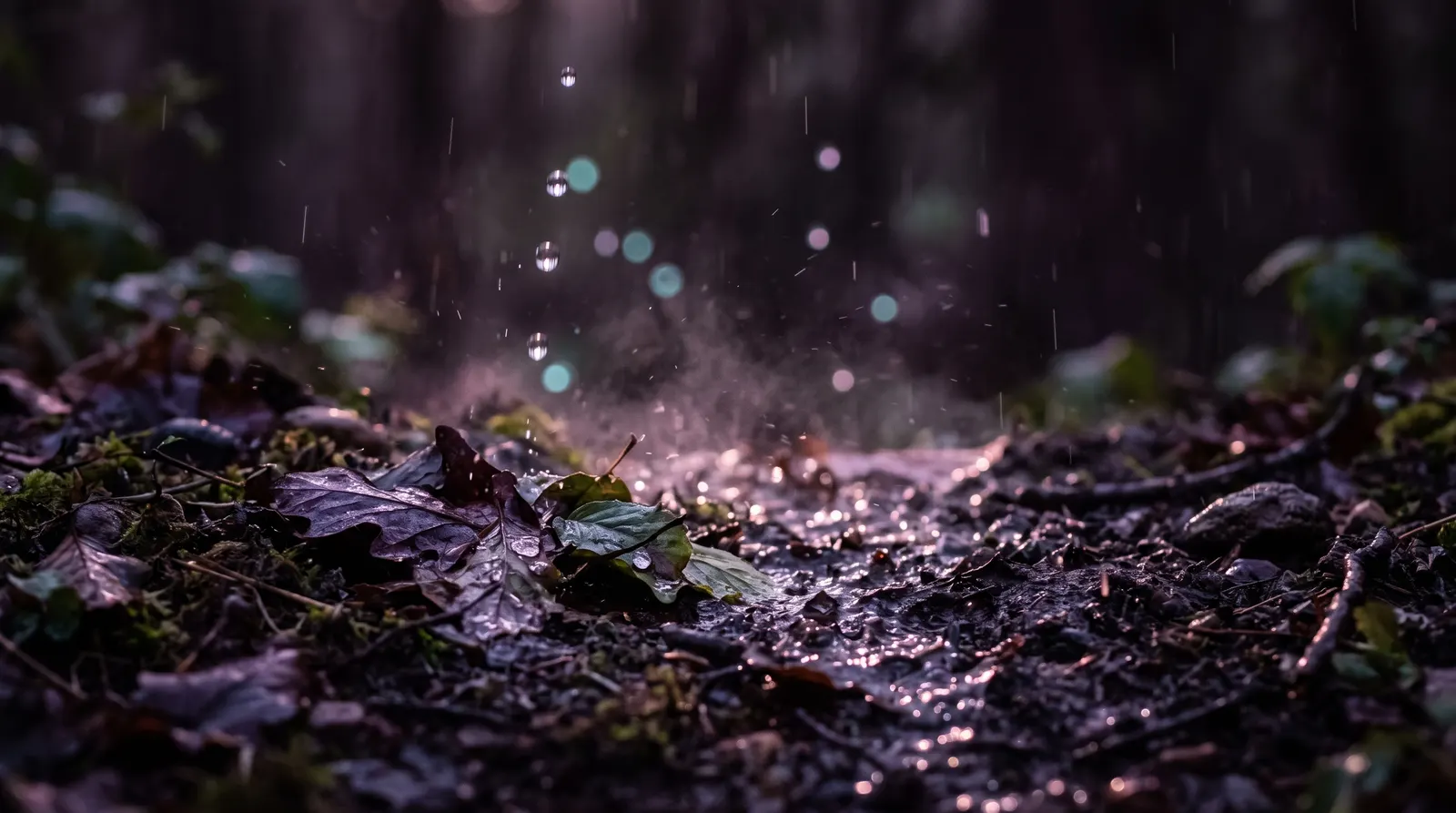
It arrives before the rain does, sometimes: that low, mineral, oddly sweet smell of a dry world about to be watered. Everyone knows it and nearly everyone loves it, which is a curious thing for a smell that is, at bottom, wet dust. It rises from summer pavements and parched gardens, from the first fat drops on a hot road, and for a minute or two it makes people stop mid-sentence and breathe in on purpose. English had no word for it at all until 1964, when two Australian scientists gave it one of the loveliest coinages in the language: petrichor, from the Greek petra, stone, and ichor, the fluid said to run in the veins of the gods. The blood of stone, released by rain.
The word coined in a laboratory
Petrichor began not as poetry but as mineralogy. Isabel Joy Bear and Richard Thomas, researchers at Australia's national science agency, were investigating a phenomenon perfumers in one Indian village had known about for generations: dry earth, baked through a hot season, holds a scent that can be extracted and bottled. In a paper in Nature they showed the smell was real chemistry rather than folklore. During dry spells, rocks and soils slowly absorb a film of oils shed by plants; when rain finally arrives, water displaces those trapped oils and their scent into the air, and the characteristic fragrance of rain on dry ground is released. They named it petrichor in the same paper (Bear and Thomas, 1964, Nature). It remains one of the few smells in the world with a precise scientific birthday.
Geosmin, the earth's signature
The scent is a chord rather than a single note, and its deepest tone is a molecule called geosmin, produced by bacteria that live in healthy soil. Geosmin means, literally, earth smell, and it is what it says: the dark, cellar-like base of the rain scent, the smell of turned garden beds and beetroot. What is remarkable is how attuned we are to it. The human nose can detect geosmin at vanishingly small concentrations, picking this one molecule of the earth out of the air the way a parent picks a child's voice out of a playground. Raindrops do the distribution work: striking porous ground, they trap tiny pockets of air and fling upward a fine aerosol of soil chemistry, which the breeze then delivers ahead of the weather. When the storm is still a street away and you can already smell it, that is the mechanism: the rain is sending its scent ahead of it like a calling card.
When the storm is still a street away and you can already smell it, the rain is sending its scent ahead of it like a calling card.
Why relief has a smell
Chemistry explains where the scent comes from; it does not quite explain why it feels the way it feels, that small unclenching, the involuntary deeper breath. Part of the answer is surely what petrichor announces. For nearly all of human history, rain after dry weather was unambiguous good news: the crops would drink, the dust would settle, the heat would break. A signal that reliable, encountered over that many generations, does not stay neutral; we respond to the smell of coming rain a little as we respond to the smell of baking bread, with a feeling older than any particular memory. And smell is the bluntest, most direct of the senses, wired closely to memory and emotion, which is why petrichor so often arrives towing a specific summer from decades ago behind it. The scent bypasses the committee of the thinking mind entirely and addresses the body directly, and the body's answer, almost always, is to slow down.
There is also the permission it carries. Like snowfall, arriving rain revises the immediate future: errands are postponed, windows are closed, plans soften. The first smell of it is the world announcing a pause before the pause begins, and something in us relaxes on the announcement alone.
It is worth pausing on how strange this is. We spend fortunes teaching ourselves to relax, and here is a scent, free and universal, that accomplishes in one breath what many apps and courses labour towards: a genuine interruption of hurry. Perfumers have chased it for a century, and dry-earth distillations are still made and sold, but the bottled version is a photograph of the thing rather than the thing. Petrichor's power seems bound up with its circumstances, the heat breaking, the light going pewter, the first cold drops on warm skin. It is less a fragrance than an event.
How to actually smell the rain
Petrichor rewards a little technique, mostly because it is brief. The scent is strongest in the first minutes of rain after a genuinely dry spell, when the ground has had time to accumulate its film of plant oils and the first drops are doing the releasing; a wet week smells of very little, which is why the scent feels rarer as autumn deepens. So the practice is one of readiness. When the sky darkens after dry days, go to a window on the weather side, or better, step out to a porch or doorway. Breathe through the nose, unhurried, and try naming what arrives: the mineral note of wet stone, the dark cellar note of the soil, the green note of leaves. Stay for the transition, scent fading as the rain settles in, and let the sound take over from the smell. Rain does this handover naturally; I sometimes recreate it indoors on dry evenings with Feelsy's rain textures and sounds, which supply the storm's second act, though its first, the scent itself, remains stubbornly and rather wonderfully unstreamable. Some pleasures still require weather.
Feelsy is a wellness product, not medical advice. If stress, anxiety or sleep problems persist, please speak with a qualified professional.
References
- Bear, I. J., & Thomas, R. G. (1964). Nature of argillaceous odour. Nature.
Frequently Asked Questions
What is petrichor?
Petrichor is the earthy scent released when rain falls on dry ground. The word was coined in 1964 by Australian scientists Isabel Joy Bear and Richard Thomas in the journal Nature, from the Greek petra, stone, and ichor, the fluid said to run in the veins of the gods.
What causes the smell of rain?
During dry spells, rocks and soil absorb a film of oils shed by plants; arriving rain displaces those oils and their scent into the air. The deepest note is geosmin, an earthy-smelling molecule made by soil bacteria, and raindrops striking porous ground fling it upward as a fine aerosol that the breeze can carry ahead of the weather.
Why can you smell rain before it arrives?
Raindrops falling on dry, porous ground trap tiny pockets of air and launch an aerosol of soil chemistry into the air. Wind then carries that scent ahead of the storm, so with the rain still a street away, its calling card has already reached your nose.
Why does the smell of rain feel so comforting?
For most of human history, rain after dry weather meant good news: crops watered, dust settled, heat broken. We seem to respond to that ancient signal with a feeling older than any particular memory, and because smell is wired closely to memory and emotion, petrichor often carries a specific remembered summer with it. It also announces a pause: errands postponed, windows closed, the day allowed to soften.
When is petrichor strongest?
In the first minutes of rain after a genuinely dry spell, when the ground has had time to accumulate plant oils and the first drops are releasing them. After days of steady rain the scent largely disappears, which is why the smell feels strongest and most precious after long dry weather.

About the author
Contributing writer
Eleonor writes about contemplative traditions, attention and the cultural history of calm. She has spent two decades collecting the rituals humans use to slow down, from zazen halls to hammams, and translating them for modern, screen-lit lives.
Feel it for yourself.
Feelsy turns reading about calm into practising it. Two minutes of a slow texture is often the whole difference.


Related reading
 ASMR
ASMRWhy the Sound of Rain Is So Calming (and So Good for Sleep)
Why rain sounds help you sleep: the acoustics of rainfall, what research says about natural sound and stress, and how to use rain well at bedtime.
 Ancient Wisdom
Why Incense Calms the Mind: The Slow Ritual of Scent and Smoke
Why incense calms the mind: the Chinese ritual of scent and rising smoke, what research suggests, and a simple incense meditation for focus or evening rest.
 Ancient Wisdom
Shinrin-Yoku: Why Forests Calm the Human Mind
Japan turned a walk in the woods into preventive medicine. The research behind forest bathing, what it does to stress physiology, and how to practise it without a forest.
 ASMRNew
Why Is Bob Ross So Relaxing? The Science of Happy Little Brushstrokes
Bob Ross has been putting people to sleep for four decades, and he'd take that as a compliment. Here's the science of why his painting videos work like ASMR.
 ASMRNew
What Is 8D Audio? The Science Behind the Spinning Sound
8D audio pans music around your head using binaural tricks. Here's how the illusion works, why it feels immersive, and whether it helps you relax or focus.
 ASMR
ASMRWhy Paint Mixing Videos Are So Satisfying
Why paint mixing videos feel so satisfying: the slow science of swirls and folds, what ASMR research suggests, and how to watch them as a mini meditation.