Why Incense Calms the Mind: The Slow Ritual of Scent and Smoke
Why incense calms the mind: the Chinese ritual of scent and rising smoke, what research suggests, and a simple incense meditation for focus or evening rest.
By Mei Lin
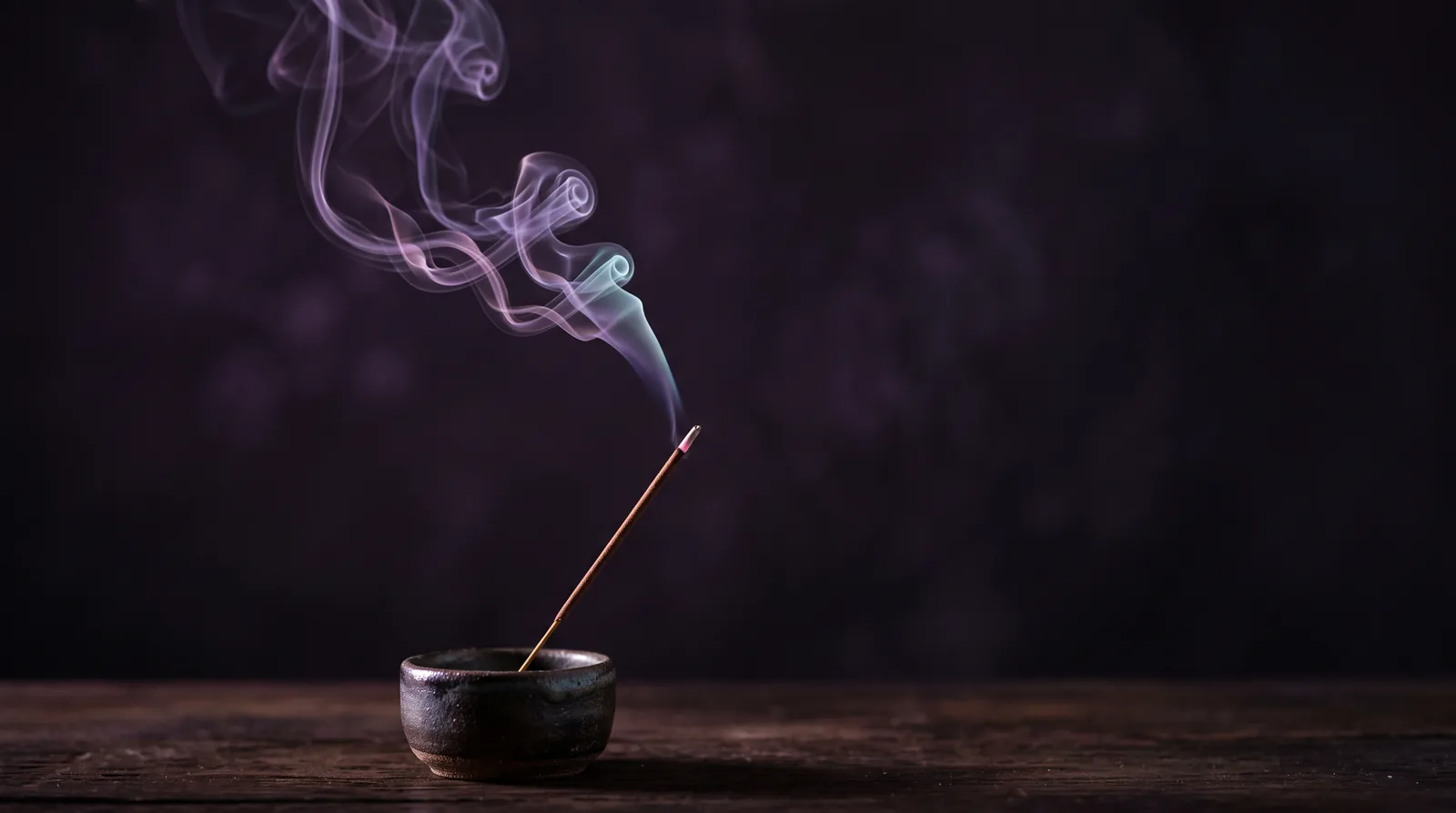
In Song dynasty China, nearly a thousand years ago, a cultivated person was expected to be practiced in four gentle arts: brewing tea, arranging flowers, hanging paintings, and burning incense. Not producing incense, or trading it. Burning it: choosing a fragrance to suit the hour, lighting it with attention, and then sitting with the thin gray thread of smoke as it rose and folded into the air. The practice was called xiangdao in its later, formalized forms, the way of fragrance, and it treated scent the way calligraphy treats a line: as something worth a whole person's attention. My grandmother kept a humbler version. One stick of sandalwood in the evening, lit without ceremony, and the apartment seemed to exhale. I used to think the incense changed the room. Now I think it changed us, and the room simply followed.
A clock made of scent
Before mechanical clocks reached daily life in East Asia, time was sometimes kept by incense itself. Incense clocks burned calibrated sticks or trails of powdered fragrance laid in patterns, and an hour was not a number on a dial but a length of scent: this stick, burned to here. Temples timed meditation sittings this way, and the habit survives informally wherever people still sit with a stick of incense. There is a quiet lesson in it. An incense stick is a visible, fragrant span of time, perhaps twenty or thirty minutes, that cannot be paused, hurried or scrolled. Lighting one is a way of saying: this much of the evening belongs to slowness. When the stick ends, the sitting ends. Until then, there is nothing to check, because the clock is the practice.
Why scent reaches so deep
Smell is the bluntest and most honest of the senses. It bypasses much of the brain's front office and speaks directly to older rooms, the ones that keep emotion and memory, which is why a single breath of sandalwood can return a childhood apartment more vividly than a photograph can. This is also why scent makes such an effective anchor for a ritual. Light the same incense each evening and the fragrance itself begins to carry the meaning: within a few weeks, the first curl of smoke tells the body what comes next, the way a lamp dimming tells a child it is nearly bedtime. Science has begun to peer inside the fragrance itself as well. Researchers studying incensole acetate, a component of frankincense resin, found that it activated newly characterized channels in the brain and produced anxiolytic-like and antidepressive-like effects in mice (Moussaieff et al., 2008, The FASEB Journal). One animal study is a hint, not a promise, and I hold it lightly. But it is a lovely thought that the resins people have burned in contemplative settings for thousands of years may not have been chosen at random.
An incense stick is a visible, fragrant span of time that cannot be paused, hurried or scrolled.
A simple incense meditation
- Choose one fragrance and keep it for this purpose only: sandalwood and aloeswood are the classical choices, but any scent you love will learn the job.
- Light the stick with attention. Watch the ember catch, wave out the flame, and take one slow breath before you sit down. This is the threshold.
- Sit where you can see the smoke against a plain background. Let your eyes rest on the rising ribbon: its twists, its hesitations, the way it folds when the air moves.
- When thoughts pull you away, return through the nose: notice the scent again, then the smoke again. Scent, smoke, breath. That is the whole loop.
- End when the stick ends. Sit for one further breath in the scented quiet before you stand up.
Smoke, honestly
A practice built on attention should be honest about its material, and the material here is smoke. Burn incense in a ventilated room, not a sealed one; choose well-made sticks with simple ingredients rather than heavily perfumed novelties; and treat it as a ritual measured in one stick, not an atmosphere maintained for hours. If smoke does not suit your lungs or your household, the ritual survives the substitution: an electric warmer releases fragrance from wood or resin without burning, and a drop of essential oil warmed in water carries the same anchoring scent. The smoke-watching, which is its own quiet pleasure, has bloodless understudies too. I keep one of Feelsy's ink-drift textures for hotel rooms and smoke-free apartments: the same slow curling motion, the same invitation to watch something rise and fold, with nothing to ventilate afterwards.
The evening exhale
What the four arts of the Song scholar had in common was not refinement for its own sake. Tea, flowers, paintings, incense: each takes a small span of ordinary time and asks you to inhabit it completely. Of the four, incense may be the most forgiving. It requires no skill, no equipment beyond a holder and a match, and no more strength than an evening usually has left. Light the stick, sit down, watch the smoke write its slow calligraphy in the air, and let the scent tell your body what my grandmother's sandalwood told hers: the day is ending, the room is safe, and for the length of one burning stick, nothing further is required of you.
Feelsy is a wellness product, not medical advice. If stress, anxiety or sleep problems persist, please speak with a qualified professional.
References
- Moussaieff, A., Rimmerman, N., Bregman, T., Straiker, A., Felder, C. C., Shoham, S., et al. (2008). Incensole acetate, an incense component, elicits psychoactivity by activating TRPV3 channels in the brain. The FASEB Journal, 22(8), 3024-3034.
Frequently Asked Questions
Why does incense calm the mind?
Several threads braid together. Smell speaks directly to the brain's older regions for emotion and memory, so a familiar fragrance can settle the body quickly, and lighting the same incense each evening turns the scent into a cue that tells you what comes next. The stick is also a fixed span of time, around twenty to thirty minutes, that cannot be paused or hurried, and watching the smoke rise gives the eyes something slow to rest on.
Is incense meditation religious?
It does not have to be. Incense has a long history in temples, but in Song dynasty China burning incense was also one of the four gentle arts of a cultivated household, alongside tea, flowers and paintings, and incense clocks were simply a way of keeping time. The practice described here is secular: light a stick, watch the smoke, follow the scent, and end when the stick ends.
What does science say about incense?
Research is early but intriguing. Scientists studying incensole acetate, a component of frankincense resin, found it activated specific channels in the brain and produced anxiety-reducing and antidepressant-like effects in mice (Moussaieff et al., 2008). That is one animal study, a hint rather than a promise, but it suggests the resins burned in contemplative settings for millennia may not have been chosen at random.
How do I meditate with incense?
Keep one fragrance just for this ritual, light it with attention, and sit where you can see the smoke against a plain background. Let your eyes rest on the rising ribbon, and when thoughts pull you away, return through the nose: scent, then smoke, then breath. The stick is your timer; end when it ends, and sit for one more breath in the scented quiet.
Is burning incense safe indoors?
Treat the smoke honestly: burn incense in a ventilated room rather than a sealed one, choose well-made sticks with simple ingredients, and measure the ritual in one stick rather than keeping smoke going for hours. If smoke does not suit your lungs or household, an electric warmer or a drop of essential oil in warm water carries the same anchoring scent without burning anything.

About the author
Contributing writer
Mei grew up in Shanghai around tea that could not be hurried and grandmothers who considered stillness a skill. She writes about slow hands and sensory ritual: tea, calligraphy, qigong, and the quiet crafts that taught the world how to pay attention.
Feel it for yourself.
Feelsy turns reading about calm into practising it. Two minutes of a slow texture is often the whole difference.


Related reading
 Ancient Wisdom
Tea Meditation: The Slow Ritual of Gongfu Cha
How to turn tea into meditation: the Chinese gongfu tea ritual, why warm slow ritual calms the nervous system, and a ten-minute practice for any mug.
 Ancient Wisdom
Trataka: The Original Visual Meditation
Centuries before screens, yogis rested their gaze on a single candle flame. How trataka works, how to practise it safely, and what it teaches modern visual meditation.
 Visual Meditation
Shan Shui: Why Misty Mountain Paintings Quiet the Mind
Why Chinese landscape painting calms the mind: what shan shui is, the psychology of mist and negative space, and how to look at a painting as meditation.
 Ancient Wisdom
Döstädning: The Gentle Swedish Art of Death Cleaning
What Swedish death cleaning really means: the calm philosophy of döstädning, how it differs from ordinary decluttering, and how to begin at any age.
 Ancient Wisdom
How to Start a Gratitude Journal You Will Actually Keep
How to start a gratitude journal that actually helps: what the research found, why most lists go stale, and the very old art of counting blessings.
 Ancient Wisdom
Haiku as Meditation: Seventeen Syllables of Attention
How writing haiku trains attention: why the tiny form works like meditation, what noticing small moments does for wellbeing, and how to write your first.