Pottery as Meditation: Why Wet Clay Quiets a Busy Mind
Why pottery is so relaxing: what studies say about clay and anxiety, what the wheel teaches about attention, and how to begin without a studio.
By Mei Lin
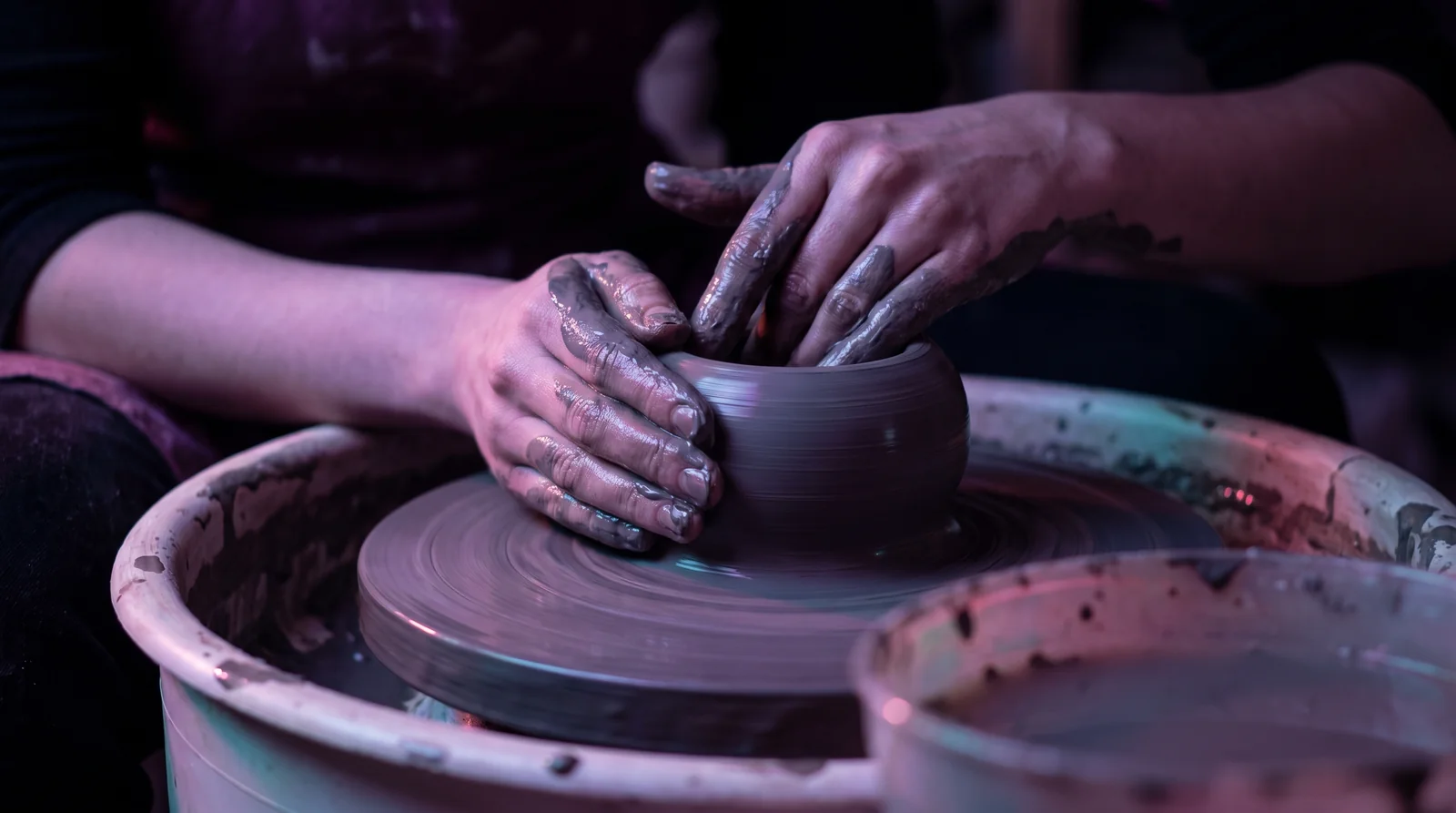
My grandmother's teapot was small, unglazed, the color of a chestnut, made in Yixing, where the clay is so prized that potters speak of it the way vintners speak of soil. The potter who made it is long gone, but the marks of his fingers are still in the walls of it, faint ripples under the thumb, and when I hold it I am holding the last hour of attention he gave it. I thought of that teapot the first time I sat at a pottery wheel and understood, within one revolution, why every potter I have ever met has quiet hands. Clay is an honest teacher. It keeps a record of exactly how present you were.
The wheel tells the truth
The first lesson at the wheel is centering, and it is humbling. A lump of clay spinning off-center wobbles, and the wobble travels up your arms and into your shoulders, and the harder you grip, the worse it becomes. Clay amplifies whatever your body brings to it. Tension in, wobble out. To center the clay you must first center yourself: elbows braced, breath low, pressure applied evenly and patiently from both hands at once. Experienced potters say you cannot muscle clay into center, you can only invite it, and they are right in a way that transfers to nearly everything. The wheel is a biofeedback machine that happens to produce bowls.
Clay does not reward force. It rewards attention, applied gently, for longer than you expected.
What the studies found
The calming effect of clay is folk knowledge in every pottery town, but it has also been measured. In a 2012 randomized controlled trial published in Art Therapy, Kimport and Robbins had adults work with clay after a mood induction; those who spent the time freely forming clay showed greater reductions in negative mood than those given a stress ball to squeeze, and structured handling of the material outperformed rote squeezing. In 2017, a randomized trial by Nan and Ho published in the Journal of Affective Disorders went further, testing a course of clay art therapy with adults being treated for depression; the clay group showed greater improvements in mood and wellbeing than the control group. These are small trials, and pottery class is not a treatment. But the direction of the evidence agrees with the potters: hands in clay, mind settles.
Why hands quiet the head
Clay speaks to the hands in a vocabulary the mind cannot ignore: temperature, moisture, resistance, the exact pressure at which a wall thins or a rim trues. Attending to that stream of touch leaves little room for the other stream, the one made of replayed conversations and rehearsed tomorrows. This is the same door that kneading dough opens, and grinding ink, and the slow rinsing of tea leaves: the crafts of patience all work by giving attention a physical anchor that responds to you. Clay may be the most demanding anchor of them all, because it answers every lapse. Drift for a moment and the wall goes uneven; a distracted hand is recorded in the object. The practice is simply returning, revolution after revolution, to what the fingers are feeling now.
A beginning without a wheel
- Buy a small block of air-dry clay; no kiln, no studio, no commitment beyond a covered table.
- Sit with a bowl of warm water, wet your hands, and knead the clay slowly until it softens, noticing temperature and give.
- Make a pinch pot: open the ball with one thumb, then thin the walls with slow, even presses, turning the pot a little after each one.
- Let the small flaws stand. An even rhythm matters more than an even rim; the pot is a record of the sitting, not a product.
Twenty minutes of this is a complete practice. The pot at the end is optional evidence.
The pot you keep
My grandmother said a teapot is finished by use, not by the kiln: years of tea season the clay, and the pot becomes a diary of every quiet hour spent with it. I think the same is true in the other direction. The hours spent making a pot season the person. On evenings when there is no clay within reach, I open Feelsy and let a slow texture answer my fingertips instead, the same conversation in a different material; the hands lead, and the mind, eventually, follows. But when the real thing is available, take it. Wet clay, warm water, a turning wheel or just two patient thumbs: it is one of the oldest ways humans have found to pour a restless mind into a pair of hands and receive it back, some time later, smoother.
Feelsy is a wellness product, not medical advice. If stress, anxiety or sleep problems persist, please speak with a qualified professional.
References
- Kimport, E. R., & Robbins, S. J. (2012). Efficacy of creative clay work for reducing negative mood: A randomized controlled trial. Art Therapy, 29(2), 74-79.
- Nan, J. K. M., & Ho, R. T. H. (2017). Effects of clay art therapy on adults outpatients with major depressive disorder: A randomized controlled trial. Journal of Affective Disorders, 217, 237-245.
Frequently Asked Questions
Why is pottery so relaxing?
Clay gives attention a physical anchor that responds to everything you do: temperature, moisture, and resistance change under your hands moment by moment. Following that stream of touch leaves little room for looping thoughts. At the wheel the effect is stronger still, because centering clay requires a centered, unhurried body first.
Is there evidence that working with clay helps anxiety or low mood?
Small trials point that way. A 2012 randomized controlled trial found adults who formed clay showed greater reductions in negative mood than those squeezing a stress ball, and a 2017 randomized trial found clay art therapy improved mood and wellbeing in adults treated for depression more than a control activity. Pottery is not a treatment, but the evidence agrees with the folk wisdom.
Do I need a pottery wheel to start?
No. A block of air-dry clay, a bowl of warm water, and a covered table are enough. Kneading the clay slowly and making a simple pinch pot, thinning the walls with even presses while turning it, gives you the full calming effect of the material without a kiln, a studio, or a class.
What kind of clay should a beginner use at home?
Air-dry clay is the simplest: it needs no firing, cleans up with water, and stays workable long enough for slow, attentive sessions. Keep it covered between sittings so it doesn't stiffen. The goal at the start is time with the material, not durable pottery, so inexpensive clay is entirely adequate.
How long does a clay session need to be?
About twenty minutes of slow, attentive handling is a complete practice. What matters is the quality of attention, an even rhythm and a soft grip, rather than the length of the sitting or whether the piece you make is worth keeping.

About the author
Contributing writer
Mei grew up in Shanghai around tea that could not be hurried and grandmothers who considered stillness a skill. She writes about slow hands and sensory ritual: tea, calligraphy, qigong, and the quiet crafts that taught the world how to pay attention.
Feel it for yourself.
Feelsy turns reading about calm into practising it. Two minutes of a slow texture is often the whole difference.


Related reading
 Breath & Body
Kneading Dough: Why Baking Bread Quiets the Mind
Baking as therapy is real: kneading dough gives restless hands rhythm, warmth and patience. Why bread calms the mind, plus a simple kneading meditation.
 Visual Meditation
Calligraphy as Meditation: Why Slow Writing Calms a Fast Mind
Why calligraphy calms a racing mind: the science of slow writing and attention, and how to practice mindful handwriting with any pen and ten quiet minutes.
 Ancient Wisdom
Tea Meditation: The Slow Ritual of Gongfu Cha
How to turn tea into meditation: the Chinese gongfu tea ritual, why warm slow ritual calms the nervous system, and a ten-minute practice for any mug.
 Breath & BodyNew
Do Cold Showers Actually Work? A Skeptic Reads the Evidence
Cold showers are pitched as a cure for everything from low energy to weak character. Here's what the actual research says, and how to try one without the cult.
 Breath & BodyNew
Dopamine Detox: What It Gets Right and What It Gets Wrong
Dopamine detox promises a factory reset for your distracted brain. Here's what the neuroscience actually says, what helps, and what's just rebranded boredom.
 Breath & Body
How to Stop Overthinking: Quieting a Mind That Will Not Move On
Why overthinking loops and how to interrupt it: what rumination research shows, why you cannot argue with a spiral, and gentler ways to change the channel.