What Is a Sound Bath? Bathing the Nervous System in Tone
What is a sound bath and what does it actually do? The history of singing bowls and gongs, what research suggests, and how to try one at home tonight.
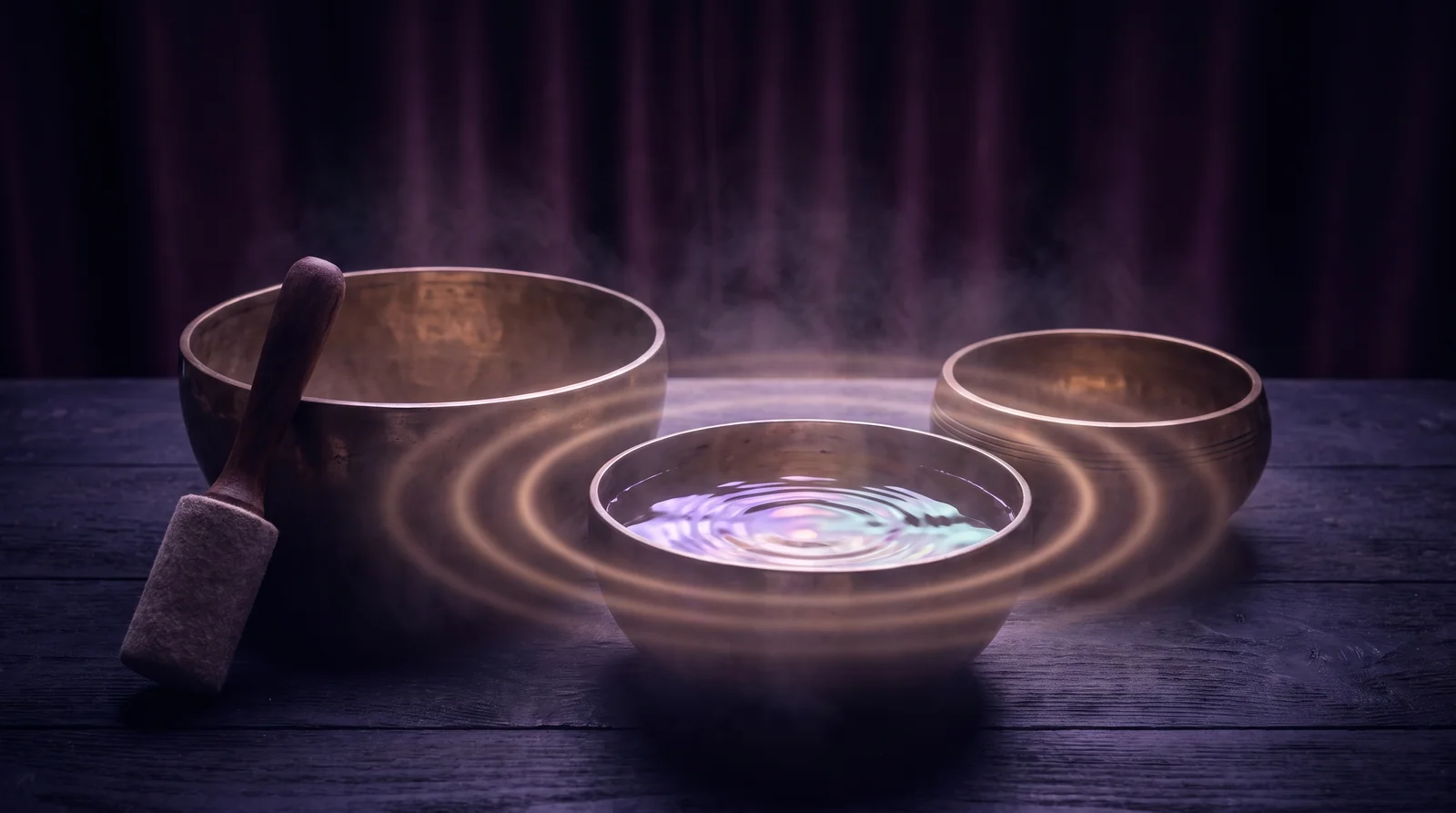
The name promises water and delivers none, and yet nobody who has been to a sound bath finds it misleading. You lie on a mat, usually blanketed, always shoeless, while a practitioner moves among bowls and gongs and chimes, and for the better part of an hour, sound washes over you in slow, overlapping waves. There is nothing to follow, nothing to achieve and nothing to understand. That is precisely the appeal. In a culture where even rest has become a performance, the sound bath asks only that you lie still and be rinsed.
If you have searched for what a sound bath actually is, whether it does anything, and how to try one without booking a studio, this is the territory. The short answers: it is a listening practice, the calm is real even where the mysticism is negotiable, and your own bedroom will do.
What happens at a sound bath
A typical session lasts forty five minutes to an hour. Participants lie on their backs, the lights go low, and the practitioner begins, most often with Himalayan metal bowls struck softly or circled with a mallet until they hum. Crystal bowls, gongs, chimes and the occasional drum join in layers. The tones are long and overlapping, rich in overtones, and deliberately unhurried; there is no melody to anticipate and no rhythm to entrain to. Without a tune to follow, the listening mind gradually stops leaning forward. Many people drift into the borderland between waking and sleep, the same threshold state that yoga nidra cultivates on purpose.
The instruments matter less than the quality of the sound: continuous, resonant, slightly unpredictable and entirely without demand. It is the acoustic equivalent of watching slow water. Nothing addresses you. Nothing requires an answer.
An old inheritance, loosely worn
Sound as a doorway to stillness is not a modern invention. Metal bowls have been part of Himalayan and East Asian ritual life for centuries, where their voices marked the beginnings and endings of meditation; gongs have opened ceremonies across Asia for far longer; bells have called European villages to prayer since the early Middle Ages. The contemporary sound bath, assembled in studios over the last few decades, borrows freely from all of these. It is fair to say the modern form is a remix rather than an unbroken lineage, and the honest practitioner will tell you as much. What is genuinely old is the underlying discovery: that long, resonant tones make it strangely easy for a mind to put itself down.
It is the acoustic equivalent of watching slow water. Nothing addresses you. Nothing requires an answer.
What the research modestly suggests
The scientific literature on sound baths is small and imperfect, and it deserves to be reported that way. The most cited study followed sixty two adults through singing bowl meditations and measured mood before and after: tension, anger, fatigue and depressed mood all fell significantly, with the largest effect on tension, and participants new to the practice showed some of the biggest shifts (Goldsby et al., 2017, Journal of Evidence-Based Complementary and Alternative Medicine). The study had no control group, so it cannot tell us how much was the bowls and how much was an hour of enforced lying down, which is itself no small medicine.
A sceptic would note, correctly, that claims about particular frequencies healing particular organs run far ahead of any evidence. A fair reading is gentler and still encouraging: slow resonant sound, received lying down with the eyes closed, reliably helps most nervous systems downshift. You need not believe anything about vibrations beyond what a cello has already taught you.
Sound baths and ASMR: cousins, not twins
Readers of this journal will notice the family resemblance. ASMR and the sound bath both use sound that is intimate, unhurried and free of demand, and both can deliver a state of deep, pleasant calm. But they work on different scales. ASMR whispers; a gong fills the room. ASMR triggers are small, close and personal, producing tingles in those wired for them, while a sound bath is immersive and impersonal, producing something closer to floating. Many people who feel no ASMR tingles at all respond strongly to resonant sound, which is worth knowing if the whisper videos have never worked on you. The two practices are neighbouring doors into the same quiet house.
How to take a sound bath at home
You do not need a studio, a practitioner or a single brass object. You need forty minutes, a floor, a blanket and something resonant to listen to. Recordings of singing bowls and gongs are abundant; choose one at least half an hour long so you are never waiting for an ending, set the volume lower than feels impressive, and lie down properly, on your back, arms loose, as if you meant it. Let the sound be the room's weather rather than a broadcast aimed at you. If the mind insists on working, give the eyes something equally slow first: in Feelsy, a drifting texture with its soundscape in autoplay mode makes a fine overture, and when the eyes close, the sound simply carries on alone.
Treat it as bathing rather than surgery: something you do regularly because it is pleasant, not a procedure awaiting results. Once a week is a lovely rhythm. The evening after a loud day is the classic occasion. And if you fall asleep on the floor before the recording ends, you have merely proved the method.
Feelsy is a wellness product, not medical advice. If stress, anxiety or sleep problems persist, please speak with a qualified professional.
References
- Goldsby, T. L., Goldsby, M. E., McWalters, M., & Mills, P. J. (2017). Effects of Singing Bowl Sound Meditation on Mood, Tension, and Well-being: An Observational Study. Journal of Evidence-Based Complementary and Alternative Medicine, 22(3), 401-406.
Frequently Asked Questions
What actually happens at a sound bath?
Participants lie on their backs, usually blanketed and shoeless, while a practitioner plays Himalayan metal bowls, crystal bowls, gongs, chimes, and sometimes drums in long, overlapping, unhurried tones. There's no melody to follow and no rhythm to keep, which lets the listening mind stop leaning forward and often drift toward the borderland between waking and sleep.
Does research support sound baths actually working?
A study following sixty two adults through singing bowl meditations found that tension, anger, fatigue, and depressed mood all fell significantly afterward, with the largest effect on tension. However, the study had no control group, so it can't separate the effect of the bowls from simply lying down and resting for an hour.
Is a sound bath the same as ASMR?
They're related but not identical. ASMR uses intimate, close, personal triggers that can produce tingles in people wired for the response, while a sound bath is immersive and impersonal, producing something closer to floating. Many people who feel no ASMR tingles at all still respond strongly to resonant sound.
Can you do a sound bath at home without any equipment?
Yes, all you need is forty minutes, a floor, a blanket, and a recording of singing bowls or gongs at least half an hour long. Set the volume lower than feels impressive, lie down properly on your back with arms loose, and let the sound be like weather in the room rather than something demanding your attention.

About the author
Contributing writer
Eleonor writes about contemplative traditions, attention and the cultural history of calm. She has spent two decades collecting the rituals humans use to slow down, from zazen halls to hammams, and translating them for modern, screen-lit lives.
Feel it for yourself.
Feelsy turns reading about calm into practising it. Two minutes of a slow texture is often the whole difference.


Related reading
 ASMR
ASMRASMR, Explained: What Science Says About the Tingles
ASMR is more than a trend. Here is what the tingles are, who feels them, and what studies have measured about their effects on heart rate, mood and calm.
 Sleep
SleepWhite Noise for Sleep: What Works and What Does Not
White, pink and brown noise all promise better sleep. Here is what the evidence actually supports, how to choose, and how to set up sound for a quieter night.
 Ancient Wisdom
Ancient Practices for Modern Calm: A World Tour
Humans have engineered calm for thousands of years. A tour through Zen, pranayama, hammam culture, forest bathing and the ancestors of visual meditation.
 ASMRNew
Why Is Bob Ross So Relaxing? The Science of Happy Little Brushstrokes
Bob Ross has been putting people to sleep for four decades, and he'd take that as a compliment. Here's the science of why his painting videos work like ASMR.
 ASMRNew
What Is 8D Audio? The Science Behind the Spinning Sound
8D audio pans music around your head using binaural tricks. Here's how the illusion works, why it feels immersive, and whether it helps you relax or focus.
 ASMR
ASMRWhy Paint Mixing Videos Are So Satisfying
Why paint mixing videos feel so satisfying: the slow science of swirls and folds, what ASMR research suggests, and how to watch them as a mini meditation.