Microsleep: When Your Brain Clocks Out Without Asking
Microsleeps are 1 to 15 second blackouts a sleep-starved brain takes by force. What causes them, why they're dangerous on the road, and the only real fix.
By Kurt Woleret
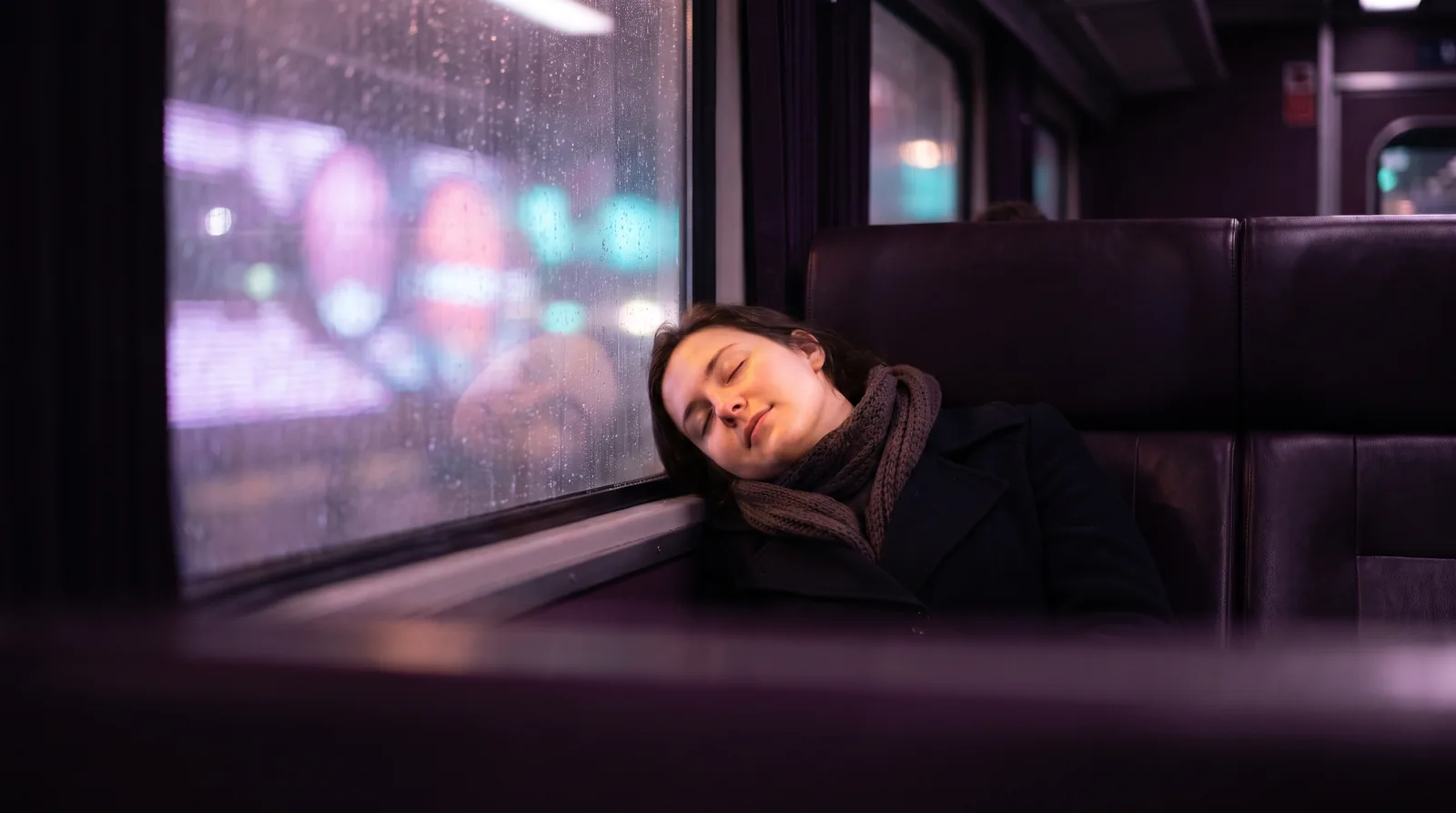
You know the head bob. Third stop on the morning train, warm car, and a stranger across from you dips, snaps upright, checks if anyone saw, dips again. That's not low battery or weak character. That's a brain taking sleep by force, a few seconds at a time, and it has a name: microsleep.
What a microsleep actually is
A microsleep is a brief episode, typically from half a second to about fifteen seconds, in which your brain slips into sleep-like activity and simply stops responding. Eyelids droop or close slowly, responses vanish, and then you're back, often with no memory that you left. The unsettling part: for the shorter ones, your eyes can be open. Nobody in the room, including you, necessarily knows it happened.
Researchers have watched this live. In one study, people performed a 50-minute visuomotor tracking task inside an fMRI scanner while cameras monitored their eyes. Frequent microsleeps showed up even though participants were normally rested, and the scans showed thalamic activity dropping during episodes while frontal regions activated, apparently fighting to restore responsiveness (Poudel et al., 2014, Human Brain Mapping). Your brain isn't quietly fading. It's losing a tug of war it refuses to stop fighting.
Why boring tasks are the trigger
Microsleeps love monotony: highway driving, long meetings, late-night spreadsheet work, any task that's continuous but understimulating. The sleep pressure was already there; the boring task just stops masking it. That's why you can feel fine walking around and then lose the fight four minutes into a quiet conference call.
A microsleep isn't your brain fading out. It's your brain losing a tug of war it will not stop fighting.
The driving problem
Here's where I stop being funny. At highway speed, a four-second microsleep is more than a football field traveled with nobody at the wheel. Drowsy-driving crashes are frequently exactly this mechanism: not falling asleep for an hour, but blinking out for a few seconds at the wrong moment. If you catch yourself drifting between lanes, missing exits, or unable to account for the last stretch of road, that's not a sign to turn up the radio. That's a sign to pull over. Twenty minutes parked is an inconvenience. The alternative isn't.
Signs you're having them
- Head nods you only catch on the way back up.
- Re-reading the same sentence three times with nothing sticking.
- Gaps: a highway exit, a paragraph, thirty seconds of a conversation you can't account for.
- Slow, heavy blinks where reopening your eyes takes actual effort.
The only real fix, plus the stopgaps
I'd love to sell you a trick, but microsleep is a symptom of exactly one thing: your brain needs sleep it isn't getting. The fix is sleep. Everything else is a stopgap. The respectable stopgaps: a 20-minute nap, which directly pays down pressure; caffeine, which takes roughly 20 to 30 minutes to land and masks pressure without removing it; movement and bright light, worth a short reprieve. Use them to get somewhere safe to sleep, not to stretch a 19-hour day to 21.
The durable fix is upstream and unglamorous: enough hours, kept regularly. If your nights run short because your brain won't power down on schedule, that part is solvable, and it's the one place I'll point at tools. A fifteen-minute wind-down, dim light, a slow Feelsy texture on autoplay, long exhales with the 4-7-8 exercise. Not because an app replaces sleep. Nothing replaces sleep. But a wind-down that gets you to bed on time, nightly, is how you stop negotiating with the tug of war in the first place.
Respect the head bob. It's the most honest feedback your body gives you all day.
Feelsy is a wellness product, not medical advice. If stress, anxiety or sleep problems persist, please speak with a qualified professional.
References
- Poudel, G. R., Innes, C. R. H., Bones, P. J., Watts, R., & Jones, R. D. (2014). Losing the struggle to stay awake: Divergent thalamic and cortical activity during microsleeps. Human Brain Mapping, 35(1), 257-269.
Frequently Asked Questions
What is a microsleep?
A microsleep is a brief episode, typically from half a second to about fifteen seconds, in which the brain slips into sleep-like activity and stops responding to the world. Eyelids droop or close slowly, responses vanish, and the person often has no memory the lapse happened. In fMRI research, thalamic activity drops during microsleeps while frontal regions activate, apparently trying to restore responsiveness.
Can microsleeps happen with your eyes open?
Yes, especially the shorter ones. The defining feature is a lapse in responsiveness, not closed eyes, which is why microsleeps can pass unnoticed by everyone in the room, including the person having them. Telltale signs are head nods, heavy slow blinks, and small gaps in memory, like a paragraph you read with nothing sticking.
How dangerous is microsleep while driving?
Very. At highway speed, a four-second lapse means traveling more than a football field with nobody effectively at the wheel, and drowsy-driving crashes often involve exactly this kind of brief blackout rather than fully falling asleep. Drifting between lanes, missing exits or being unable to recall the last stretch of road are signals to pull over and rest, not to turn up the radio.
How do I stop microsleeping?
The only real fix is sleep, because microsleep is a symptom of sleep pressure your brain is no longer willing to postpone. A 20-minute nap pays down some pressure directly, and caffeine can mask it for a while after the 20 to 30 minutes it takes to kick in, but these are stopgaps for getting somewhere safe. The durable answer is enough hours, kept on a regular schedule, supported by a consistent wind-down.

About the author
Contributing writer
Kurt is a New York based writer covering the practical science of stress, sleep and focus. He is the resident sceptic of the Journal: if a technique cannot survive a crowded subway commute and a deadline week, he is not interested in it.
Feel it for yourself.
Feelsy turns reading about calm into practising it. Two minutes of a slow texture is often the whole difference.


Related reading
 Sleep
Sleep Inertia: Why You Wake Up Groggy (and How to Shake It Faster)
That heavy fog after waking has a name: sleep inertia. Here's why mornings feel broken, what the research says, and how to clear your head faster.
 Sleep
How to Fall Asleep Faster: Sound, Light and Ritual
Falling asleep is a skill, not a stroke of luck. Here is how sound, light and a 15-minute ritual can quiet a racing mind and shorten the trip to sleep.
 Breath & Body
The 4-7-8 Breathing Technique, Step by Step
A focused walkthrough of the 4-7-8 breath: what it is, how to do it, why the long exhale calms you, and when to use it during the day and before sleep.
 Sleep
How to Lucid Dream (and Whether It's Worth It)
Lucid dreaming is learnable, over-marketed, and genuinely interesting. What research says actually works, what's hype, and how to try it without wrecking sleep.
 Sleep
Do Sunrise Alarm Clocks Actually Work?
Sunrise alarm clocks promise gentler mornings by faking the dawn. Here's what the research says about light alarms, cortisol and waking up groggy.
 Sleep
Sleepmaxxing: What Actually Works and What's Just Content
Sleepmaxxing is everywhere: mouth tape, kiwis, trackers, red light. Here's which sleep optimization habits hold up and which are just good video.