How to Fall Asleep Faster: Sound, Light and Ritual
Falling asleep is a skill, not a stroke of luck. Here is how sound, light and a 15-minute ritual can quiet a racing mind and shorten the trip to sleep.
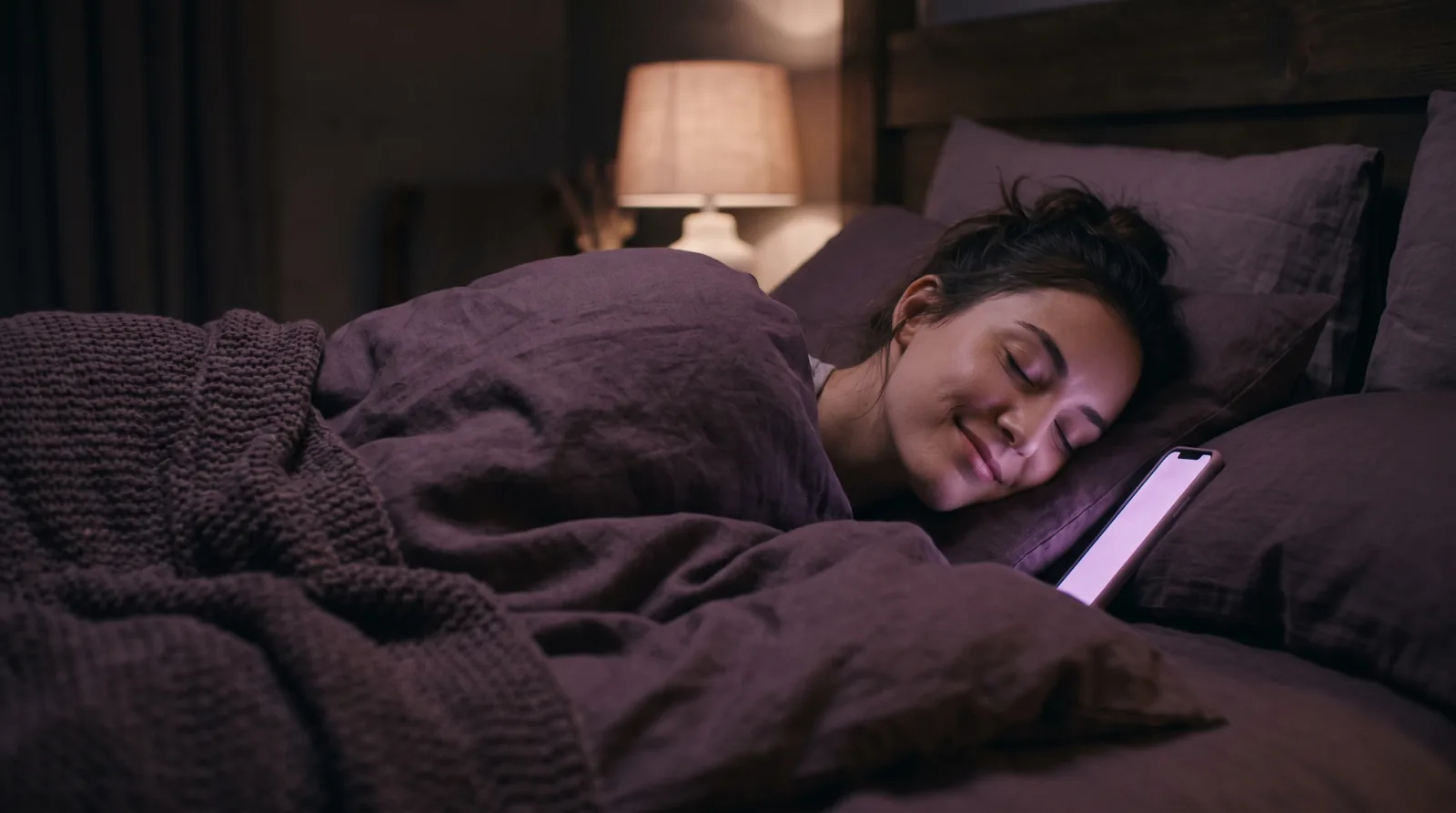
You know the shape of it. You get into bed tired. You close your eyes. Instead of sleep, you get a small parade of unfinished thoughts, tomorrow's meetings, a mildly awkward message from three months ago, and the specific worry that you are not falling asleep. An hour later you are more awake than when you started.
Falling asleep is often treated as luck. It is really a skill, and a very learnable one. The trick is that most of the work happens before your head touches the pillow, and it depends on three things you can actually control: sound, light, and ritual.
Why minds race at night
During the day, your mind has a job: keep you functional. It filters, plans, and tracks a hundred small threads. In the evening, when the external demands drop away, those threads do not vanish. They surface. The mental noise you notice in bed is often the same noise your day was covering up.
This is not a character flaw. It is a nervous system that has not been given a clean signal to switch tasks. Falling asleep faster is largely about sending that signal, on purpose, every night.
Sound as a sleep aid: what the evidence says
There is now a large, if imperfect, body of research on using continuous sound to help sleep. A systematic review examined studies on continuous noise, including white noise, and concluded that although the evidence is mixed and the study quality varies, sound-based interventions can reduce sleep onset latency, particularly in environments with intrusive background noise or for people prone to racing thoughts (Riedy et al., 2020, Sleep Medicine Reviews).
The two mechanisms that come up most often are masking (external noises like traffic or a neighbour's television are smoothed into a steady background so they stop startling your brain awake) and anchoring (a predictable sound gives an active mind something to rest on so it stops generating stories).
You do not need to buy anything special. A fan works. So does rain, a distant thunderstorm, a soft ASMR loop, or any of the sleep sounds and sleepcasts inside a well-designed sleep app. For a deeper look at the different colours of noise, see our guide to white noise for sleep.
Falling asleep is not luck. It is a signal you send to your nervous system, every night, on purpose.
Light, honestly
You have already heard the strict version of this advice: no screens after nine, complete darkness, never look at your phone in bed. The strict version is easier to preach than practise, and pretending otherwise makes people give up on the whole idea.
A more honest version:
- The problem is rarely the screen. It is what is on the screen. Fifteen minutes of doomscrolling is a physiological alarm. Fifteen minutes of a slow, dim visual with your notifications off is closer to candlelight.
- Dim overhead lights well before bed. Warm bedside lamps beat bright ceiling bulbs by a wide margin.
- If you must use a phone or tablet, drop the brightness as low as you can still read, switch to warm colour, and pick content that soothes rather than stimulates.
- Total darkness is ideal, but not always possible. An eye mask is a small purchase with an outsized effect.
The goal is not moral purity about screens. The goal is to lower stimulation in the hour before sleep, whatever the source.
A 15-minute wind-down ritual
The most reliable thing you can do for sleep is a small, repeatable ritual. Ritual is not woo. It is a shortcut: after a few weeks, the sequence itself starts to make you sleepy, because your body has learned what comes next.
Here is a simple template. Adjust freely, but keep the order.
- Minute 1 to 3. Physical reset. Brush teeth, wash face, put phone on charger across the room. If a task keeps coming to mind, write it on a piece of paper and leave it for the morning.
- Minute 4 to 8. Sensory downshift. Dim the room. Start a soft continuous sound (rain, brown noise, a slow ASMR loop). Get into bed.
- Minute 9 to 12. Breath. Do two rounds of the 4-7-8 breathing technique, or four minutes of extended-exhale breathing. Let your eyes rest on a soft, slow visual if you like.
- Minute 13 to 15. Let go. Stop trying to sleep. Just keep the sound, keep the breath long, and let attention drift wherever it wants.
That is the whole ritual. If sleep has not arrived by the end of it, that is fine. You have still lowered your heart rate, quieted your mind, and made the next hour easier.
Sleepcasts and narrated rest
For a certain kind of racing mind, the missing ingredient is a voice. Not a loud voice with content, but a slow, soft narration that gives the mind a low-stakes place to follow. This is where sleepcasts and guided rest sessions shine. They are close cousins to the ancient practice of Yoga Nidra, which uses a guided body scan to move the practitioner into deep rest without falling into unconscious sleep.
If you find that breath alone leaves your mind free to wander back to your worry list, try a narrated session. The voice takes the seat your worry was sitting in.
Consistency beats perfection
The single biggest lever for sleep is the least glamorous: a roughly consistent bedtime, a roughly consistent wake time, and a small ritual you actually do. Perfect sleep hygiene once a week loses to imperfect sleep hygiene six nights out of seven.
One more note. If you are lying in bed anxious about not sleeping, get up. Sit in dim light. Do the wind-down again. Go back when you are sleepy. Your bed is for sleeping. Do not train your body to associate it with frustration.
Feelsy is a wellness product, not medical advice. If stress, anxiety or sleep problems persist, please speak with a qualified professional.
References
- Riedy, S. M., Smith, M. G., Rocha, S., & Basner, M. (2020). Noise as a sleep aid: A systematic review. Sleep Medicine Reviews, 55, 101385.
Frequently Asked Questions
Why does my mind race when I try to fall asleep?
During the day your mind filters, plans and tracks many threads to keep you functional, and in the evening when external demands drop away those threads surface instead of vanishing. This is not a character flaw, it is a nervous system that has not been given a clean signal to switch tasks, so falling asleep faster is largely about sending that signal on purpose every night.
Does sound actually help you fall asleep faster?
A systematic review by Riedy and colleagues in 2020 found that although the evidence is mixed, sound-based interventions can reduce sleep onset latency, particularly in noisy environments or for people prone to racing thoughts. Sound helps through two mechanisms, masking sudden noises like a car door or a creak, and anchoring an active mind on a predictable texture so it stops generating stories.
How should I handle light and screens before bed?
The problem is rarely the screen itself but what is on it, since doomscrolling is a physiological alarm while a slow, dim visual with notifications off is closer to candlelight. Dim overhead lights well before bed, favour warm bedside lamps over bright ceiling bulbs, drop screen brightness as low as you can still read, and consider an eye mask if full darkness is not possible.
What does a good wind-down ritual look like?
A simple fifteen-minute template starts with a physical reset like brushing teeth and charging your phone away from the bed, then a sensory downshift with dimmed lights and soft continuous sound, then breathwork such as two rounds of the 4-7-8 technique, and finally letting go of trying to sleep while keeping the sound and slow breath going. Doing this consistently, even imperfectly, lowers your heart rate and quiets your mind even if sleep does not arrive immediately.
What should I do if I am lying awake anxious about not sleeping?
Get up, sit in dim light, and repeat the wind-down ritual, then go back to bed once you feel sleepy again. The idea is to avoid training your body to associate the bed itself with frustration, since the single biggest lever for sleep is a roughly consistent bedtime and wake time paired with a small ritual you actually do most nights.

About the author
Contributing writer
Eleonor writes about contemplative traditions, attention and the cultural history of calm. She has spent two decades collecting the rituals humans use to slow down, from zazen halls to hammams, and translating them for modern, screen-lit lives.
Feel it for yourself.
Feelsy turns reading about calm into practising it. Two minutes of a slow texture is often the whole difference.


Related reading
 Sleep
SleepWhite Noise for Sleep: What Works and What Does Not
White, pink and brown noise all promise better sleep. Here is what the evidence actually supports, how to choose, and how to set up sound for a quieter night.
 Ancient Wisdom
Yoga Nidra: A Guide to Conscious Rest
Yoga Nidra is one of the oldest and most forgiving relaxation practices. Here is what it is, why it works, and how to try your first 20-minute session.
 Breath & Body
Breathing Exercises for Anxiety: From Pranayama to 4-7-8
Breath is the remote control of your nervous system. Here is what slow breathing does, three techniques with steps, and when not to force it.
 SleepNew
Night Owl vs Early Bird: The Science of Chronotypes
Night owl or early bird isn't a personality flaw or a virtue. It's a chronotype. Here's what the science says about your body clock and how to work with it.
 SleepNew
How to Wake Up Early (Without Hating Your Life)
Want to become a morning person? Here's how to wake up early using light, timing and consistency, based on what circadian science actually shows.
 Sleep
SleepCan't Sleep? Why Getting Out of Bed Is the Counterintuitive Fix
Lying awake trying harder is the one thing that makes insomnia worse. Here's the 20-minute rule, the science of stimulus control, and how to use it.