Why a Cat's Purr Is So Calming (and So Easy to Fall Asleep To)
A cat's purr soothes like almost nothing else: a low, steady rumble of safety. Here is what a purr actually is, and why the sound helps humans relax and sleep.
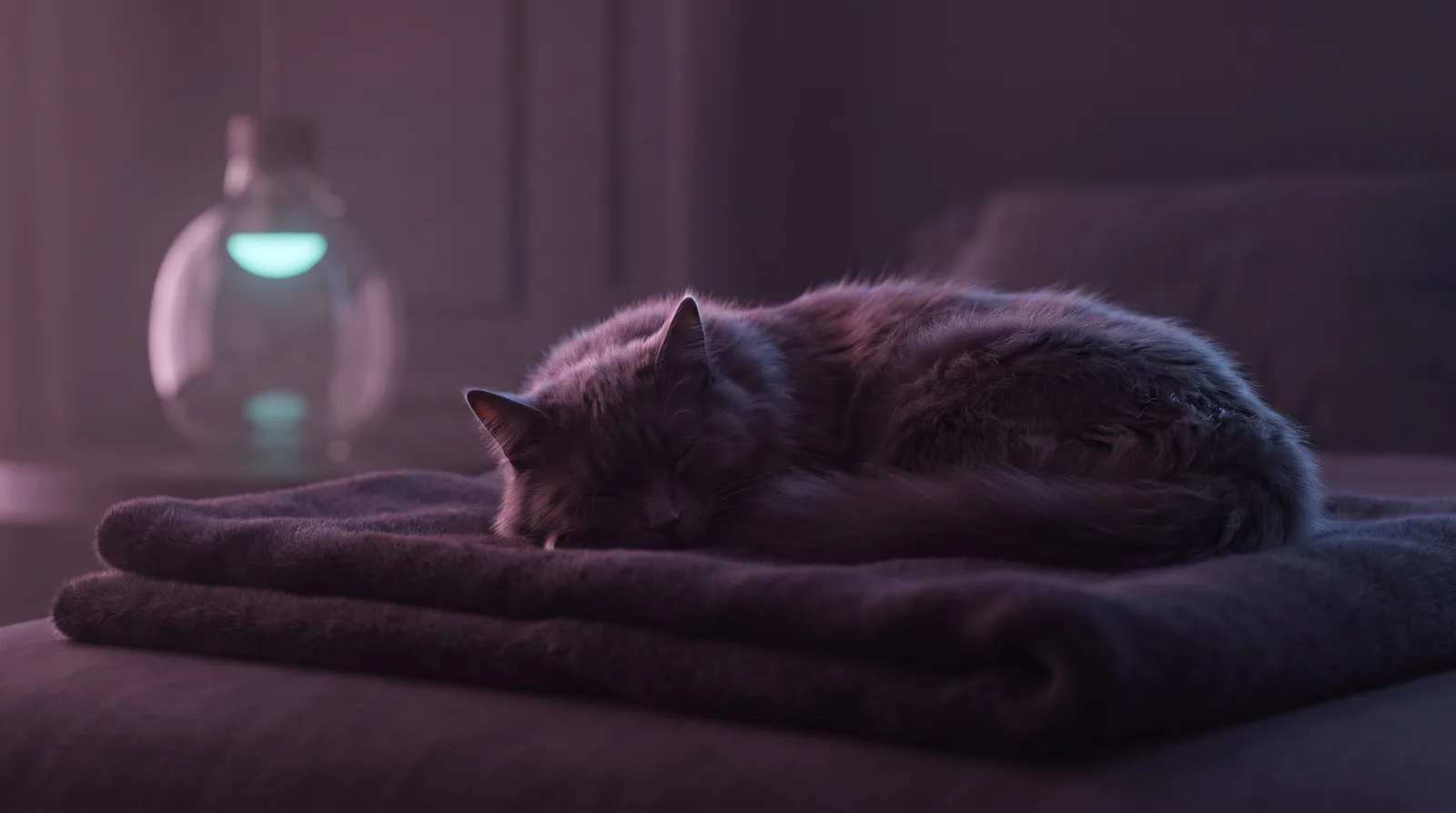
Of all the sounds an animal makes, the cat's purr is the only one I can think of that humans routinely fall asleep to on purpose. We do not drift off to birdsong at close range, and nobody seeks out a dog mid-bark as a bedtime companion. But a purring cat on the duvet is widely regarded as one of the finest sleep aids ever domesticated. The interesting question is why this particular sound, a rough little motor no louder than a whisper, should reach so deep into the human nervous system.
What a purr actually is
A purr is not a voice in the ordinary sense. Cats produce it by rhythmically tensing the muscles of the larynx as they breathe, so the sound runs continuously on both the in-breath and the out-breath, a feat no cry or meow can manage. The result is less like a note and more like a texture: a low, granular oscillation felt as much as heard, typically rumbling away in the low tens of hertz, down where sound begins to shade into touch.
Curiously, the purr has long puzzled biologists because cats do not only purr when content. They purr when injured, when frightened, when giving birth. One much-discussed acoustic analysis measured purring across several species of cat and noted that the dominant frequencies fall in ranges that have elsewhere been studied in connection with tissue and bone response to vibration, leading its author to ask whether the purr might serve some restorative function for the cat itself (von Muggenthaler, 2001, Journal of the Acoustical Society of America). That remains a hypothesis rather than a settled fact, and we should hold it lightly. But it reframes the purr beautifully: perhaps it is not a smile in sound, but something closer to a cat's way of resting deliberately.
The sound of nothing being wrong
Whatever the purr does for the cat, its effect on the human listener is easier to describe. The purr is a safety broadcast. It is produced only at close range, only in stillness, and it stops the instant the cat startles. Over thousands of years of sharing rooms with cats, the sound has become an honest signal that this small, hyper-vigilant predator, equipped with far better hearing than ours, has surveyed the situation and elected to switch off. When the sentry sleeps, the village relaxes.
The acoustics cooperate. A purr is low-pitched, unbroken and almost perfectly predictable, the same properties that make rain, distant thunder and brown noise such reliable relaxers. Sharp, irregular, information-bearing sounds are what the brain sits up for; the purr is their opposite, a sound that reassures precisely because it never changes its mind. Add the physical element, the faint vibration of a warm animal against your ribs, and you have something close to a weighted blanket that loves you back.
When the sentry sleeps, the village relaxes. A purr is the sound of the watch standing down.
Purring as unintentional ASMR
It will not surprise anyone who browses ASMR channels that cat purring has a devoted audience there. The purr sits neatly among the great unintentional triggers: it is quiet, close, textured and utterly without performance. Like the hum of a fan or pages turning in a library, it rewards the kind of soft, sideways listening in which attention finally puts its bags down. Some listeners report the classic tingles; many more simply report that their breathing slows to match the rhythm, which is its own small mercy at midnight.
The rhythm matters more than we usually notice. A purr rises and falls with the cat's breathing, a tide of perhaps twenty unhurried cycles a minute, and human breath has a well-known habit of falling in with rhythms slower than its own. This is the same quiet entrainment that makes us breathe with the swell of ocean waves or the pulse of a slow visual. The cat, in other words, is not merely broadcasting safety; it is conducting. Lie still long enough with a purring animal on your chest and you will find your own breath has signed up to its tempo without consulting you.
If you have no cat to hand
The obvious remedy is borrowed sound. Recordings of purring loop gracefully, and low granular textures do much of the same work: brown noise, soft rain, a fan. In Feelsy we tend to reach for the deeper, rounder soundscapes for exactly this reason, paired with something slow for the eyes, a texture kneading itself over and over like a cat settling into a blanket. Put the two together with autoplay on and the screen dim, and you have a fair approximation of the animal, minus the four a.m. demand for breakfast.
There is one thing the recording cannot supply, of course, which is the vote of confidence. A real purr says: I have checked, and it is safe here. Perhaps the deepest reason the sound calms us is that we believe it. Trust, it turns out, has a frequency, and it is low, steady and slightly furry.
Feelsy is a wellness product, not medical advice. If stress, anxiety or sleep problems persist, please speak with a qualified professional.
References
- von Muggenthaler, E. (2001). The felid purr: A healing mechanism? Journal of the Acoustical Society of America, 110(5), 2666.
Frequently Asked Questions
Why is a cat's purr so relaxing to humans?
A purr is a safety broadcast: it is produced only at close range, in stillness, and it stops the moment the cat startles, so we have learned to read it as an honest signal that a highly vigilant animal has decided nothing is wrong. Acoustically it is low, unbroken and predictable, the same properties that make rain and brown noise relaxing, and the faint vibration of a warm animal adds a physical layer of comfort.
What actually is a purr?
Cats purr by rhythmically tensing the muscles of the larynx as they breathe, so the sound runs continuously on both the in-breath and the out-breath, unlike a meow or cry. The result is a low, granular oscillation felt as much as heard, rumbling in the low tens of hertz where sound begins to shade into touch.
Do cats only purr when they are happy?
No, and this is one of the purr's oldest puzzles. Cats also purr when injured, frightened or giving birth. One acoustic analysis noted that purr frequencies fall in ranges studied elsewhere in connection with tissue and bone response to vibration, and asked whether purring might serve some restorative function for the cat itself. That remains a hypothesis, but it suggests the purr may be less a smile in sound than a way of resting deliberately.
Can purring sounds help you sleep if you have no cat?
Recordings of purring loop well, and sounds with similar properties do much of the same work: brown noise, soft rain, or a fan all offer the same low, steady predictability. Pairing a deep, round soundscape with something slow for the eyes and the screen kept dim approximates the effect, though without the living animal's vote of confidence.

About the author
Contributing writer
Eleonor writes about contemplative traditions, attention and the cultural history of calm. She has spent two decades collecting the rituals humans use to slow down, from zazen halls to hammams, and translating them for modern, screen-lit lives.
Feel it for yourself.
Feelsy turns reading about calm into practising it. Two minutes of a slow texture is often the whole difference.


Related reading
 ASMR
ASMRWhy the Sound of Rain Is So Calming (and So Good for Sleep)
Why rain sounds help you sleep: the acoustics of rainfall, what research says about natural sound and stress, and how to use rain well at bedtime.
 ASMR
ASMRASMR, Explained: What Science Says About the Tingles
ASMR is more than a trend. Here is what the tingles are, who feels them, and what studies have measured about their effects on heart rate, mood and calm.
 Sleep
SleepDo Weighted Blankets Actually Work? What the Research Says
Weighted blankets promise calmer nights through deep pressure. Here's what the best clinical trial actually found, who benefits most, and how to pick one.
 ASMRNew
Why Is Bob Ross So Relaxing? The Science of Happy Little Brushstrokes
Bob Ross has been putting people to sleep for four decades, and he'd take that as a compliment. Here's the science of why his painting videos work like ASMR.
 ASMRNew
What Is 8D Audio? The Science Behind the Spinning Sound
8D audio pans music around your head using binaural tricks. Here's how the illusion works, why it feels immersive, and whether it helps you relax or focus.
 ASMR
ASMRWhy Paint Mixing Videos Are So Satisfying
Why paint mixing videos feel so satisfying: the slow science of swirls and folds, what ASMR research suggests, and how to watch them as a mini meditation.