Why Clutter Stresses You Out (It's Not a Character Flaw)
Visual clutter makes your brain work harder and keeps stress chemistry simmering. Why messy rooms drain you, and the small fixes that don't need minimalism.
By Kurt Woleret
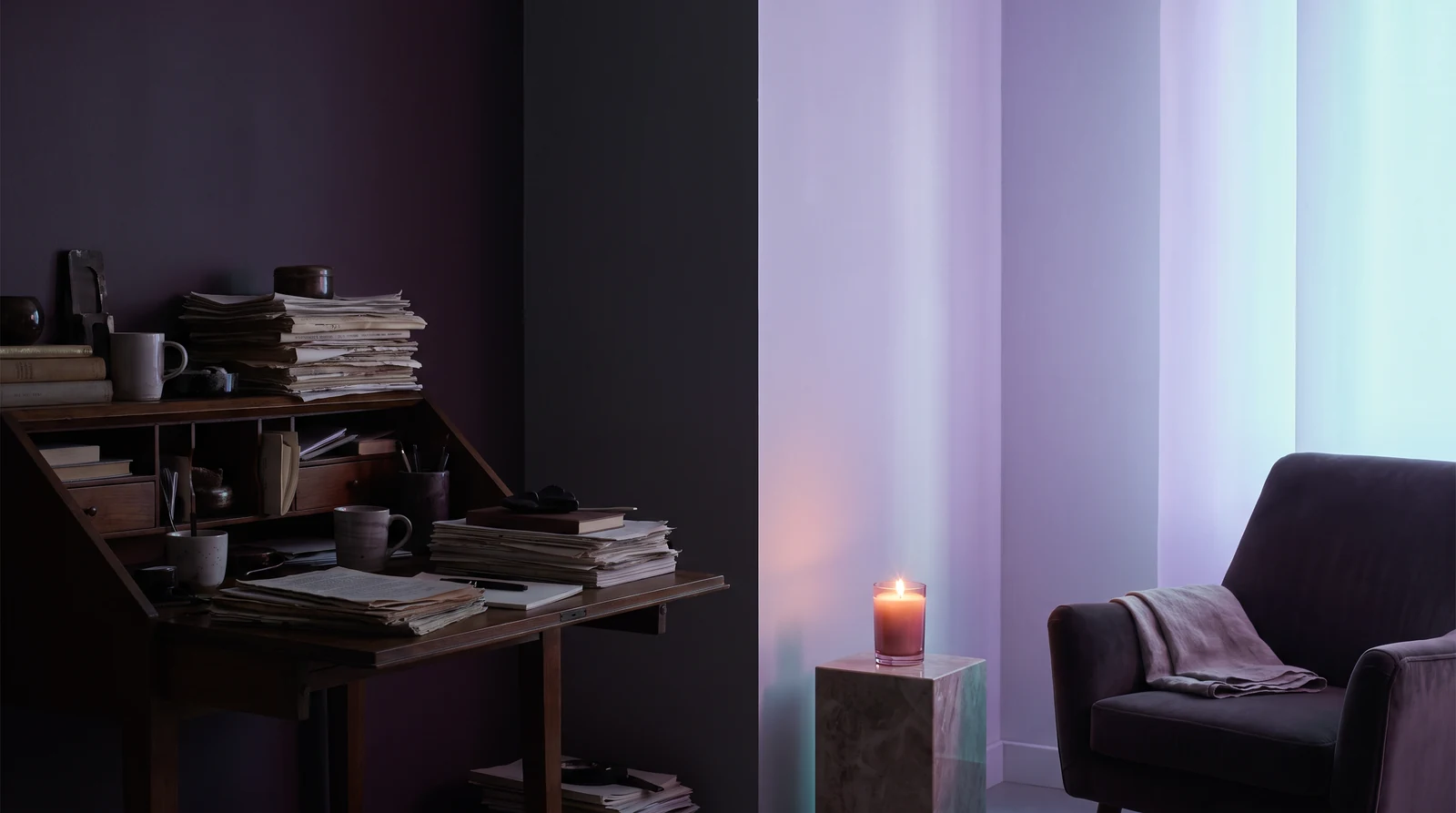
I live in a New York apartment, which means my kitchen is also my office, my bookshelf is also my pantry overflow, and every flat surface is in a constant state of negotiation. So when I say clutter stresses you out, I'm not preaching from some sun-drenched minimalist loft. I'm reporting from the field. And the field is covered in mail I haven't opened.
Here's the thing I didn't expect when I went looking at the research: the stress isn't a moral feeling. It's not guilt about being messy, or at least it's not only that. Visual clutter taxes the brain at the level of raw perception, before any opinions get involved. Your visual system has a budget, clutter spends it, and you pay the bill as that low-grade fried feeling at the end of a day spent in a chaotic room.
Your visual cortex has a budget
The mechanics are surprisingly blunt. Neuroscientists at Princeton used fMRI to watch what happens in the visual cortex when multiple objects appear in view at once, and the short version is: they fight. Objects presented together suppress each other's neural representation, competing for limited processing resources, and the more stuff in view, the more suppression (McMains & Kastner, 2011, Journal of Neuroscience). Attention is the referee. When you focus on one thing, your brain has to actively dampen its response to everything else in the visual field. A cluttered room means the referee never stops working.
That's why a messy desk makes focus feel like pushing a cart with a stuck wheel. Every object in your peripheral vision, the mug, the cables, the pile of receipts, is a tiny bid for attention that your brain has to keep declining, over and over, all day. No single rejection costs much. Thousands of them add up to a tax you can feel but can't name.
Every object in view is a tiny bid for your attention. A cluttered room makes thousands of them, all day, and your brain pays for each no.
The cortisol part
It goes beyond attention. In a study out of UCLA, researchers followed couples through home tours and tracked their stress hormones across the day. Women who described their homes with more words about clutter and unfinished projects showed flatter, less healthy daily cortisol slopes, the pattern associated with chronic stress, while those who described their homes as restful showed healthier declines (Saxbe & Repetti, 2010, Personality and Social Psychology Bulletin). Correlation, yes, and self-description matters as much as square footage of mess. But it fits the lived experience: a home that reads as an unfinished to-do list never lets you fully clock out.
That's the real injury. Clutter isn't just visually loud, it's semantically loud. The pile of laundry isn't an object, it's a task. The stack of papers is six tasks. A cluttered room is a wall of open browser tabs rendered in physical space, and your brain treats it accordingly.
Why 'just tidy up' is bad advice
The standard prescription is a full declutter, and sure, if you have a free weekend and the executive function of a Navy quartermaster, go nuts. But the all-or-nothing framing is exactly why most people do nothing. The research doesn't say your whole home must be minimalist. It says visual load in your field of view matters. That's a much smaller, much more winnable game: you don't need a tidy apartment, you need a calm rectangle to look at.
- Clear one surface completely, ideally the one in front of you when you work. A single visually quiet zone gives your attention somewhere to rest.
- Point your desk at the calmest view available, even if that's a blank wall. A blank wall is a feature, not a failure.
- Use closed storage over open shelves where you can. A box of chaos reads as one object. A shelf of chaos reads as forty.
- Try a ten-minute nightly reset instead of a weekend overhaul. You're not cleaning, you're lowering tomorrow's visual noise floor.
Give your eyes one quiet thing
There's a flip side to all this, and it's the part I actually find useful on deadline weeks when the apartment entropy wins. If visual chaos taxes the brain, visual simplicity refunds some of the tax. It's the same reason people stare at fish tanks, fireplaces, and the window of a moving train: one slow, coherent thing to watch, no bids for attention, referee finally off duty. I keep Feelsy around for this exact purpose. When the room is a lost cause at 9pm, five minutes watching one slow slime texture move, with nothing else in the frame, works like a visual palate cleanser. It doesn't fold the laundry. But it reliably turns down the static so the laundry stops yelling.
So no, you're not weak because the mess gets to you. You're wired like everyone else: finite visual budget, automatic competition, stress chemistry that reads your home like a status report. Shrink the field of view, quiet one corner, and give your eyes a single thing to rest on. The apartment can be a work in progress. Your nervous system just needs one rectangle that isn't.
Feelsy is a wellness product, not medical advice. If stress, anxiety or sleep problems persist, please speak with a qualified professional.
References
- McMains, S., & Kastner, S. (2011). Interactions of top-down and bottom-up mechanisms in human visual cortex. Journal of Neuroscience, 31(2), 587–597.
- Saxbe, D. E., & Repetti, R. (2010). No place like home: Home tours correlate with daily patterns of mood and cortisol. Personality and Social Psychology Bulletin, 36(1), 71–81.
Frequently Asked Questions
Why does clutter cause anxiety?
Two reasons. Perceptually, every visible object competes for limited processing resources in your visual cortex, so a cluttered room forces your brain to constantly suppress distractions, which is tiring. Semantically, clutter reads as unfinished tasks: a pile of papers isn't one object, it's several obligations, so the room keeps your stress system on duty like a wall of open tabs.
Does a messy room really affect your stress hormones?
There's evidence it can. A UCLA study that followed couples at home found that women who described their homes in terms of clutter and unfinished projects showed flatter, less healthy daily cortisol patterns, while those who described their homes as restful showed healthier declines. It's correlational, but it matches the experience of never fully relaxing in a messy space.
How do I reduce clutter stress without decluttering everything?
You don't need a minimalist home, just a calm field of view. Clear one surface completely, face your desk toward the calmest view available, use closed storage so chaos reads as one object instead of forty, and do a ten-minute nightly reset to lower the next day's visual noise. One visually quiet zone gives your attention somewhere to rest.
Why do I focus better in tidy spaces?
Neuroscience research shows that objects in view suppress each other's representation in the visual cortex, competing for your attention. In a tidy space there are fewer competing bids, so your brain spends less effort filtering and more on the actual task. In a cluttered space the filtering never stops, which is why focus feels harder there.

About the author
Contributing writer
Kurt is a New York based writer covering the practical science of stress, sleep and focus. He is the resident sceptic of the Journal: if a technique cannot survive a crowded subway commute and a deadline week, he is not interested in it.
Feel it for yourself.
Feelsy turns reading about calm into practising it. Two minutes of a slow texture is often the whole difference.


Related reading
 Visual Meditation
Calming Colours: What Actually Soothes the Eye, and Why
What are the most calming colors? What research says about blue, green and lavender, why saturation matters more than hue, and how to use colour to unwind.
 Ancient Wisdom
Döstädning: The Gentle Swedish Art of Death Cleaning
What Swedish death cleaning really means: the calm philosophy of döstädning, how it differs from ordinary decluttering, and how to begin at any age.
 Visual Meditation
In Defense of Staring Out the Window
Staring out the window isn't wasted time. The science of soft fascination and attention restoration, and why your brain needs unfocused minutes.
 Visual MeditationNew
Apricity: The Forgotten Pleasure of Winter Sun
Apricity is a forgotten English word for the warmth of the sun in winter. Here is why a few minutes of low winter sunlight can soften the darkest months.
 Visual MeditationNew
Momijigari: The Japanese Art of Autumn Leaf Viewing
Momijigari is the old Japanese tradition of travelling to see autumn leaves. Here is why fiery foliage calms the mind, and how to practise it anywhere.
 Visual MeditationNew
Why Libraries Feel So Calming
Step into a library and your shoulders drop. Here is the psychology of hush, tall shelves and shared silence, and how to borrow that feeling for your rooms.