Why Podcasts Put You to Sleep Faster Than Silence
Press play, someone starts talking, you're out in ten minutes. Why podcasts knock you out faster than silence, and how to set them up so they help your sleep.
By Kurt Woleret
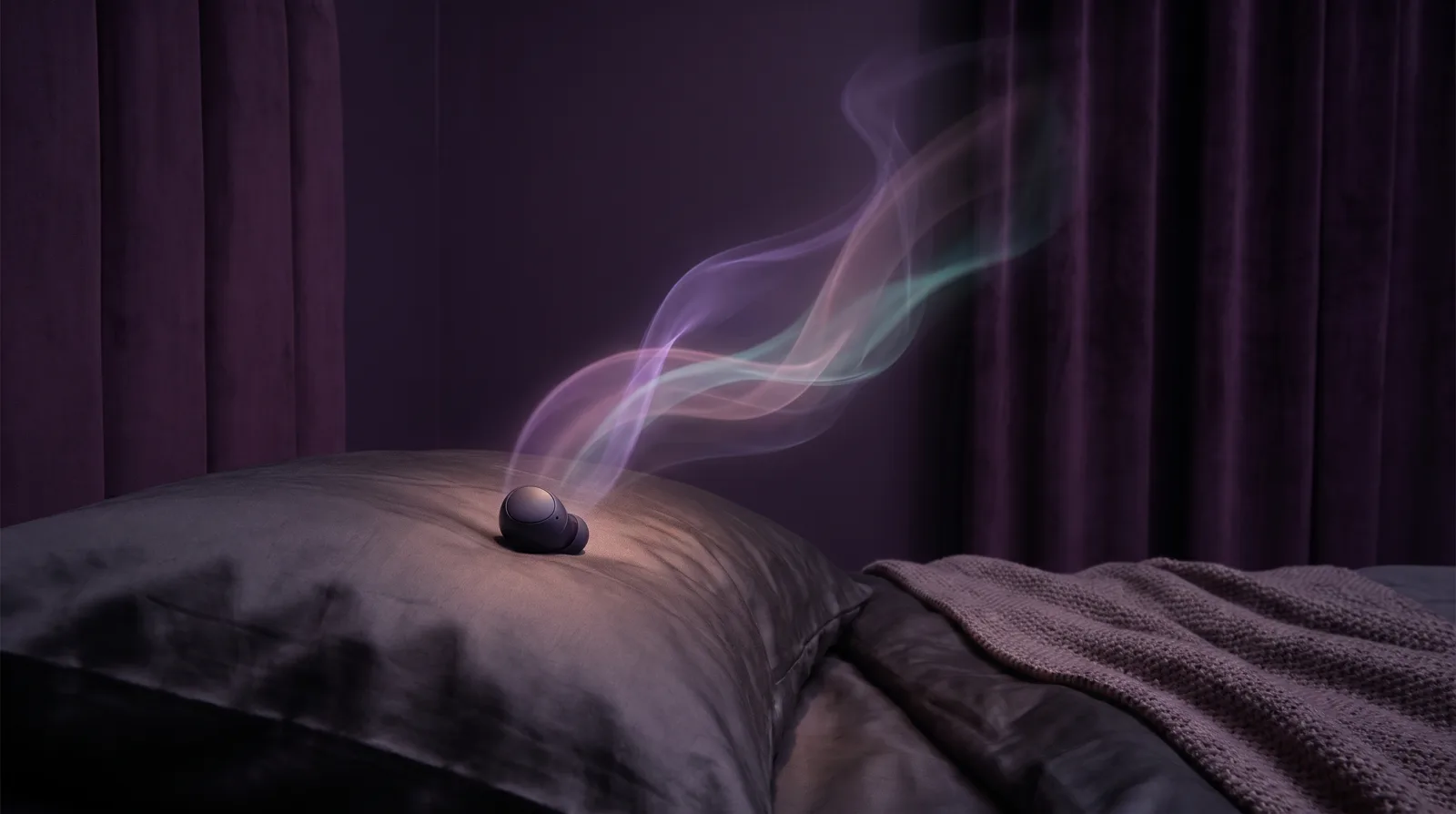
I have fallen asleep to the same episode about Roman concrete eleven times. I could not tell you how it ends. I'm not sure episodes of that show end so much as politely dissolve, which is exactly the quality I hired it for. Somewhere around minute nine, two calm people discussing volcanic ash become indistinguishable from sleep itself. If you do this too, you've probably wondered whether it's weird, or bad, or a sign that your brain is broken in some new podcast-shaped way. Good news: the mechanism is sensible, the habit is defensible with a few guardrails, and there's a reason a mediocre history show outperforms total silence for so many of us.
Silence isn't neutral when your brain is loud
The naive model of falling asleep says: remove all stimulation, sleep happens. That works if your mind cooperates. But for a lot of people, the quiet dark isn't empty; it's a vacuum, and the second you lie down, the day's unfinished business rushes in to fill it. Tomorrow's meeting, that thing you said in 2019, a fresh audit of your finances. The technical name for this loop is rumination, and it's absurdly good at keeping you awake, because it's self-generated, which means it never runs out of material. A podcast changes the equation. It hands your attention something external to hold, and attention is roughly a one-lane road at that hour. While you're following a sentence about aqueducts, you are not chairing the 1 a.m. meeting about your life. The voice doesn't put you to sleep. It evicts the thing that was keeping you up.
A calm voice is an old safety signal
There's a second, softer layer. Humans are wired to read tone long before we finish parsing words, and an unhurried, low-stakes voice signals that nothing around here requires vigilance. It's the same channel that makes whispered ASMR and sleep stories work, and it's ancient: quiet talk nearby has meant safety for as long as people have slept in groups. Falling asleep to a podcast is arguably just the modern subscription version of drifting off near a fire while someone tells a long story you don't need to follow. The content is beside the point. The prosody is the product.
The voice doesn't put you to sleep. It evicts the thing that was keeping you up.
Why boring beats brilliant
Here's the design problem: you need enough engagement to displace rumination, and little enough that letting go costs nothing. That's why your favorite true-crime show is a terrible sleep aid; cliffhangers are wakefulness with production values. News is worse, since it hands the rumination loop fresh material. The sweet spot is content that's mildly interesting and completely unimportant: niche history, gentle rewatches, a familiar episode you've heard before. Familiarity matters more than people think. A known episode has zero narrative tension; your brain isn't waiting for anything, so it can put the story down mid-sentence. That's the real reason I've heard the first third of the Roman concrete episode eleven times. It's not an accident. It's engineering.
Voice matters as much as subject. You want one or two speakers, unhurried, with no big dynamic swings; a panel show where four people keep laughing is an alarm clock with extra steps, because every laughter spike drags you back up the slope you just descended. Production style counts too. Shows mixed for commutes are loud and compressed so they can beat the subway; at midnight that same mix is a firehose. The ideal sleep show sounds like it was recorded by people who assumed nobody was fully listening. Many of the best ones, I suspect, know exactly what they are for and are politely pretending otherwise.
The honest caveats
Time for the skeptic paragraph, because this beat is mine. The research on falling asleep to talk audio is thinner than the podcast industry would like you to believe; what we mostly have is plausible mechanism plus a mountain of anecdote, mine included. And there are real caveats. Audio that plays all night keeps feeding your ears through the lighter stages of sleep, when outside sound can still nudge you toward waking, so an episode that runs till 4 a.m. isn't harmless. A strong I-can't-sleep-without-it association is worth avoiding too; you want a tool, not a requirement, especially the first night your phone dies. And if you're dealing with real insomnia rather than a chatty mind, a history podcast is not a treatment plan. It's a lullaby with sponsors.
The setup that actually works
- Use a sleep timer, 20 to 45 minutes. The goal is a voice for the descent, silence for the night.
- Pick familiar over new, flat over dramatic. One calm speaker, no laughter spikes, no cliffhangers, no news.
- Keep volume just above audible, ideally from a speaker across the room rather than an earbud you'll sleep on.
- If words hook you too hard, trade the plot for pure texture: slow visuals and soft sound in Feelsy's autoplay mode do the same occupy-the-loop job with literally nothing to follow.
Verdict from the eleventh listen
Falling asleep to podcasts isn't a character flaw or a disorder. It's a reasonable hack for a brain that treats silence as an open mic. Respect the guardrails: timer on, stakes low, volume low, and keep one non-audio route to sleep in your back pocket so the tool stays a tool. Somewhere out there, a podcaster spent forty hours researching an episode I have never consciously finished. I hope they'd take it as the compliment it is. They built the fire; I just sleep near it.
Feelsy is a wellness product, not medical advice. If stress, anxiety or sleep problems persist, please speak with a qualified professional.
Frequently Asked Questions
Why do podcasts make me fall asleep so fast?
At night your attention is roughly a one-lane road, and a podcast fills it with something external and low-stakes. That displaces rumination, the self-generated loop of worries and replays that thrives in silence. A calm, unhurried voice also reads as an old safety signal, the same channel that makes whispered audio and sleep stories relaxing.
Is it bad to fall asleep listening to podcasts every night?
With guardrails, it's a reasonable habit. Use a sleep timer of 20 to 45 minutes so audio doesn't keep feeding your ears through lighter sleep stages all night, keep the volume just above audible, and avoid building a can't-sleep-without-it dependence. If you're dealing with persistent insomnia rather than a busy mind, a podcast is not a treatment.
What kind of podcast is best for sleep?
Mildly interesting and completely unimportant is the sweet spot: niche history, gentle conversation, or a familiar episode you've already heard. Familiar episodes work especially well because there's no narrative tension left, so your brain can put the story down mid-sentence. Avoid cliffhangers, laughter spikes, and news.
Should I use headphones to fall asleep to podcasts?
A speaker across the room at low volume is the better setup. It spares you sleeping on an earbud and keeps the sound quiet enough to fade behind you as you drift off. The goal is a voice for the descent and silence for the rest of the night.
What if podcasts keep me awake instead?
Some brains latch onto words too tightly, and every sentence becomes a hook. In that case trade the plot for pure texture: slow visuals with soft sound, like Feelsy's autoplay mode, occupy attention the same way with nothing to follow. Wordless audio such as rain or noise colors works on the same principle.

About the author
Contributing writer
Kurt is a New York based writer covering the practical science of stress, sleep and focus. He is the resident sceptic of the Journal: if a technique cannot survive a crowded subway commute and a deadline week, he is not interested in it.
Feel it for yourself.
Feelsy turns reading about calm into practising it. Two minutes of a slow texture is often the whole difference.


Related reading
 Sleep
SleepSleep Stories for Adults: Why Being Read to Still Works
Why sleep stories work for adults: the science of narrative distraction at bedtime, what makes a story sleep-worthy, and how to build a listening ritual.
 ASMR
ASMRASMR for Sleep: What the Research Actually Says
Millions fall asleep to whisper videos every night. Here's what research says about ASMR for sleep, who it helps, and how to use it without staying up later.
 Sleep
SleepCognitive Shuffling: How to Bore Your Brain to Sleep
Cognitive shuffling is the sleep technique where random, meaningless images walk your brain to sleep. What it is, why it may work, and how to try it tonight.
 ASMRNew
Brushing ASMR: Why a Soft Brush on a Microphone Melts Your Brain
Brushing ASMR turns a soft brush on a microphone into deep calm. Here's why your brain reads brushing as care, and how to use it for sleep and focus.
 ASMR
ASMRWhy Is Bob Ross So Relaxing? The Science of Happy Little Brushstrokes
Bob Ross has been putting people to sleep for four decades, and he'd take that as a compliment. Here's the science of why his painting videos work like ASMR.
 ASMR
ASMRWhat Is 8D Audio? The Science Behind the Spinning Sound
8D audio pans music around your head using binaural tricks. Here's how the illusion works, why it feels immersive, and whether it helps you relax or focus.