Why Watching Waterfalls Is So Calming: The Science of Falling Water
Why does watching a waterfall calm the mind so fast? The science of soft fascination, blue space and falling water, and how to borrow the effect indoors.
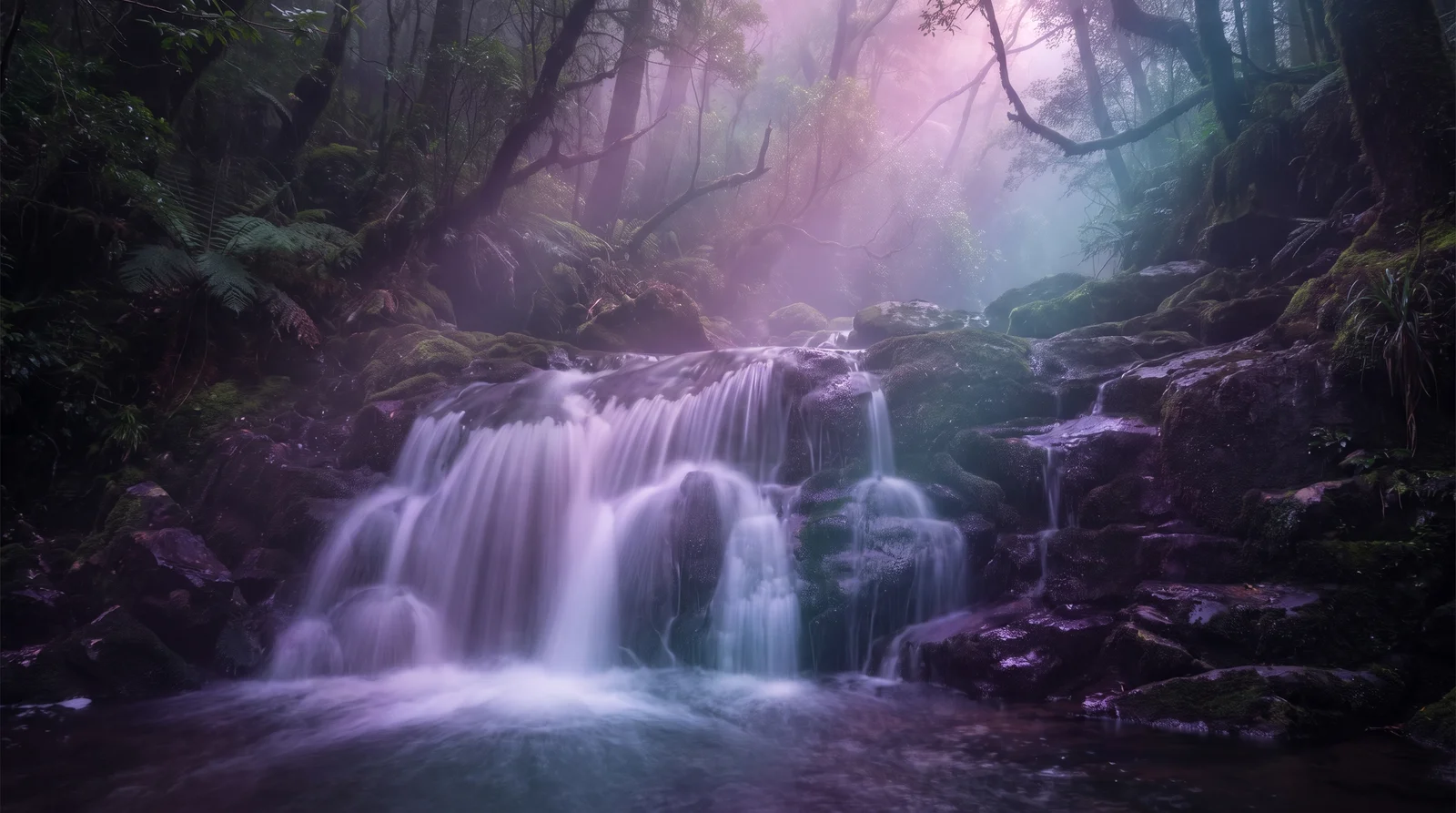
There is a particular kind of quiet that arrives when you stand in front of a waterfall. It is not silence; a waterfall is one of the loudest things in a forest. It is something stranger: a loud sound that empties the mind rather than crowding it, a wall of motion that somehow makes you still. People travel a long way to stand in that noise, and then find they have nothing to say. I have watched a group of chattering hikers fall wordless within seconds of rounding the last bend, as though the water had asked them to.
Motion that holds the eye without alarming it
Begin with what the eye is doing. A waterfall is in constant, complex motion, and yet almost none of that motion is threatening. Water falls in the same direction, at the same rhythm, in patterns that shift endlessly without ever doing anything sudden. There is a great deal to look at and nothing to brace against. Your gaze can wander across the cascade, follow one thread of water down and lose it in the spray, drift to the next, and never once be startled.
This combination, endless variation with no threat, is precisely the recipe that environmental psychologists associate with restoration. Rachel and Stephen Kaplan named the state it produces soft fascination: attention that is held gently, effortlessly, by something that does not demand a response. In their Attention Restoration Theory (Kaplan, 1995, Journal of Environmental Psychology), the everyday, effortful attention we spend on work and worry is a resource that runs down through the day. What refills it is not blankness but soft fascination, and few things offer it as completely as falling water.
A waterfall is a loud sound that empties the mind rather than crowding it, a wall of motion that somehow makes you still.
The particular comfort of blue space
Water does something that even beautiful dry landscapes do not quite manage. Researchers who study how places affect wellbeing have begun to talk about blue space, the category of watery places, alongside the more familiar green space of parks and forests. In a study spanning eighteen countries, Mathew White and colleagues found that contact with blue and green spaces was associated with better mental wellbeing and a lower likelihood of psychological distress (White et al., 2021, Scientific Reports). Something in us settles near water in a way we have not fully explained, though we feel it reliably.
A waterfall is blue space at its most concentrated: moving water, cool air, the smell of wet stone, and a sound that seems to wash the edges off every other thought. You are not only looking at something restful. You are standing inside a small weather system built entirely of calm.
The sound that hides the world
The noise of a waterfall matters as much as the sight. Falling water produces a broad, steady wash of sound across many frequencies at once, close to what engineers call broadband noise. That kind of sound is a remarkably effective mask: it does not startle, it does not carry information, and it gently buries the sharp, meaningful noises, the distant voice, the sudden clatter, that keep an anxious mind alert and scanning. Under a waterfall there is nothing to overhear, and so nothing to monitor.
This is the same principle behind the rain and river sounds so many people use to sleep, and behind the broadband hush that white and pink noise provide. The waterfall simply does it in the wild, and pairs the sound with the sight, so that ear and eye are settled by the same thing at the same moment. When two senses agree that the world is safe and slow, the body believes them faster.
Why we are drawn to it in the first place
There is an older, more speculative layer to all this. For most of human history, the sound of running fresh water meant something urgent and good: drink, safety, life. Some researchers suspect that our ease near water carries an echo of that long inheritance, an ancient association between the sound of a stream and the certainty that we would not go thirsty. Whether or not that is the reason, the pull is real and nearly universal. We do not have to be taught to find a waterfall beautiful. We arrive already knowing.
How to borrow the waterfall indoors
Most of us cannot step outside to a cascade when the day tightens around us. The good news is that the ingredients travel surprisingly well, because what calms us about a waterfall is not the geography but the pattern: safe, endless motion paired with a broad, steady sound.
- Give your eyes slow, non-threatening motion to rest on. A window with moving trees, a real stream if you are lucky enough to have one, or a slow visual texture on a screen all offer the same soft fascination.
- Add a broadband sound underneath it. Recorded water, rain, or a gentle noise track masks the sharp sounds that keep attention on guard.
- Let the two senses agree. The effect is strongest when what you hear and what you see share the same unhurried rhythm, so that eye and ear settle together.
- Stay a little longer than feels necessary. The shift is not instant; give your nervous system a few minutes to trust that nothing is going to jump.
This is much of the thinking behind the way I use Feelsy on a frayed afternoon: a slow, falling texture to hold the eyes, a wash of water or ambient sound to hide the office behind it, both moving at the same gentle pace on autoplay. It is not a mountain gorge. But it borrows the waterfall's real trick, which was never the water itself, only the particular kind of attention it invites.
The stillness on the other side of the noise
It is a lovely paradox that one of the most reliably calming sights in nature is also one of the loudest and most restless. A waterfall never stops moving and never stops roaring, and yet standing before one quiets people who cannot sit still in a silent room. The lesson is the one visual meditation keeps teaching in different costumes: calm is not the absence of stimulation but the right kind of it, motion and sound that ask nothing of you, so that your attention can finally, gratefully, rest.
Feelsy is a wellness product, not medical advice. If stress, anxiety or sleep problems persist, please speak with a qualified professional.
References
- Kaplan, S. (1995). The restorative benefits of nature: Toward an integrative framework. Journal of Environmental Psychology, 15(3), 169-182.
- White, M. P., Elliott, L. R., Grellier, J., et al. (2021). Associations between green/blue spaces and mental health across 18 countries. Scientific Reports, 11, 8903.
Frequently Asked Questions
Why is watching a waterfall so calming?
A waterfall gives your eyes endless, complex motion that is never sudden or threatening, so your attention is held gently without being put on guard. It pairs that sight with a broad, steady sound that masks sharper noises, and it sits within water, an environment people find reliably soothing. Together these settle the nervous system into a restful, effortless kind of attention.
What is soft fascination?
Soft fascination is a term from Attention Restoration Theory, developed by Rachel and Stephen Kaplan, for attention that is held gently and effortlessly by something that does not demand a response, such as moving water, clouds or firelight. The idea is that our everyday, effortful attention gets depleted through the day, and soft fascination is what allows it to recover.
What is blue space?
Blue space is the term researchers use for watery environments such as rivers, lakes, coasts and waterfalls, alongside the green space of parks and forests. A large study across eighteen countries found that contact with blue and green spaces was associated with better mental wellbeing and less psychological distress. A waterfall is blue space in a very concentrated form.
Why does the sound of a waterfall help me relax?
Falling water produces a broad, steady wash of sound across many frequencies at once, close to what engineers call broadband noise. That kind of sound does not startle and carries no information to track, so it gently buries the sharp, meaningful noises that keep an anxious mind alert and scanning. With nothing to overhear, there is nothing to monitor.
How can I get the calming effect of a waterfall at home?
You do not need the waterfall itself, only its pattern: safe, endless motion paired with a broad, steady sound. Give your eyes slow, non-threatening movement to rest on, such as trees through a window or a slow visual texture on a screen, and add a broadband sound like recorded water or rain underneath it. Let the two share the same unhurried rhythm, and stay a few minutes longer than feels necessary.

About the author
Contributing writer
Eleonor writes about contemplative traditions, attention and the cultural history of calm. She has spent two decades collecting the rituals humans use to slow down, from zazen halls to hammams, and translating them for modern, screen-lit lives.
Feel it for yourself.
Feelsy turns reading about calm into practising it. Two minutes of a slow texture is often the whole difference.


Related reading
 Visual Meditation
Why Watching Ocean Waves Calms the Mind
Why the sea calms the mind: the science of wave rhythm, blue space and shoreline sound, and how to borrow the ocean's stillness far from any coast.
 ASMR
ASMRWhy the Sound of Rain Is So Calming (and So Good for Sleep)
Why rain sounds help you sleep: the acoustics of rainfall, what research says about natural sound and stress, and how to use rain well at bedtime.
 Visual Meditation
What Is Visual Meditation? The Complete Guide
Visual meditation rests your attention on slow, pleasing motion so calm happens almost on its own. Here is how it works, what the research says, and how to practise it in three minutes.
 Visual MeditationNew
Highway Hypnosis: Why You Can't Remember the Last Ten Miles
You arrive at your exit with no memory of driving there. Highway hypnosis is real and common: here's the science of the road trance and how to use it safely.
 Visual Meditation
Why the Northern Lights Mesmerise Us: Aurora Watching as Visual Meditation
What causes the northern lights, why the aurora feels so calming to watch, and how to turn sky watching into a simple visual meditation practice.
 Visual Meditation
Blue Mind: Why Being Near Water Calms the Brain
What blue mind theory says about why oceans, lakes and rivers soothe us: the research on blue space, water's pull on the eye, and how to use it daily.