What Is Visual Meditation? The Complete Guide
Visual meditation rests your attention on slow, pleasing motion so calm happens almost on its own. Here is how it works, what the research says, and how to practise it in three minutes.
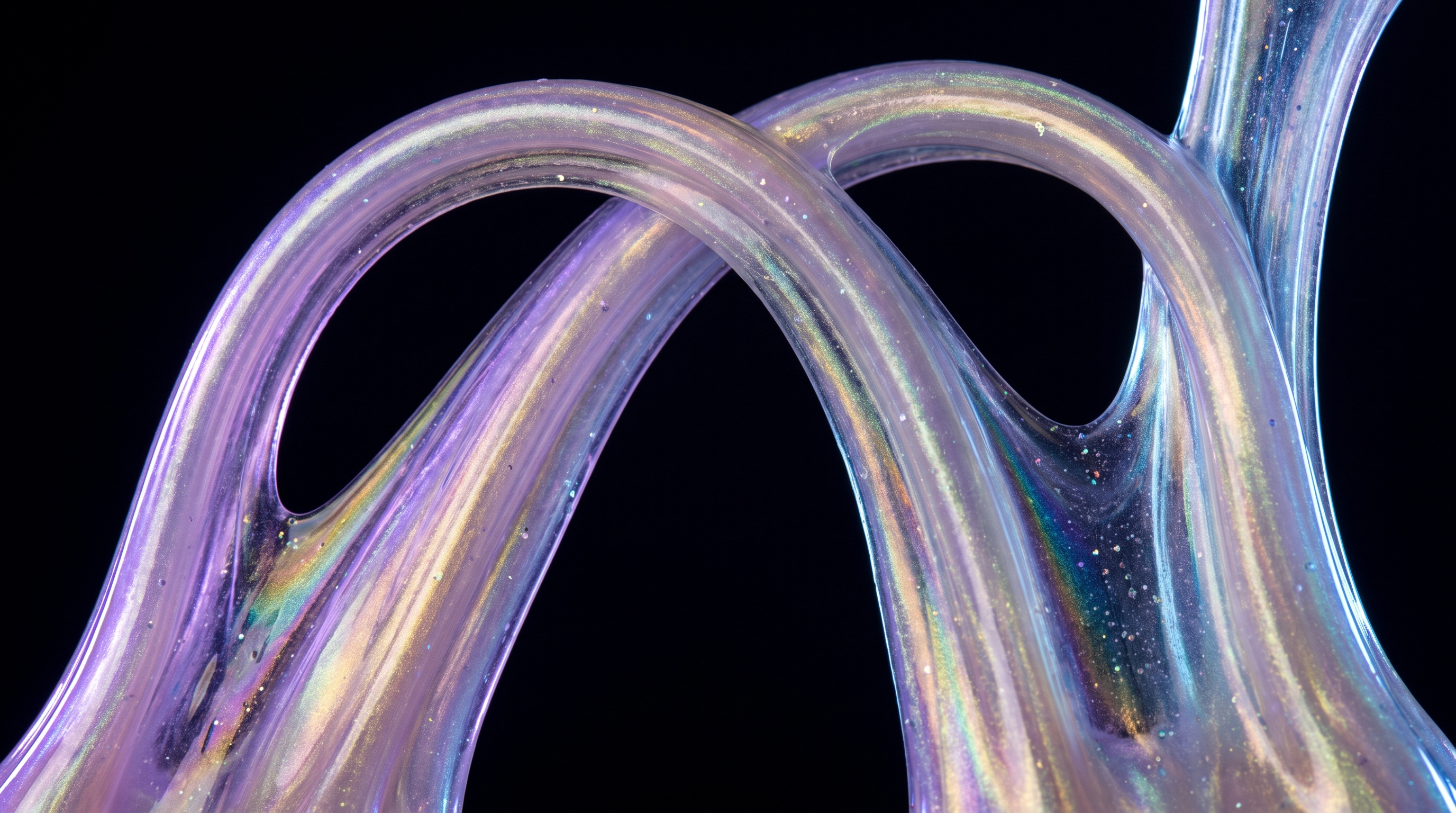
Most guides to meditation begin with an instruction that sounds simple and turns out to be almost impossible: close your eyes and clear your mind. Visual meditation flips that instruction on its head. Instead of trying to empty your mind, you give it something soft to rest on. A slow ribbon of fluid. A stretch of slime folding back on itself. A field of particles drifting like snow. Your attention lands, softens, and then loosens all by itself.
This is not a trick. It is one of the oldest ways humans have quietened their nervous systems, from candle gazing in yogic trataka to sand gardens in Zen temples. What is new is that a phone screen can hold that same slow motion in your pocket, on demand, without a cushion or a teacher.
A working definition
Visual meditation is the practice of resting attention on slow, pleasing motion, letting perception do the work of calming the body. You are not trying to control your thoughts. You are watching something that is already peaceful, and borrowing its rhythm.
The key ingredients are consistent: motion that is smooth rather than sudden, colour that is soft rather than jarring, sound that either matches the visual or is absent entirely, and a duration long enough for your body to notice. Two minutes is usually enough to feel a first shift.
Why beginners fail at classical meditation
If you have ever sat down to meditate and given up after ninety seconds, you are not doing it wrong. You are meeting the actual problem: an untrained mind resists being asked to sit still with nothing to do. The first few minutes of silence are often when anxious thoughts arrive with the volume turned up.
Classical meditation solves this over time by teaching the mind to accept that discomfort. That is a beautiful skill and worth building. But it is not the only entrance. For many people, the fastest way in is to give the senses a small, gentle job first. Watch this. Listen to that. Breathe with this rhythm. Once the body has settled, the mind follows on its own.
You are not trying to empty your mind. You are giving it somewhere soft to land.
The science of soft fascination
Environmental psychologists have a name for what happens when we watch clouds move, leaves rustle, or waves break: soft fascination. The idea comes from Attention Restoration Theory, developed by Rachel and Stephen Kaplan (Kaplan, 1995, Journal of Environmental Psychology). Their argument is that our directed attention, the effortful kind we use to answer email and read spreadsheets, is a finite resource that gets depleted through the day. What restores it is not silence, but a different kind of attention altogether: effortless, curious, and pulled gently by the world instead of pushed by us.
A large systematic review has since collected the evidence that exposure to natural environments produces measurable psychological restoration, including on attention measures (Ohly et al., 2016, Journal of Toxicology and Environmental Health, Part B). You do not need a forest for the effect to appear. You need slow, complex, safe stimuli that hold your gaze without demanding anything back.
That is the design brief behind visual meditation. A well-made loop of fluid or slime is a pocket version of the same thing your grandparents got from watching a fire.
The three senses that anchor calm
A visual meditation practice usually engages three senses, in this order:
- Sight. Slow motion, harmonious colour, and shapes that fold and reveal without ever spiking your alertness.
- Touch. Interactive textures that respond to your finger with a small, satisfying delay, so your body feels agency without effort.
- Sound. Layered ASMR or ambient tones that match the visual, letting your ears settle into the same pace as your eyes.
The more of these senses are engaged in the same slow rhythm, the faster your nervous system decides it is safe to downshift. For a closer look at the sound layer, see our guide to what the science says about ASMR.
How to practise in three minutes
You do not need a special place or posture. You need three minutes and permission to do very little.
- Sit or lie comfortably. Loosen your jaw and shoulders. Rest the device where you can see it without straining.
- For the first minute, just watch. Do not try to relax. Let your eyes follow the motion the way you would follow a candle flame.
- For the second minute, breathe with the motion. When the shape expands, inhale. When it settles, exhale. Do not force the count.
- For the third minute, if it feels natural, touch. Let one finger move slowly across the texture and notice how the visual answers back.
Do this once. Notice your shoulders. That is the practice.
When to use visual meditation
Visual meditation is at its best in the small windows where a full practice would feel absurd but doing nothing feels worse.
- On a commute, to unclench between one part of the day and the next.
- During a lunch break, as a reset before an afternoon that needs your best attention.
- In the twenty minutes before sleep, when the mind wants a place to land that is not a news feed.
- In the middle of a stressful workday, for ninety seconds, to lower your heart rate before answering the next message.
If you often feel that you cannot meditate, this is where to start. We wrote a whole guide on that question in meditation for people who cannot meditate. And if breath is your preferred anchor, the 4-7-8 technique pairs beautifully with a slow visual.
The point is not perfection
Visual meditation is not a competition. There is no correct number of sessions per week, no streak that unlocks calm. The goal is to remember that your attention is yours, and that a few soft minutes are almost always available, even on the hardest days.
Feelsy is a wellness product, not medical advice. If stress, anxiety or sleep problems persist, please speak with a qualified professional.
References
- Kaplan, S. (1995). The restorative benefits of nature: Toward an integrative framework. Journal of Environmental Psychology, 15(3), 169–182.
- Ohly, H., White, M. P., Wheeler, B. W., et al. (2016). Attention Restoration Theory: A systematic review of the attention restoration potential of exposure to natural environments. Journal of Toxicology and Environmental Health, Part B, 19(7), 305–343.
Frequently Asked Questions
What is visual meditation?
Visual meditation is the practice of resting your attention on slow, pleasing motion, such as a ribbon of fluid or a folding piece of slime, so your body relaxes without you having to try to empty your mind. Instead of controlling your thoughts, you watch something already peaceful and borrow its rhythm. The key ingredients are smooth motion, soft colour, matching or absent sound, and a duration long enough for your body to notice, usually around two minutes.
Why do I fail at classical meditation?
If you give up after ninety seconds of classical meditation, you are not doing it wrong, you are meeting the real problem: an untrained mind resists sitting still with nothing to do, and anxious thoughts often arrive loudest in the first few minutes of silence. Classical meditation trains the mind to accept that discomfort over time, but for many people the faster way in is to give the senses a small, gentle job first, like watching or listening, so the body settles and the mind follows.
What does the science say about watching slow motion to relax?
Environmental psychologists call this soft fascination, a concept from Attention Restoration Theory developed by Rachel and Stephen Kaplan, which holds that our effortful, directed attention gets depleted through the day and is restored by effortless, curious attention pulled gently by the world. A later systematic review by Ohly and colleagues found that exposure to natural environments produces measurable psychological restoration, including on attention measures, and you do not need an actual forest for the effect, just slow, complex, safe stimuli.
How do I practise visual meditation in three minutes?
Sit or lie comfortably, loosen your jaw and shoulders, and rest the device where you can see it without straining. For the first minute just watch the motion, for the second minute breathe with it, inhaling as the shape expands and exhaling as it settles, and for the third minute, if it feels natural, trace the texture slowly with one finger and notice how it responds.
When is the best time to use visual meditation?
It works well in small windows where a full practice would feel absurd but doing nothing feels worse, such as during a commute, on a lunch break, in the twenty minutes before sleep, or for ninety seconds in the middle of a stressful workday to lower your heart rate before answering the next message. There is no correct number of sessions per week, the goal is simply to remember that a few soft minutes are almost always available.

About the author
Contributing writer
Eleonor writes about contemplative traditions, attention and the cultural history of calm. She has spent two decades collecting the rituals humans use to slow down, from zazen halls to hammams, and translating them for modern, screen-lit lives.
Feel it for yourself.
Feelsy turns reading about calm into practising it. Two minutes of a slow texture is often the whole difference.


Related reading
 ASMR
ASMRASMR, Explained: What Science Says About the Tingles
ASMR is more than a trend. Here is what the tingles are, who feels them, and what studies have measured about their effects on heart rate, mood and calm.
 Visual Meditation
Meditation for People Who Can't Meditate
If sitting still with your eyes closed feels impossible, you are not broken. Here is a gentler on-ramp built around senses, movement and very small doses.
 Breath & Body
The 4-7-8 Breathing Technique, Step by Step
A focused walkthrough of the 4-7-8 breath: what it is, how to do it, why the long exhale calms you, and when to use it during the day and before sleep.
 Visual MeditationNew
Highway Hypnosis: Why You Can't Remember the Last Ten Miles
You arrive at your exit with no memory of driving there. Highway hypnosis is real and common: here's the science of the road trance and how to use it safely.
 Visual Meditation
Why the Northern Lights Mesmerise Us: Aurora Watching as Visual Meditation
What causes the northern lights, why the aurora feels so calming to watch, and how to turn sky watching into a simple visual meditation practice.
 Visual Meditation
Blue Mind: Why Being Near Water Calms the Brain
What blue mind theory says about why oceans, lakes and rivers soothe us: the research on blue space, water's pull on the eye, and how to use it daily.