The Quiet Benefits of Birdwatching: Why Noticing Birds Settles the Mind
Birdwatching is quietly powerful for the mind. Here is what research suggests everyday encounters with birds do for wellbeing, and how to begin with no kit.
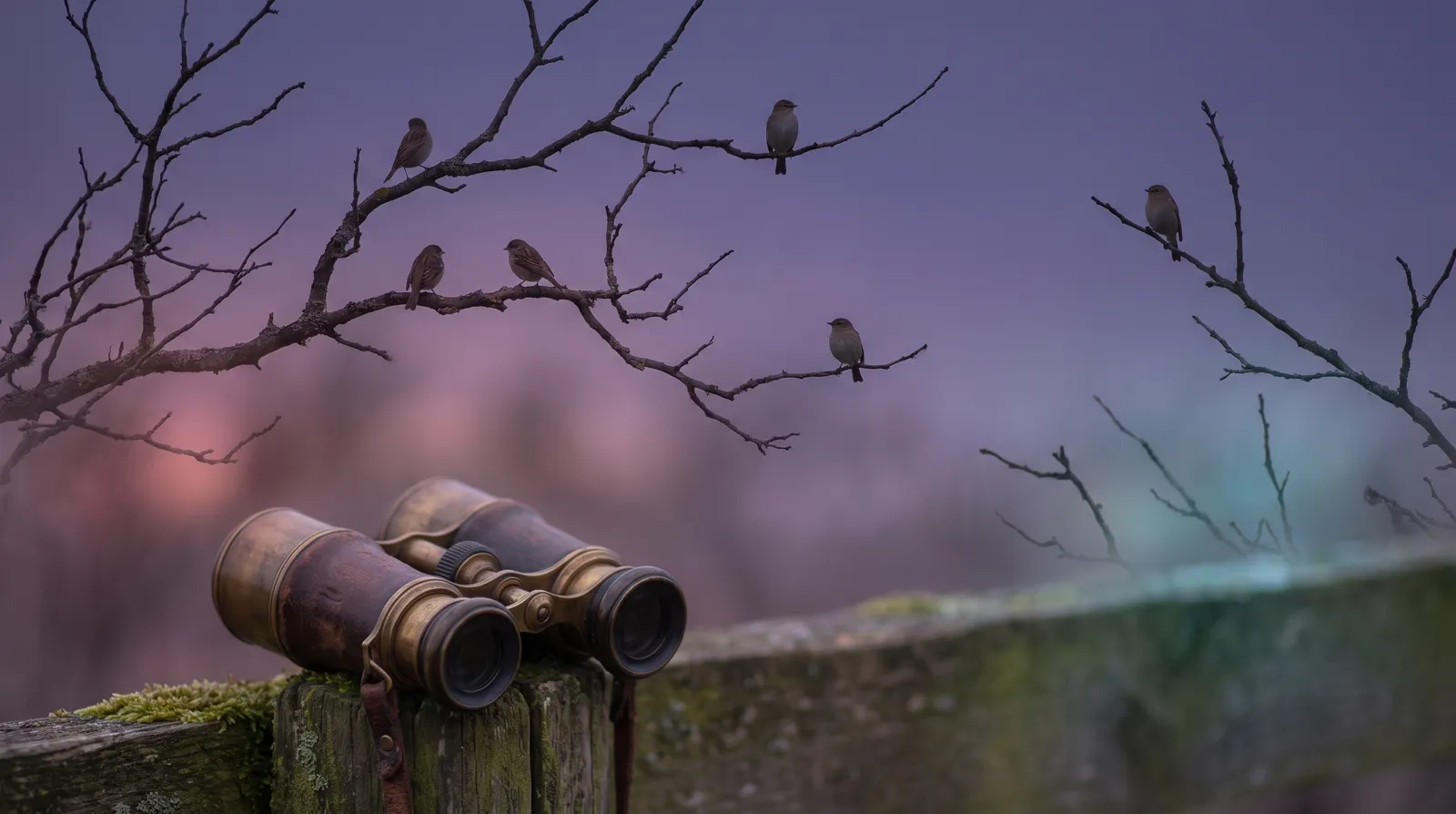
Birdwatching has an image problem it has never much minded: the anorak, the flask, the pre-dawn vigil in a damp hide. But strip the hobby to its essence and what remains is something far more ordinary and far more available. A person stops what they are doing because a bird has appeared, and for the length of the encounter they think about nothing else. The robin on the fence gets thirty seconds of complete attention; the wren working the hedge gets a minute; the sparrowhawk, should one arrive, empties the mind entirely. Watching birds is one of the oldest informal attention practices we have, it requires no equipment, no fitness and no garden, and a body of recent research suggests that these small encounters do measurable good to the watcher. The birds, characteristically, remain indifferent to all of this, which is part of the charm.
What the research keeps finding
The most striking modern evidence comes from a study that caught people in the act of everyday life rather than in a laboratory. Researchers using a smartphone app pinged over a thousand participants several times a day to record their surroundings and their mood, and found that moments when people could see or hear birds came with measurable improvements in mental wellbeing; encouragingly, the lift was present for people with a diagnosed mental health condition as well, and the benefit of an encounter could still be detected hours later (Hammoud et al., 2022, Scientific Reports). Sound alone appears to carry real weight. In a mischievous field experiment in Colorado, ecologists hid speakers along stretches of hiking trail and played a richer dawn chorus; hikers who walked through this phantom flock reported greater wellbeing than those who walked the same trail in ordinary quiet, and much of the effect ran through the sense that the place was more alive (Ferraro et al., 2020, Proceedings of the Royal Society B). None of this proves that a blue tit is a course of therapy. It does suggest that the pleasure birdwatchers report is not sentimental invention; the encounters register, and they linger.
Soft fascination, feathered
Why should watching a small dinosaur descendant eat seeds do anything for a mind full of deadlines? One useful frame is the idea, long discussed by environmental psychologists, that attention comes in two costs. Directed attention, the kind that spreadsheets and inboxes demand, is effortful and depletes; fascination, the kind a moving, mildly unpredictable natural scene invites, is effortless and seems to allow the directed sort to recover. Birds are almost ideally engineered for the second kind. They move constantly but not frantically; they appear and vanish on their own schedule; they are various enough to reward recognition and common enough to guarantee it. A feeder outside a window is, in attention terms, a small theatre with continuous performances and no plot to follow. The watching asks just enough of the eye to occupy it and nothing at all of the will, which is precisely the combination that lets the rest of the mind put its luggage down. It is the same principle on which Feelsy's slow textures work: motion gentle enough to hold the gaze without ever demanding it. Nature simply got there first, and added wings.
The watching asks just enough of the eye to occupy it and nothing at all of the will.
The listening half of the practice
Half of birdwatching, perhaps the better half, is birdlistening. Song reaches where sight cannot, through leaves, around corners, into a kitchen with the window cracked open, and learning even three or four local voices changes the texture of ordinary places. The commute acquires a soundtrack of specific characters rather than generic tweeting; the supermarket car park turns out to have its own resident singer. There is also a seasonal gift in it. Birdsong marks time honestly, swelling in spring, thinning in late summer, resolving into the spare calls of winter, and a person who knows the difference is subscribed, free of charge, to the turning of the year. The phantom chorus experiment hints at why this matters: what soothed the hikers was partly the sense of walking through a living world. Learning to hear that world is a way of switching the sense on permanently.
How to begin, gently
Begin smaller than you think. Choose one window, or one bench, or ten minutes of one walk, and simply notice what birds are present; even a city offers pigeons with iridescent collars, gulls running their patrols, the odd startling flash of a goldfinch. Learn the names of five local species, no more, and let the rest accumulate on their own. If you have a sill or a scrap of outdoor space, a feeder will bring the theatre to you within days. Binoculars are a pleasure but not an entry requirement; the naked-eye robin at three metres offers more than the distant speck ever will. And resist the urge to make it productive. No list is required, no photograph, no identification app consulted mid-encounter. The practice is the noticing itself: eyes up, phone away, one bird given your whole attention for as long as it cares to stay. On the days the sky is empty, the habit of looking up remains, and that habit, birdwatchers will tell you, was the real prize all along.
Feelsy is a wellness product, not medical advice. If stress, anxiety or sleep problems persist, please speak with a qualified professional.
References
- Hammoud, R., Tognin, S., Burgess, L., Bergou, N., Smythe, M., Gibbons, J., Davidson, N., Afifi, A., Bakolis, I., & Mechelli, A. (2022). Smartphone-based ecological momentary assessment reveals mental health benefits of birdlife. Scientific Reports.
- Ferraro, D. M., Miller, Z. D., Ferguson, L. A., Taff, B. D., Barber, J. R., Newman, P., & Francis, C. D. (2020). The phantom chorus: birdsong boosts human well-being in protected areas. Proceedings of the Royal Society B.
Frequently Asked Questions
Is birdwatching actually good for your mental health?
Research suggests everyday encounters with birds are linked with better mood. A smartphone-based study that pinged over a thousand people during daily life found that seeing or hearing birds came with measurable improvements in mental wellbeing, detectable hours after the encounter, including among people with a diagnosed mental health condition.
Why is watching birds so calming?
Birds invite what psychologists call fascination: they move constantly but not frantically, and they ask just enough of the eye to occupy it without demanding effort. That combination lets the effortful, directed attention that work consumes recover, which is why a feeder outside a window can function as a small restorative theatre.
Do I need binoculars to start birdwatching?
No. Binoculars are a pleasure but not an entry requirement; a robin at three metres seen with the naked eye offers more than a distant speck ever will. Start with one window, bench or ten-minute stretch of a walk, learn the names of five local species, and let the rest accumulate on its own.
Does birdsong alone have benefits, even without seeing birds?
It seems so. In a field experiment, ecologists hid speakers along hiking trails and played a richer dawn chorus; hikers who walked through it reported greater wellbeing than those who walked the same trail in ordinary quiet. Much of the effect came from the sense that the landscape was more alive.
How do I attract birds to watch at home?
A simple feeder on a sill or in any scrap of outdoor space will usually bring birds within days, turning a window into a reliable watching spot. Then keep the practice unproductive: no lists or photographs required, just one bird given your whole attention for as long as it cares to stay.

About the author
Contributing writer
Eleonor writes about contemplative traditions, attention and the cultural history of calm. She has spent two decades collecting the rituals humans use to slow down, from zazen halls to hammams, and translating them for modern, screen-lit lives.
Feel it for yourself.
Feelsy turns reading about calm into practising it. Two minutes of a slow texture is often the whole difference.


Related reading
 ASMR
ASMRWhy Birdsong Calms the Mind
Why birdsong calms an anxious mind: the science of soft fascination, what bird sounds do for attention and mood, and how to bring the dawn chorus indoors.
 Visual Meditation
Awe Walks: The Simple Practice of Walking Until the World Grows Large
An awe walk is an ordinary stroll taken with attention tuned to vastness and wonder. Here is the research behind awe walks and how to take one this week.
 Visual Meditation
Why Starling Murmurations Are So Mesmerising: The Sky Turned Liquid
Thousands of starlings wheel as one and the evening sky turns liquid. Here is the science of murmurations, why they mesmerise us, and how to watch one well.
 Visual MeditationNew
Highway Hypnosis: Why You Can't Remember the Last Ten Miles
You arrive at your exit with no memory of driving there. Highway hypnosis is real and common: here's the science of the road trance and how to use it safely.
 Visual Meditation
Why the Northern Lights Mesmerise Us: Aurora Watching as Visual Meditation
What causes the northern lights, why the aurora feels so calming to watch, and how to turn sky watching into a simple visual meditation practice.
 Visual Meditation
Blue Mind: Why Being Near Water Calms the Brain
What blue mind theory says about why oceans, lakes and rivers soothe us: the research on blue space, water's pull on the eye, and how to use it daily.