Why Starling Murmurations Are So Mesmerising: The Sky Turned Liquid
Thousands of starlings wheel as one and the evening sky turns liquid. Here is the science of murmurations, why they mesmerise us, and how to watch one well.
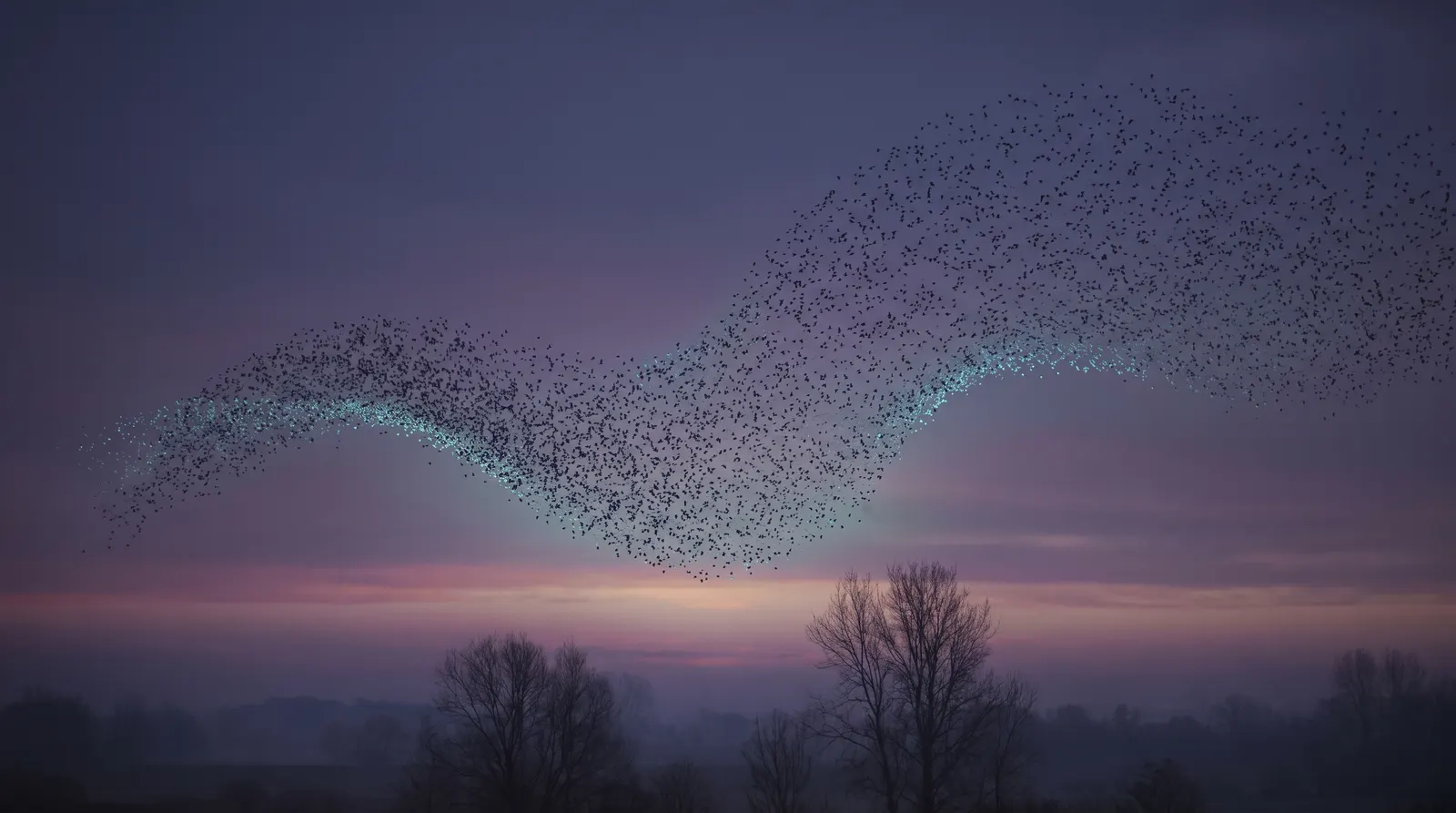
On winter evenings, above certain piers and reedbeds, the sky performs. A few hundred starlings gather, then a few thousand, and then something happens that has no satisfying name in English: the flock stops being a collection of birds and becomes a single fluid thing, folding and pouring and turning itself inside out against the dusk. People pull over on motorways to watch. Strangers stand together in car parks, faces up, saying very little. We borrowed the word murmuration from the soft rush of all those wings, and it remains one of the few natural spectacles that can silence a crowd holding phones. It is worth asking what, exactly, the starlings are doing to us.
How ten thousand birds turn as one
The first mystery is the birds' own. A murmuration has no leader, no choreographer, no bird with the plan. Each starling attends only to its closest neighbours, matching their speed and direction from moment to moment, and out of thousands of these small local courtesies the great global shapes emerge. What makes the display so uncanny is how fast information travels through it. When a group of physicists in Rome filmed murmurations over the city's railway station and reconstructed the flocks in three dimensions, they found that the birds' changes of direction were correlated across the entire flock, however large it grew: a turn begun at one edge reaches the far side almost as though the whole flock were a single connected material (Cavagna et al., 2010, PNAS). The researchers called these scale-free correlations, and the phrase repays a moment's thought. It means the flock behaves less like a crowd and more like a fabric; touch one corner and the whole cloth answers.
The physicists reached for comparisons from their own field: systems poised at a critical point, where the parts are so exquisitely responsive to one another that the whole can reorganise in an instant. Whether or not one follows the mathematics, the eye grasps the conclusion at once. A murmuration looks alive at a scale nothing alive should manage, and the looking mind, trying to decide whether it is watching many things or one thing, never quite settles the question. That unsettled question, I suspect, is a large part of the spell.
Awe, from a safe distance
Murmurations are also one of the most reliable doses of awe available to a commuter. Awe tends to arrive when something vast refuses to fit our existing categories, and a murmuration fails to fit on two counts at once: it is enormous, and it is ambiguous, both flock and fluid, both many and one. Watching it, people report the familiar signatures of the emotion, the dropped shoulders, the slowed breath, the sudden smallness of whatever they had been worrying about in the car. Unlike the mountain range or the night sky, the murmuration moves, which means the vastness keeps renewing itself; and unlike the thunderstorm, it asks nothing of us. It is awe with the danger removed, sublime weather made of birds. And because it recurs nightly through a season, it is awe one can make an appointment with, which may be the most practical sentence ever written about the emotion.
The eye, trying to decide whether it is watching many things or one thing, never quite settles the question. That unsettled question is the spell.
Soft fascination in ten thousand parts
There is a gentler mechanism working underneath the awe. The murmuration is a near perfect example of the kind of stimulus that holds attention without spending it: endlessly various, entirely without stakes. The shapes never repeat, so the eye is always employed; nothing in the display needs you, so the mind is never braced. This is the same effortless attention that firelight and falling snow invite, scaled up to the width of a sky. Ten minutes of it leaves the deliberate, task-holding part of the mind rested in a way ten minutes of scrolling never does, because the murmuration supplies constant novelty with no demand for response. It is stimulation with the cost removed, which is a rarer thing than it sounds.
How to watch one well
Murmurations are a cold-season gift. From roughly October to March, starlings gather at dusk before settling into communal roosts: reedbeds, seaside piers, city centres with generous ledges. Arrive twenty minutes or so before sunset, dress warmly, and resist the urge to film the whole display; a murmuration watched through a screen is a murmuration missed. Let the eye travel with the flock rather than fixing on any point, the way you would watch water rather than a single wave. When the birds funnel down into the roost at the end, all at once, like liquid finding a drain, the abruptness of the silence afterwards is part of the experience. Walk back slowly. The practice, if we want to call it that, is simply to let something vast and harmless use your whole attention for a quarter of an hour.
For the eleven months of evenings without starlings, the qualities that make a murmuration soothing can be found at smaller scales: smoke curling from a candle, silt swirling in a river, the flowing particle textures I sometimes leave drifting on Feelsy's autoplay while the kettle boils, small skies of a sort, pouring and reforming on a dark screen. None of them will empty a motorway. But the watching is the same watching: many things moving as one thing, asking nothing, settling everything.
Feelsy is a wellness product, not medical advice. If stress, anxiety or sleep problems persist, please speak with a qualified professional.
References
- Cavagna, A., Cimarelli, A., Giardina, I., et al. (2010). Scale-free correlations in starling flocks. Proceedings of the National Academy of Sciences.
Frequently Asked Questions
What is a starling murmuration?
A murmuration is the aerial display formed when hundreds or thousands of starlings gather at dusk and fly as one coordinated, constantly reshaping mass before settling into a communal roost. The word comes from the soft rushing murmur of all those wings. The display has no leader: each bird simply tracks its closest neighbours, and the vast global shapes emerge from those small local adjustments.
How do starlings fly in murmurations without colliding?
Each starling continuously matches the speed and direction of the few birds nearest to it. Researchers who filmed and reconstructed real flocks in three dimensions found that changes of direction are correlated across the entire flock regardless of its size, so a turn starting at one edge passes through the whole group almost instantly, as though the flock were a single connected fabric.
When and where can you see a murmuration?
In the cold months, roughly October to March, starlings gather at dusk before roosting communally in places like reedbeds, seaside piers and city centres with generous ledges. Arrive around twenty minutes before sunset and watch until the birds funnel down into the roost, which happens all at once at the end of the display.
Why is watching a murmuration so calming?
A murmuration combines awe with what psychologists would recognise as effortless attention: it is vast and ambiguous enough to stop the mind in its tracks, yet it never repeats and asks nothing of you. The eye stays fully employed while the task-holding part of the mind gets a rest, the same restful watching that firelight and falling snow invite, scaled up to the width of a sky.

About the author
Contributing writer
Eleonor writes about contemplative traditions, attention and the cultural history of calm. She has spent two decades collecting the rituals humans use to slow down, from zazen halls to hammams, and translating them for modern, screen-lit lives.
Feel it for yourself.
Feelsy turns reading about calm into practising it. Two minutes of a slow texture is often the whole difference.


Related reading
 Visual Meditation
Awe Walks: The Simple Practice of Walking Until the World Grows Large
An awe walk is an ordinary stroll taken with attention tuned to vastness and wonder. Here is the research behind awe walks and how to take one this week.
 Visual Meditation
Cloud Watching: The Easiest Meditation There Is
Why drifting clouds restore tired attention when screens cannot: the science of soft fascination, and how to practise the art of looking up.
 Visual Meditation
Why Fractals Calm the Mind: The Quiet Mathematics of Ferns and Coastlines
Ferns, clouds and coastlines share a repeating geometry called fractals. Here is why nature's self-similar patterns soothe the eye, and how to use them.
 Visual MeditationNew
Highway Hypnosis: Why You Can't Remember the Last Ten Miles
You arrive at your exit with no memory of driving there. Highway hypnosis is real and common: here's the science of the road trance and how to use it safely.
 Visual Meditation
Why the Northern Lights Mesmerise Us: Aurora Watching as Visual Meditation
What causes the northern lights, why the aurora feels so calming to watch, and how to turn sky watching into a simple visual meditation practice.
 Visual Meditation
Blue Mind: Why Being Near Water Calms the Brain
What blue mind theory says about why oceans, lakes and rivers soothe us: the research on blue space, water's pull on the eye, and how to use it daily.