Why You Can't Sleep in Hotels: The First-Night Effect, Explained
Sleep badly every first night somewhere new? That's the first-night effect: half your brain literally stays on guard duty. Here's the science and what helps.
By Kurt Woleret
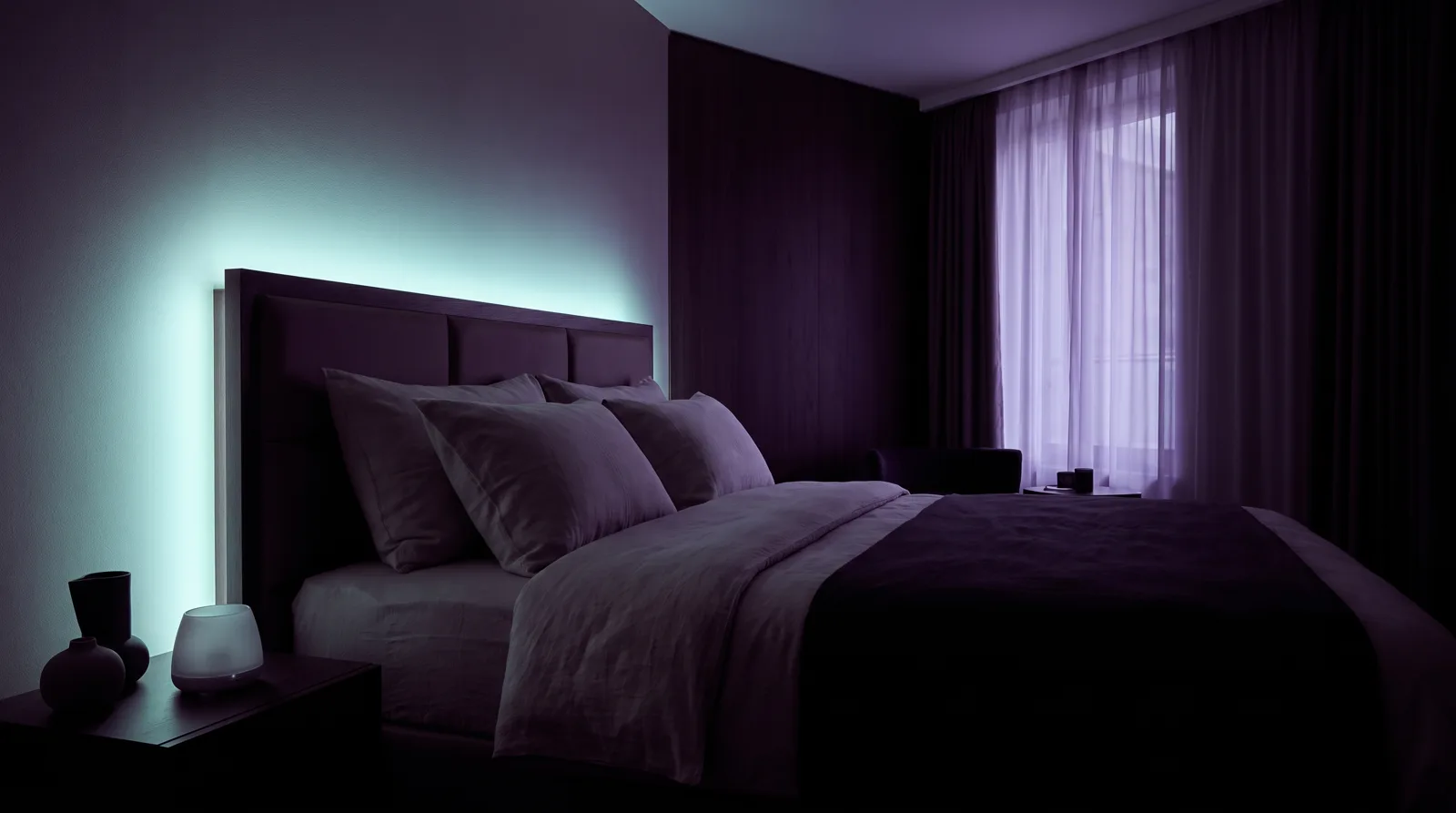
Every business trip, same ritual. Great hotel, blackout curtains, a bed objectively nicer than the one in my apartment, and I lie there at 2 a.m. listening to the ice machine like it owes me money. Then the second night I sleep fine. If that pattern sounds familiar, congratulations: you've met the first-night effect, one of the best-documented quirks in sleep research. And the explanation is stranger than you'd guess. It's not the pillow. It's that half of your brain refuses to fully clock out.
Your brain posts a night watchman
Sleep researchers have known for decades that people sleep measurably worse on their first night in a lab: longer to fall asleep, more waking, less deep sleep. It was so reliable that scientists routinely threw out the first night's data. In 2016, a team at Brown University finally asked what the brain is actually doing during that bad first night, and the answer made headlines. Using neuroimaging, Tamaki and colleagues found that on the first night in a new place, the left hemisphere maintained noticeably shallower sleep than the right, stayed more responsive to unusual sounds, and could trigger faster wake-ups. By the second night, the asymmetry faded (Tamaki et al., 2016, Current Biology).
In other words: one half of your brain stays on guard duty. Ducks and dolphins do a dramatic version of this, sleeping with one hemisphere at a time so the other can watch for predators. Your brain apparently runs a subtle, part-time edition of the same program whenever the bedroom is unfamiliar.
One half of your brain stays on guard duty. The hotel isn't the problem. The novelty is.
Evolution doesn't care about your meeting
This makes complete sense if you zoom out about 50,000 years. An unfamiliar sleeping place used to be a real gamble: new sounds, new exits, unknown neighbors with unknown intentions. A brain that slept lightly in new territory and woke fast at strange noises kept its owner alive. The fact that your new territory is a Marriott with a keycard and a continental breakfast has not yet reached the relevant departments. Your threat-detection system sees an unfamiliar room and staffs the night shift accordingly.
I find this weirdly comforting. The 2 a.m. hotel stare-at-the-ceiling session isn't a personal failing or broken sleep hygiene. It's an ancient security feature doing exactly what it was built to do, in a context where it's no longer useful. You can't uninstall it. But you can absolutely negotiate with it.
What makes it worse
The watchman is specifically listening for novelty, so novel input feeds it. Unfamiliar sounds are the big one: every building has its own acoustic fingerprint of hums, pipes, elevators, and hallway doors, and each new sound gets flagged for review. Checking the clock makes it worse, because now you're doing sleep math, and sleep math is just anxiety with numbers. So does treating the first night as a test you might fail; pressure to sleep is spectacularly bad at producing sleep.
It's not only your ears, either. A new room smells different, the sheets have a different weight, the mattress pushes back in unfamiliar places, the dark has its own arrangement of tiny lights. None of it is threatening, but all of it is new, and new is exactly the category the vigilant hemisphere was hired to review. The more of those inputs you can swap for known ones, the shorter the watchman's checklist gets.
How to make a strange room boring
You can't make a new room familiar, but you can make it less interestingly unfamiliar. The goal is to reduce the amount of novel input the night watchman has to process:
- Bring one piece of home for your senses: your own pillowcase, a t-shirt you've slept in, anything that smells and feels like your actual bed.
- Run your normal wind-down routine in the normal order. If you always read ten pages, read ten pages. The sequence itself tells your brain this counts as bedtime.
- Cover the room's acoustic fingerprint with a familiar one. Steady noise you already know masks the building's unfamiliar sounds and gives the watchman nothing new to flag.
- Scope out the room for two minutes when you arrive: where's the door, the bathroom, the light switch. A little spatial familiarity is exactly the information the vigilant hemisphere is missing.
- Turn the clock away. The watchman doesn't need a scoreboard.
The sound trick is the one I lean on hardest. I travel with the same wind-down I use at home: the same Feelsy texture with the same soundscape, low volume, autoplay on so I never touch the phone again after lights out. The point isn't that it's fancy. The point is that it's identical every night, and identical is the one thing a strange room can't offer. My brain hears the sound it associates with my own bed, and some gullible ancient circuit concludes we must be home.
The good news: it's one night
The first-night effect is, by definition, a first-night problem. In the Brown study the hemispheric asymmetry was gone by night two; your brain files the room under known territory remarkably fast. So if you're traveling for a few days, expect a mediocre first night, don't panic about it, and know that better sleep is coming without any effort from you. And if you sleep badly every night, at home, in a bed your brain has known for years, that's not the first-night effect; that's worth a conversation with a professional.
Feelsy is a wellness product, not medical advice. If stress, anxiety or sleep problems persist, please speak with a qualified professional.
References
- Tamaki, M., Bang, J. W., Watanabe, T., & Sasaki, Y. (2016). Night Watch in One Brain Hemisphere during Sleep Associated with the First-Night Effect in Humans. Current Biology, 26(9), 1190-1194.
Frequently Asked Questions
Why can't I sleep the first night in a hotel?
It's called the first-night effect. Brain imaging research from Brown University found that on the first night in an unfamiliar place, your left hemisphere sleeps more shallowly than the right, stays more responsive to sounds, and wakes you faster. It's an evolutionary security system: your brain treats a new sleeping location as unverified territory and keeps a partial watch.
How long does the first-night effect last?
Usually exactly one night. In the 2016 Current Biology study, the asymmetry between brain hemispheres had faded by the second night. Your brain reclassifies the room as familiar territory quickly, which is why night two in the same hotel almost always feels dramatically better.
How do I sleep better in a new place?
Reduce novelty for your senses. Bring something that smells like your own bed, run your usual wind-down routine in its usual order, mask the building's unfamiliar sounds with a steady sound you already sleep to at home, and glance around the room when you arrive so the layout isn't unknown. Familiar input quiets the brain's night-watch response.
Do animals also sleep with half their brain?
Yes, some do it far more dramatically than we do. Dolphins and many birds sleep one hemisphere at a time so the other can stay alert for threats. The human first-night effect looks like a subtle, temporary version of the same strategy, appearing only when the sleeping environment is new.
Is bad hotel sleep the same as insomnia?
No. The first-night effect is a normal, temporary response to an unfamiliar environment and resolves on its own by the next night. Insomnia is persistent trouble sleeping in familiar surroundings. If you regularly sleep badly at home, that pattern deserves attention from a qualified professional.

About the author
Contributing writer
Kurt is a New York based writer covering the practical science of stress, sleep and focus. He is the resident sceptic of the Journal: if a technique cannot survive a crowded subway commute and a deadline week, he is not interested in it.
Feel it for yourself.
Feelsy turns reading about calm into practising it. Two minutes of a slow texture is often the whole difference.


Related reading
 Sleep
SleepHow to Fall Asleep Faster: Sound, Light and Ritual
Falling asleep is a skill, not a stroke of luck. Here is how sound, light and a 15-minute ritual can quiet a racing mind and shorten the trip to sleep.
 Sleep
SleepWhy You Wake Up at 3 AM (and How to Get Back to Sleep)
Waking at 3 AM isn't a curse or a sign something's broken. Here's the sleep science behind those small-hours wake-ups, and what actually gets you back down.
 Sleep
SleepWhite Noise for Sleep: What Works and What Does Not
White, pink and brown noise all promise better sleep. Here is what the evidence actually supports, how to choose, and how to set up sound for a quieter night.
 SleepNew
Night Owl vs Early Bird: The Science of Chronotypes
Night owl or early bird isn't a personality flaw or a virtue. It's a chronotype. Here's what the science says about your body clock and how to work with it.
 SleepNew
How to Wake Up Early (Without Hating Your Life)
Want to become a morning person? Here's how to wake up early using light, timing and consistency, based on what circadian science actually shows.
 Sleep
SleepCan't Sleep? Why Getting Out of Bed Is the Counterintuitive Fix
Lying awake trying harder is the one thing that makes insomnia worse. Here's the 20-minute rule, the science of stimulus control, and how to use it.