Why You Can't Sleep Without Your Fan (It's Not Just the Breeze)
Millions can't fall asleep without a fan running. The science of why fan noise and moving air knock you out, plus when the habit works against you.
By Kurt Woleret
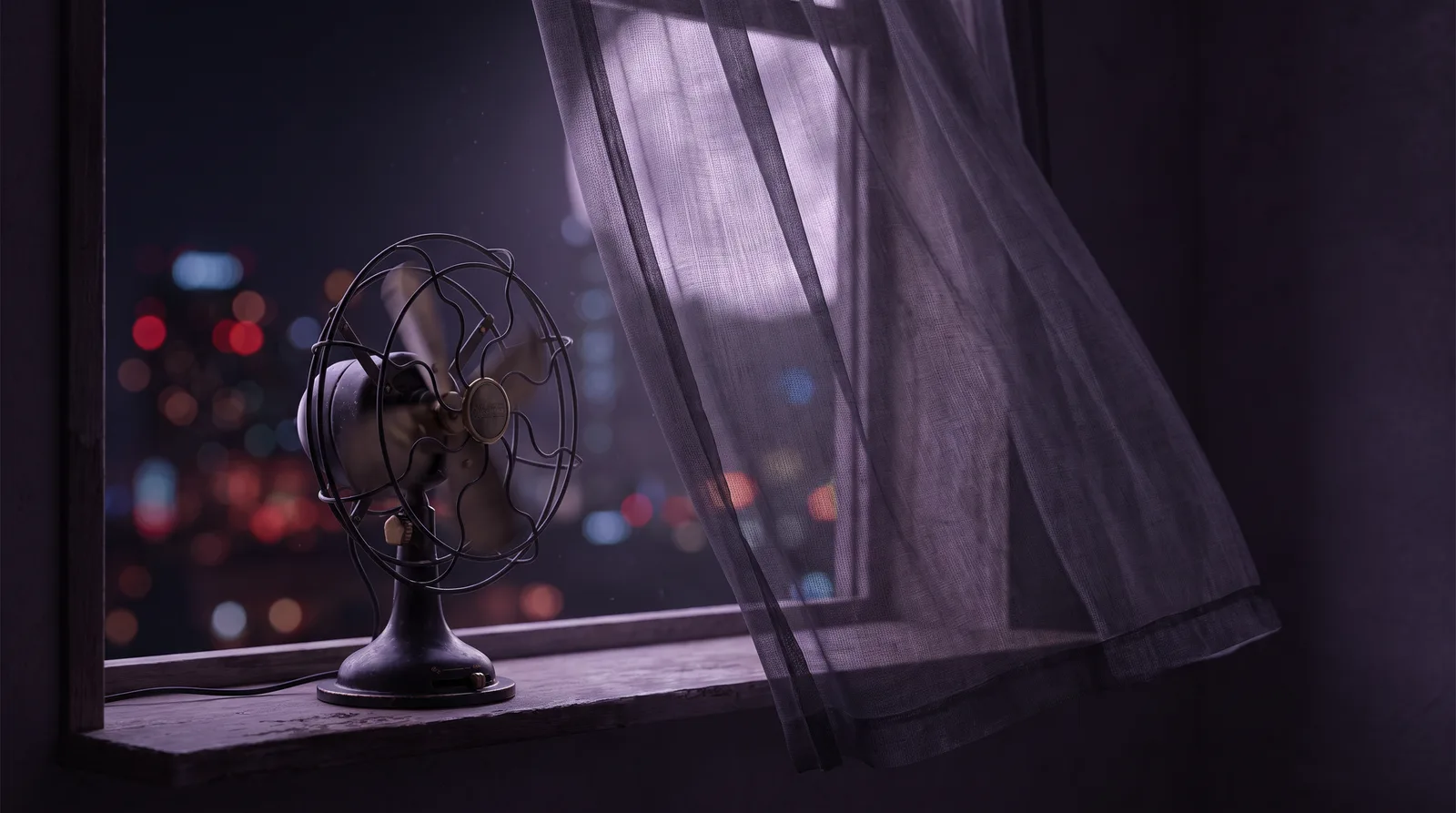
I once house-sat in a place with central air, triple-glazed windows, and total silence. Objectively luxurious sleeping conditions. I lay awake for two hours. The problem wasn't noise; it was the absence of my noise. No fan. I'd been sleeping next to a cheap box fan for so long that its dumb little motor had become a load-bearing part of my nervous system. If you've ever packed a travel fan in a suitcase, or opened a fan-sound video in a hotel at 2 a.m., you know exactly what I mean. So let's take the habit seriously for a minute: why does a spinning piece of plastic outperform silence?
The fan is a white noise machine that also moves air
A fan does two jobs at once, and both of them matter for sleep. Job one is acoustic. A fan produces a steady, broadband whir, which is functionally white noise with a mechanical accent. That steady sound does something valuable in a noisy environment: it raises the floor. Your sleeping brain keeps monitoring sound all night, and what tends to wake you isn't loudness itself but sudden change, the slammed car door against the quiet street. A fan narrows the gap between background and interruption, so the door, the pipes, and the upstairs neighbor's 3 a.m. chair drag all land softer relative to the hum. The fan doesn't silence your building. It makes your building's noises less newsworthy.
And this isn't just cope from fan people like me. A study of sleepers in loud parts of New York City found that adding continuous white noise to high-noise bedrooms improved sleep compared with the ambient racket alone (Ebben, Yan, & Krieger, 2021). Small study, real effect, and it matches what half this city already figured out empirically at the hardware store.
Job two: your brain likes sleeping cool
The second job is thermal. Falling asleep rides on a drop in your core body temperature; it's one of the signals your brain reads as 'night has begun.' A room that's too warm fights that drop, which is why hot nights produce that special flavor of rotisserie-style insomnia where you rotate slowly and resent everything. Moving air helps sweat evaporate and pulls heat off your skin, nudging you toward the cool-down your sleep system wants. The fan isn't lowering the room's temperature much; it's helping your body shed its own heat faster. Breeze plus hum is a two-for-one, which is why the fan habit is so sticky compared to a pure noise machine.
There's a useful number hiding in here too. Most sleep researchers put the ideal bedroom somewhere around 65 degrees Fahrenheit, give or take a few degrees for personal taste, which is colder than most people keep their homes. If your bedroom runs warm and you can't fix the thermostat, the fan is doing disproportionate work, and pointing it across the bed rather than at the ceiling gets you more of the evaporative benefit. In winter the equation flips: the room is already cool, so the fan is mostly there for the sound, and you can drop it to the lowest setting and keep the ritual without the wind chill.
The fan doesn't silence your building. It makes your building's noises less newsworthy.
The conditioning effect: your fan is a bedtime password
There's a third thing going on that has nothing to do with acoustics or airflow. After years of pairing that sound with falling asleep, the sound itself becomes a cue. Flip the switch, and your brain hears the opening notes of the going-to-sleep routine. That's classical conditioning, the same mechanism behind why your wind-down routine works, and honestly it's the part I'd defend hardest. A reliable cue that tells your nervous system 'we're done for today' is worth protecting. It's also why the silent luxury apartment wrecked me: no password, no entry.
When the fan works against you
Fair is fair, so here's the case against. A fan pointed straight at your face all night can dry out your eyes, mouth, and sinuses, and if you're prone to allergies it does a great job of keeping dust circulating like it's on payroll. Cheap fans also develop rattles, and a rattle is the opposite of broadband noise: it's a rhythmic attention magnet. And if you're using roaring air to bury a genuinely loud environment every single night, the fan can become a bandage over a problem worth actually fixing with weatherstripping, a rug, or a conversation with the drummer upstairs. The dose makes the medicine: angle it away from your face, keep it clean, and let it hum rather than howl.
If you love the sound but not the wind
Some nights you want the hum without the airflow: winter, a sore throat, a partner who considers moving air a personal attack. That's when a steady sound source does the fan's acoustic job on its own. This is exactly how I use Feelsy when I travel; I put on one of its low steady soundscapes with a slow dark texture drifting on the screen, set it by the bed, and my brain accepts the substitute password without complaint. At home, the box fan keeps its job. The broader point stands either way: a consistent, boring, steady sound at a modest volume is one of the cheapest sleep aids there is, whether it comes from a motor, an app, or a machine. Silence is overrated. Ask anyone who's tried to sleep in it.
Feelsy is a wellness product, not medical advice. If stress, anxiety or sleep problems persist, please speak with a qualified professional.
References
- Ebben, M. R., Yan, P., & Krieger, A. C. (2021). The effects of white noise on sleep and duration in individuals living in a high noise environment in New York City. Sleep Medicine, 83, 256-259.
Frequently Asked Questions
Why do I sleep better with a fan on?
A fan helps on three fronts at once. Its steady whir acts like white noise, masking sudden sounds that would otherwise wake you; its airflow helps your body shed heat, supporting the core temperature drop that starts sleep; and after years of pairing the sound with bedtime, the hum itself becomes a learned cue that tells your brain it's time to shut down.
Is it bad to sleep with a fan on every night?
For most people, no. The main downsides are dryness in your eyes, mouth, and sinuses if the fan blows directly on your face, and circulating dust if you have allergies. Angling the fan away from your face and keeping the blades clean solves most of it.
Does a fan count as white noise?
Effectively, yes. A fan produces steady broadband sound, which works the same way white noise does: it raises the background sound level so sudden noises stand out less to your sleeping brain. A study of sleepers in loud New York City bedrooms found continuous white noise improved sleep compared with the ambient noise alone.
What can I use instead of a fan for sleep sounds?
Any steady, boring, consistent sound at a modest volume does the acoustic job: a white noise machine, a fan recording, or a sleep sound app. Steadiness matters more than the exact sound. If you also relied on the fan's breeze, pair the sound with a cooler room so you're covering both halves of what the fan did.

About the author
Contributing writer
Kurt is a New York based writer covering the practical science of stress, sleep and focus. He is the resident sceptic of the Journal: if a technique cannot survive a crowded subway commute and a deadline week, he is not interested in it.
Feel it for yourself.
Feelsy turns reading about calm into practising it. Two minutes of a slow texture is often the whole difference.


Related reading
 Sleep
SleepWhite Noise for Sleep: What Works and What Does Not
White, pink and brown noise all promise better sleep. Here is what the evidence actually supports, how to choose, and how to set up sound for a quieter night.
 Sleep
SleepThe Best Temperature for Sleep (and Why Your Bedroom Runs Hot)
What's the best temperature for sleep? Why cooler rooms help you fall asleep faster, what the research says about heat, and how to fix a hot bedroom.
 Sleep
SleepBrown Noise for Sleep and Focus: What It Is and Why It Works
Brown noise is the internet's favorite sleep and focus sound. What it actually is, how it differs from white and pink noise, and what research really shows.
 SleepNew
Night Owl vs Early Bird: The Science of Chronotypes
Night owl or early bird isn't a personality flaw or a virtue. It's a chronotype. Here's what the science says about your body clock and how to work with it.
 SleepNew
How to Wake Up Early (Without Hating Your Life)
Want to become a morning person? Here's how to wake up early using light, timing and consistency, based on what circadian science actually shows.
 Sleep
SleepCan't Sleep? Why Getting Out of Bed Is the Counterintuitive Fix
Lying awake trying harder is the one thing that makes insomnia worse. Here's the 20-minute rule, the science of stimulus control, and how to use it.