Is Bed Rotting Bad for You? What Sleep Science Actually Says
Bed rotting feels like self-care until your bed stops meaning sleep. Here's what stimulus control research says, and how to rest without ruining your nights.
By Kurt Woleret
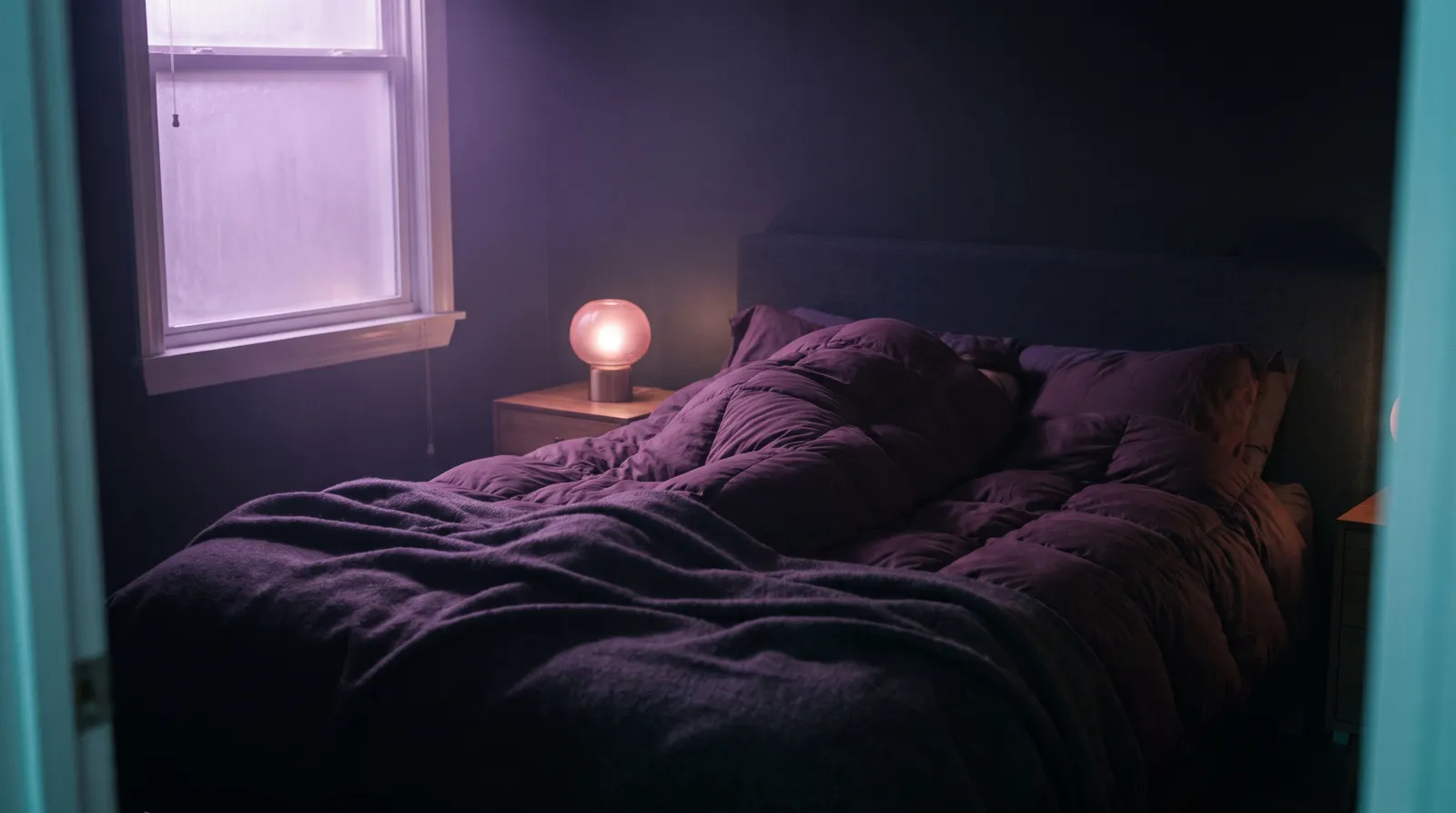
Bed rotting, for anyone whose feeds haven't served it up yet, is the practice of staying in bed for hours while awake, on purpose, doing nothing productive: scrolling, snacking, watching a show you've already seen, existing horizontally. The internet has rebranded this as self-care, which is the internet's favorite move. And look, as a man who has spent entire January Sundays in a Brooklyn apartment where the bed is technically also the living room, I'm not here to judge the impulse. The impulse is legitimate. The question is whether the bed is the right venue, and on that question sleep science has an actual opinion, backed by fifty years of research. Short version: your future 2 a.m. self would like a word.
The case for rotting
Let's be fair to the rot. Most people are carrying a real rest deficit; the calendar is full, the commute is loud, and the modern weekend has been colonized by errands and optimization. A day with zero demands is not laziness, it's the correction. There's also a decompression argument: lying still with low stimulation is roughly what every wellness tradition prescribes, just with worse lighting and more crumbs. If a horizontal day helps you show up Monday as a person instead of a husk, that's not a disorder. The problem was never the resting. The problem is the address.
It's also worth naming why this trend found its moment. Bed rotting went viral in an era when rest itself got turned into a product category, complete with routines, gear, and performance metrics. Rotting is the opt-out: rest with no skincare step, no journal prompt, no before-and-after. There's something almost principled about it. In a small apartment, the bed is often the only soft territory you've got, the one surface that doesn't double as a desk. I get why it became the sanctuary. That's precisely why it's worth protecting what the sanctuary is for.
The catch: your bed is a trained cue
Here's the piece the trend skips. Sleep researchers have known since the early 1970s, when psychologist Richard Bootzin developed what's called stimulus control therapy, that the bed works as a conditioned cue. Spend your bed time sleeping, and the bed itself starts triggering drowsiness, the way your kitchen makes you hungry and your inbox makes you tense. Spend hours in bed awake, scrolling, eating, and watching television, and you teach your brain the opposite lesson: this is a place where we are alert and entertained. The classic instructions, bed is for sleep, get out if you're lying awake, exist precisely to protect that association. And this isn't vintage theory on a dusty shelf: a 2024 systematic review and meta-analysis in the Journal of Sleep Research found stimulus control effective as a treatment for insomnia, on its own and not just as a garnish inside broader therapy (Jansson-Fröjmark et al., 2024). Fifty years on, the boring rule keeps winning.
Your bed keeps a ledger. Every awake hour you spend in it is a small withdrawal from how fast you'll fall asleep tonight.
So the honest answer to is bed rotting bad for you is: it depends on your nights. If you fall asleep the moment you're horizontal and sleep like a sedated cat, an occasional rot day probably costs you little; your bed-sleep association has deep reserves. But if you already lie awake at night, watch the ceiling at 2 a.m., or describe yourself as tired but wired, then bed rotting is training the exact reflex that's keeping you up. You're rehearsing wakefulness on the very stage where you need the opposite performance.
How to rot responsibly
I'm not going to tell you to spend your recovery day doing sunrise yoga. Keep the rot; adjust the logistics:
- Move the rot two feet. Couch, floor cushion, the armchair you bought for reading and use for laundry. You get the full horizontal do-nothing experience while your bed keeps its one job.
- If it must be the bed, put a time box on it. A lazy morning hour is a different animal from a twelve-hour residency. Get up, break the association, come back at night.
- Hold your wake time anyway. Sleeping in until noon before a rot day shifts your body clock later, and Monday's alarm collects the difference with interest.
- Downgrade the stimulation as the day goes on. A feed is a slot machine; evening rot goes better with slower input. I'll put Feelsy's autoplay on, textures drifting along on their own, precisely because it asks nothing of me, and my thumb gets the night off too.
The verdict
Rest is not the enemy; the science is actually on the side of doing nothing more often. But the bed is special terrain. It's the one piece of furniture with a trained job, and the job is fragile in exactly the people most drawn to rotting: the exhausted, the wired, the ones whose nights are already a negotiation. So take the day off. Take it seriously, even. Just take most of it on the couch, keep your wake time, and let your bed stay typecast in the one role it was born to play. The whole point of the rot day is to feel better afterward, and nothing undoes a day of rest faster than a night of staring at the ceiling in the room where you spent twelve hours teaching your brain to stay awake.
Feelsy is a wellness product, not medical advice. If stress, anxiety or sleep problems persist, please speak with a qualified professional.
References
- Jansson-Fröjmark, M., Sandlund, C., & Norell-Clarke, A. (2024). Stimulus control for insomnia: A systematic review and meta-analysis. Journal of Sleep Research.
Frequently Asked Questions
Is bed rotting bad for your sleep?
It depends on your nights. Your bed works as a conditioned cue: spend bed time sleeping and the bed itself triggers drowsiness, but spend long awake hours in it scrolling and watching shows and you weaken that association. If you already struggle with lying awake at night, bed rotting rehearses wakefulness exactly where you need sleepiness.
What is stimulus control therapy?
It's a behavioral approach developed by psychologist Richard Bootzin in the early 1970s, built on the idea that the bed is a learned cue for sleep. The core rules are to use the bed only for sleep and to get out of bed when you're lying awake, protecting the bed-sleep association. A 2024 systematic review and meta-analysis in the Journal of Sleep Research found it effective as an insomnia treatment on its own.
Is it okay to spend a whole day resting in bed?
An occasional lazy day is a legitimate correction for a real rest deficit, and if you fall asleep easily at night it probably costs you little. The safer version is to move most of the resting to a couch or armchair, time-box any bed portion to an hour or so, and keep your normal wake time so your body clock doesn't drift.
How can I rest all day without wrecking my sleep schedule?
Keep the do-nothing day but change the venue: rot on the couch so your bed keeps its one job. Get up at your usual time even on rest days, since sleeping until noon shifts your body clock later and Monday collects the difference. And wind the stimulation down as evening approaches, trading fast feeds for slower, calmer input.

About the author
Contributing writer
Kurt is a New York based writer covering the practical science of stress, sleep and focus. He is the resident sceptic of the Journal: if a technique cannot survive a crowded subway commute and a deadline week, he is not interested in it.
Feel it for yourself.
Feelsy turns reading about calm into practising it. Two minutes of a slow texture is often the whole difference.


Related reading
 Sleep
SleepRevenge Bedtime Procrastination: Why You Won't Go to Sleep
Revenge bedtime procrastination is staying up late to steal back your day. Here's why exhausted people do it, and how to stop without giving up your evening.
 Sleep
SleepCan't Sleep? Why Getting Out of Bed Is the Counterintuitive Fix
Lying awake trying harder is the one thing that makes insomnia worse. Here's the 20-minute rule, the science of stimulus control, and how to use it.
 Sleep
SleepTired but Can't Sleep? Why You're Wired at Bedtime
Exhausted all day, wide awake at midnight. Here's the science of being tired but wired, and what actually works to switch your brain off at bedtime.
 SleepNew
Why Do You Wake Up With Anxiety? Blame Your Body's Morning Chemistry
Waking up with anxiety isn't a character flaw; it's partly chemistry. Here's how the cortisol awakening response works and what actually calms it down.
 SleepNew
Why You Get a Second Wind Right Before Bed
Exhausted all evening, wide awake at 11pm? That burst of energy before bed is your brain's wake maintenance zone. Here's the science and how to beat it.
 Sleep
SleepWhy You Wake Up Right Before Your Alarm Goes Off
Waking up minutes before your alarm isn't spooky. Your body clock predicts the morning and preps you in advance. Here's the science of pre-alarm waking.