What the Mid-Autumn Festival Teaches About Slowing Down
Mid-Autumn Festival is a masterclass in slowness: moon gazing, shared mooncakes, a table full of family. What a thousand-year-old holiday knows about rest.
By Mei Lin
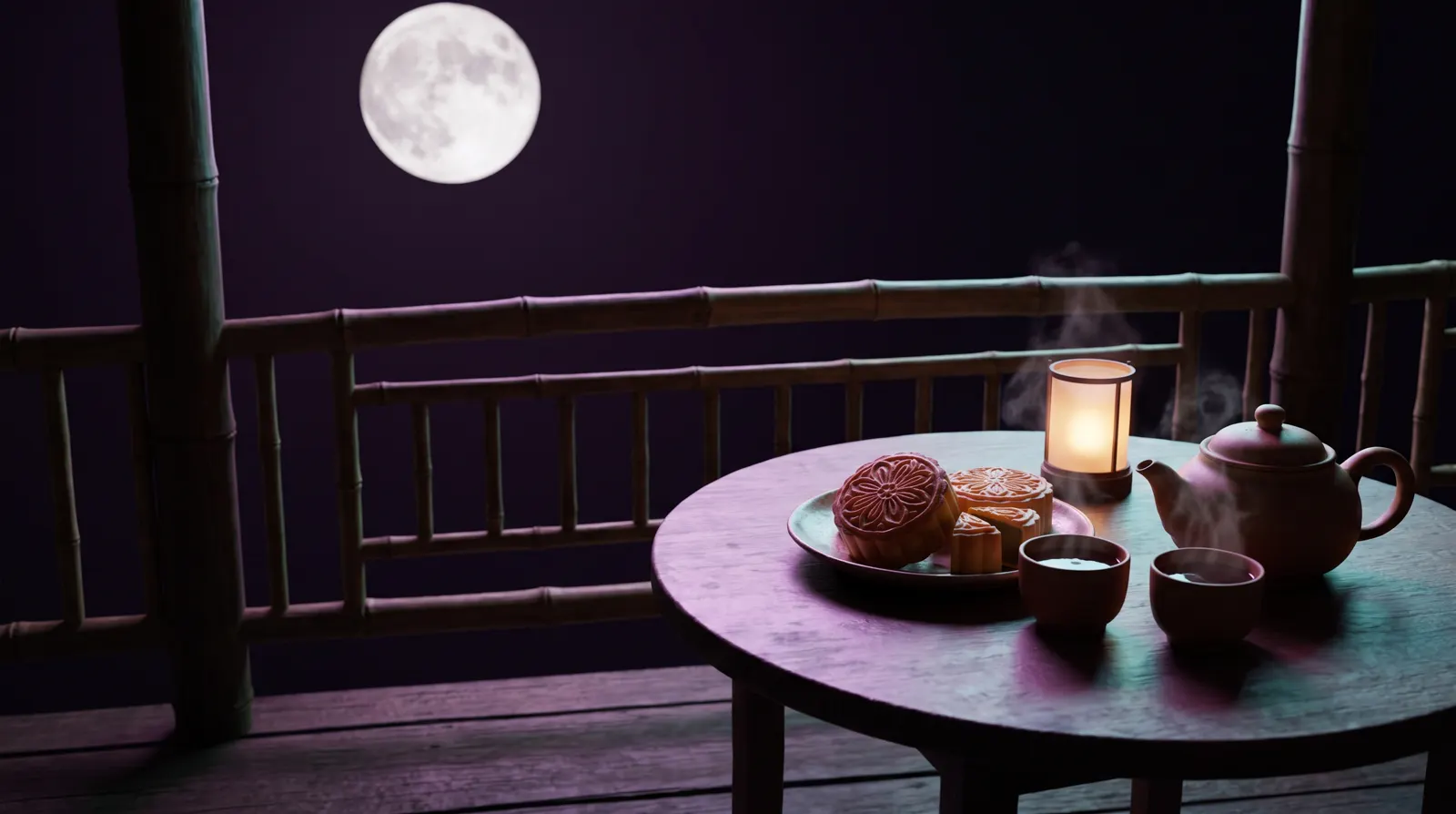
Every autumn of my childhood, on the fifteenth night of the eighth lunar month, my family carried a small table onto the balcony. On it went a pot of tea, a plate of mooncakes cut into slivers, and a bowl of pomelo my grandmother peeled in one unbroken spiral. Then we did something that sounds almost radical now: we sat together and looked at the moon. Not for a photo. Not for a caption. Just looking, the way you look at a fire, until the tea went cool and someone finally said it was time for bed.
This is the Mid-Autumn Festival, and this year it arrives in late September, when the moon is said to be at its roundest and brightest. It is one of the most important holidays in the Chinese calendar, celebrated for over a thousand years, and underneath the lanterns and the pastry, it is something else as well: a masterclass in slowing down.
A festival built around looking up
Most holidays organize themselves around doing. The Mid-Autumn Festival organizes itself around watching. Moon appreciation, shangyue, is the heart of the evening; poets of the Tang dynasty made an art form of it, writing verses to the full moon that schoolchildren still recite today. The festival falls at harvest time, when the work of the season is done and the granaries are full, and the moon at its fullest became the symbol of that completeness.
The full circle carries a second meaning. In Chinese, reunion is tuanyuan, and the second character means round. A round moon, a round table, a round pastry: the festival's whole vocabulary points at the same idea, that on this night the family circle closes. People travel long distances to be home for it, and those who cannot travel step outside and look up, knowing the people they miss are looking at the same moon. It is a technology for feeling close across distance, and it needs no signal.
The evening has its supporting cast too. Children carry paper lanterns through the streets, small warm lights bobbing at knee height. In Shanghai the season smells of sweet osmanthus, and the flowers find their way into wine and syrup and tea. But none of the extras compete with the main event. Everything on the table, everything in the street, is arranged to face the sky.
The economy of smallness
Consider the mooncake. It is dense, rich, and small, a palm-sized pastry pressed with flowers and characters, filled with lotus seed paste or red bean, sometimes hiding a salted duck egg yolk like a small golden moon. And here is the detail I love: you are not meant to eat one alone. A mooncake is cut into slivers and shared around the table, one thin piece per person, with tea to answer the sweetness.
There is a quiet lesson in that. The pleasure is not in quantity but in ceremony: the cutting, the offering, the small slice savored slowly because it is rich enough to insist on slowness. My grandmother would make one mooncake last an entire conversation. The festival does not say indulge. It says pay attention.
The moon does not hurry, and for one evening, neither do we.
Why rituals like this calm us
It is tempting to file all this under nostalgia, but psychology suggests rituals earn their keep. A widely cited review of the research describes how rituals, with their fixed sequences and symbolic weight, help people regulate emotions, feel connected to others, and mark meaning in ways ordinary habits do not (Hobson et al., 2018, Personality and Social Psychology Review). The steps matter because they are steps: fill the pot, cut the cake, carry the table out, look up. A ritual tells the nervous system that this hour is different from the hours around it.
The Mid-Autumn evening bundles several calming practices into one: gentle attention on a slow, luminous object; warm food and drink taken unhurried; the company of people who require no performance from you. Any one of these would soothe. The festival simply had the wisdom to schedule all three at once, annually, for a millennium.
Borrowing the festival, wherever you live
You do not need to be Chinese, or near family, or in possession of a single mooncake to borrow the shape of the evening. The ingredients travel well:
- Step outside on the night of the full moon and give it ten unhurried minutes. No phone, no photo. Let your eyes adjust and notice how much light a full moon actually throws.
- Share something small and rich with someone, cut into slivers, with tea. The ceremony of dividing it is half the point.
- If the people you miss are far away, agree on a time and look at the moon together from your separate cities. It is the festival's oldest trick, and it still works.
- End the evening softly. Moonlight, then lamplight, then bed. No feed in between.
A softer light to end the day
What stays with me from those balcony evenings is not the pastry. It is the pace. An entire holiday built around sitting still with people you love, watching the slowest show in the sky, eating one small sweet thing with full attention. If the clouds cover your moon this month, or your balcony faces the wrong way, you can still keep the spirit of it: some evenings I end the day with the drifting orb textures in Feelsy on autoplay, a small private moon that rises on request, while the kettle does its work. The festival's lesson does not depend on the weather. Find something round and luminous, share something small and sweet, and let one evening a month move at the moon's speed instead of yours.
Feelsy is a wellness product, not medical advice. If stress, anxiety or sleep problems persist, please speak with a qualified professional.
References
- Hobson, N. M., Schroeder, J., Risen, J. L., Xygalatas, D., & Inzlicht, M. (2018). The psychology of rituals: An integrative review and process-based framework. Personality and Social Psychology Review, 22(3), 260–284.
Frequently Asked Questions
What is the Mid-Autumn Festival?
The Mid-Autumn Festival is one of the most important holidays in the Chinese calendar, celebrated for over a thousand years on the fifteenth night of the eighth lunar month, when the moon is said to be at its roundest and brightest. Families reunite, share mooncakes cut into slivers with tea, and practice moon appreciation, sitting together to watch the full moon. It falls at harvest time and the full moon symbolizes completeness and reunion.
Why are mooncakes shared instead of eaten whole?
A mooncake is dense and rich by design, so it is cut into thin slivers and shared around the table, one piece per person, with tea to answer the sweetness. The pleasure lies in the ceremony of cutting, offering and savoring slowly rather than in quantity. The pastry is rich enough to insist on slowness, which is part of the festival's quiet lesson: pay attention, do not simply indulge.
Why do rituals like moon gazing feel so calming?
Research on the psychology of rituals suggests that fixed sequences with symbolic weight help people regulate emotions, feel connected to others, and mark meaning in ways ordinary habits do not. A ritual tells the nervous system that this hour is different from the hours around it. The Mid-Autumn evening also bundles several calming practices at once: gentle attention on a slow, luminous object, warm food taken unhurried, and company that asks no performance of you.
How can I celebrate the Mid-Autumn Festival if I am far from family?
Use the festival's oldest trick: agree on a time with the people you miss and look at the moon together from your separate cities, knowing you are watching the same one. Then borrow the rest of the shape of the evening, ten unhurried minutes outside under the full moon, something small and rich shared in slivers with tea, and a soft ending to the night, moonlight, then lamplight, then bed.
About the author
Contributing writer
Mei grew up in Shanghai around tea that could not be hurried and grandmothers who considered stillness a skill. She writes about slow hands and sensory ritual: tea, calligraphy, qigong, and the quiet crafts that taught the world how to pay attention.
Feel it for yourself.
Feelsy turns reading about calm into practising it. Two minutes of a slow texture is often the whole difference.


Related reading
 Visual Meditation
Moon Gazing Meditation: The Oldest Night Practice There Is
Why looking at the moon calms the mind, what older traditions understood about moonlight, and how to practise a simple moon gazing meditation tonight.
 Ancient Wisdom
Tea Meditation: The Slow Ritual of Gongfu Cha
How to turn tea into meditation: the Chinese gongfu tea ritual, why warm slow ritual calms the nervous system, and a ten-minute practice for any mug.
 Ancient Wisdom
Why Chinese Grandmothers Prescribe Hot Water for Everything
In China, plain hot water is comfort, care and daily ritual in a single cup. The story of he re shui, thermos culture, and what a warm slow sip can teach.
 Ancient Wisdom
Döstädning: The Gentle Swedish Art of Death Cleaning
What Swedish death cleaning really means: the calm philosophy of döstädning, how it differs from ordinary decluttering, and how to begin at any age.
 Ancient Wisdom
How to Start a Gratitude Journal You Will Actually Keep
How to start a gratitude journal that actually helps: what the research found, why most lists go stale, and the very old art of counting blessings.
 Ancient Wisdom
Haiku as Meditation: Seventeen Syllables of Attention
How writing haiku trains attention: why the tiny form works like meditation, what noticing small moments does for wellbeing, and how to write your first.