The Six Healing Sounds: A Gentle Guide to Liu Zi Jue
Liu Zi Jue, the Six Healing Sounds, is a qigong practice built on six slow exhalations. A beginner's guide to the sounds, their history, and how to start softly.
By Mei Lin
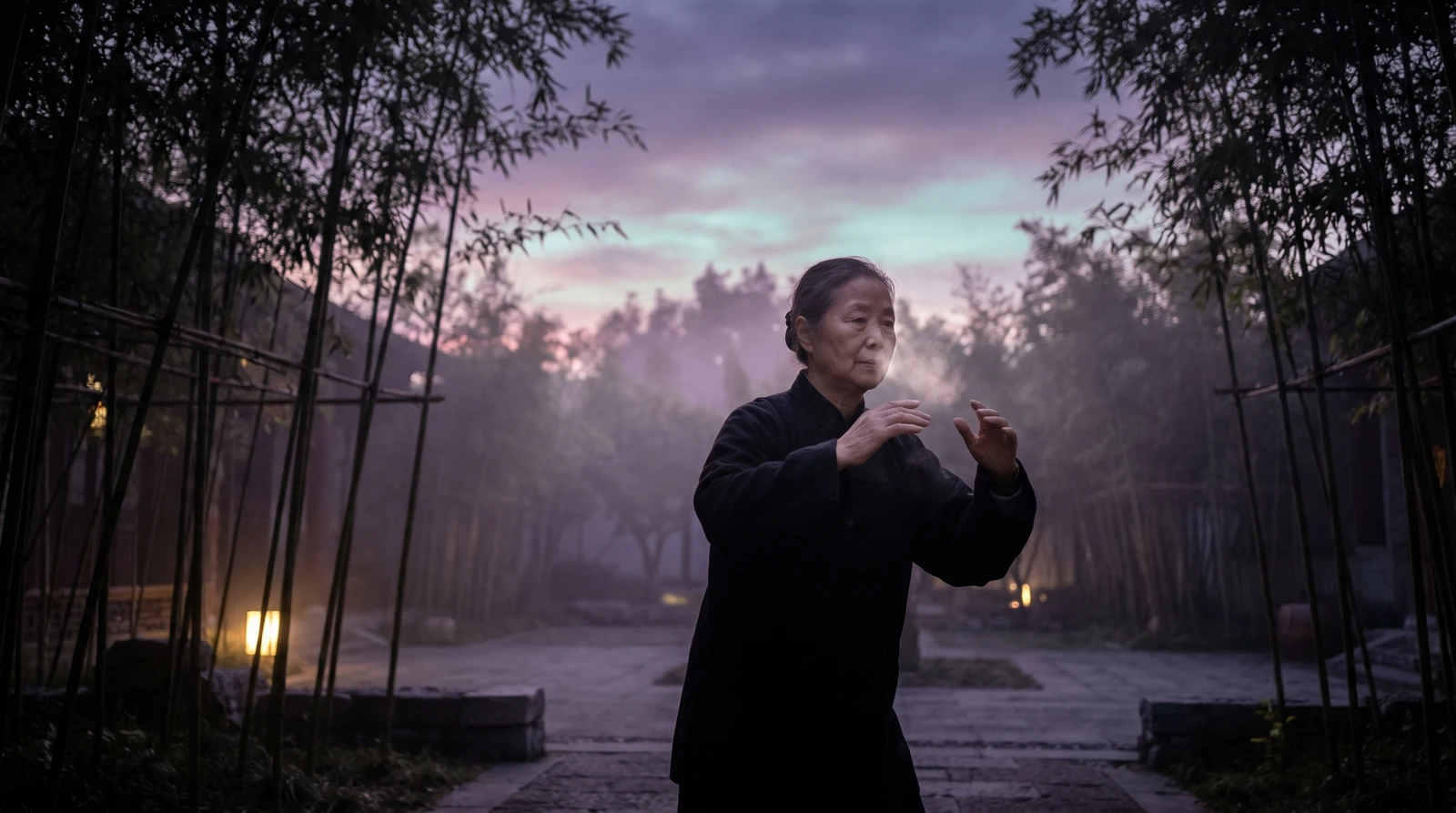
In the park near my grandmother's apartment in Shanghai, the morning belonged to the old people. Tai chi by the camphor trees, fan dancing by the pond, and here and there a quieter practice that a visitor might miss entirely: men and women standing still, lips barely parted, releasing long breaths that carried a faint sound. Shhh. Haaa. Whooo. Not singing, not speaking. Exhaling, with shape.
This is Liu Zi Jue, the Six Healing Sounds, sometimes called the six-word formula. It is one of the oldest breathing practices in the Chinese tradition, and one of the gentlest. There are no postures to master and nothing to memorize beyond six soft syllables. If you can sigh, you already have the only skill it requires.
One way in, six ways out
The practice is usually traced to Tao Hongjing, a Daoist scholar and physician of the fifth and sixth centuries, who recorded it in a text on nourishing life. His summary of the method has survived almost as a slogan: there is only one way to breathe in, but six ways to breathe out. The inhale is always the same, quiet and through the nose. All of the practice lives in the exhale.
For most of its first thousand years, Liu Zi Jue was purely a breathing exercise. Flowing arm movements were paired with the sounds much later, and the standardized modern form taught today includes them, but the heart of the practice has never changed: a slow breath out, shaped into a soft sound, repeated with attention.
The six sounds
Each sound is a different way of letting air leave the body, and in traditional Chinese medicine each is paired with an organ system and, by extension, with an emotional quality. You do not need to adopt that framework to practice; it helps to think of the pairings as a mnemonic that gives each exhale a character of its own.
- Xu (pronounced like a soft 'shoo'), traditionally paired with the liver: a wide, flat hiss through barely parted lips.
- He ('her' without the r), paired with the heart: an open, warm breath from the back of the throat.
- Hu ('who'), paired with the spleen: a rounded sound, lips in a soft O.
- Si ('sss'), paired with the lungs: a thin, even hiss past the teeth.
- Chui ('chway'), paired with the kidneys: a cooling sound, as if gently blowing on hot soup.
- Xi ('shee'), paired with the triple burner, a concept unique to Chinese medicine: a light, relieved sigh.
Spoken aloud the sounds are almost inaudible. A listener two meters away should hear wind, not words. The volume matters less than the length: each exhale is allowed to be slow, complete, and unforced, with a quiet natural inhale between.
There is only one way to breathe in, the old text says, but six ways to breathe out.
Why sounded exhales feel different
Anyone who has sighed with relief already knows the core of this practice. A long exhale slows the breath cycle, and shaping the exhale into a sound does two useful things. First, the sound regulates the pace for you: you cannot rush an exhale that has to carry a steady 'ssss' to the end. Second, the gentle vibration gives the mind a physical anchor, the same reason humming practices like bhramari feel so settling. You are not counting, not forcing, just listening to your own breath leave.
The research picture, told honestly, is young. A 2020 historical review in SAGE Open traced how Liu Zi Jue evolved from a simple breathing regimen into the comprehensive form taught today, and most clinical studies of the practice come from rehabilitation settings, where it has been used as a gentle breathing exercise for people recovering lung capacity. That is a narrow evidence base, and this article makes no medical claims from it. What the tradition offers the rest of us is simpler: a structured, pleasant way to spend five minutes exhaling slowly, which is the one lever of the nervous system almost everyone can reach.
A five-minute way to begin
Stand or sit with your feet flat and your spine comfortable, hands resting low on your belly. Breathe in quietly through the nose, and breathe out the first sound, xu, letting it run as long as it wants to without strain. Take one ordinary breath in between. Then move to the next sound. One unhurried pass through all six takes about three minutes; classical practice repeats each sound six times, but one round is a complete beginner's session.
Keep the face soft. If a sound feels awkward, let it be awkward; precision is not the point, length and ease are. Some people like to practice with eyes closed, others rest their gaze on something slow. A folding texture in Feelsy makes a kind companion here: let the slime stretch as you exhale the sound, and settle as you breathe in, so the eyes and the breath keep the same unhurried time. The 4-7-8 exercise in the app teaches the same long-exhale principle with counts instead of sounds, and the two make good neighbors.
If you feel dizzy or light-headed, pause and breathe normally; that is a sign to make the exhales shorter, not a sign to push through. And if standing still in a park releasing a long shhh toward the trees feels strange at first, I can only say that in Shanghai, nobody would look up. You would simply be one more person who knows the oldest secret of the morning: the day goes better when you empty the breath slowly before filling it.
Feelsy is a wellness product, not medical advice. If stress, anxiety or sleep problems persist, please speak with a qualified professional.
References
- Mind-body health technique Liu Zi Jue: Its creation, transition, and formalization (2020). SAGE Open.
Frequently Asked Questions
What is Liu Zi Jue, the Six Healing Sounds?
Liu Zi Jue, sometimes called the six-word formula, is a traditional Chinese qigong practice built on six slow, shaped exhalations: xu, he, hu, si, chui and xi. It is usually traced to the Daoist scholar and physician Tao Hongjing of the fifth and sixth centuries, whose summary survives as a slogan: there is only one way to breathe in, but six ways to breathe out. For most of its history it was purely a breathing exercise, with flowing movements added much later.
Do I need to believe in the organ pairings to practice the six sounds?
No. In traditional Chinese medicine each sound is paired with an organ system, such as xu with the liver and chui with the kidneys, but you can simply treat the pairings as a mnemonic that gives each exhale its own character. The practice itself is six soft, lengthened exhales with quiet natural inhales in between.
How loud should the six healing sounds be?
Barely audible. A listener two meters away should hear wind rather than words. Volume matters much less than length: each exhale should be slow, complete and unforced, and the sound mainly serves to pace the breath and give the mind a gentle physical anchor.
Is there scientific evidence behind Liu Zi Jue?
The research picture is young. A 2020 historical review in SAGE Open traced how the practice evolved from a simple breathing regimen into the standardized form taught today, and most clinical studies come from rehabilitation settings where it is used as a gentle breathing exercise. That is a narrow evidence base, so the honest case for the practice is simpler: it is a structured, pleasant way to spend five minutes exhaling slowly.
How do I start practicing the six sounds as a beginner?
Stand or sit comfortably with hands resting low on the belly, breathe in quietly through the nose, and exhale the first sound, xu, for as long as it runs without strain, then take an ordinary breath and move to the next sound. One unhurried pass through all six takes about three minutes. Stop and breathe normally if you feel dizzy, and shorten the exhales next time.

About the author
Contributing writer
Mei grew up in Shanghai around tea that could not be hurried and grandmothers who considered stillness a skill. She writes about slow hands and sensory ritual: tea, calligraphy, qigong, and the quiet crafts that taught the world how to pay attention.
Feel it for yourself.
Feelsy turns reading about calm into practising it. Two minutes of a slow texture is often the whole difference.


Related reading
 Breath & Body
Breathing Exercises for Anxiety: From Pranayama to 4-7-8
Breath is the remote control of your nervous system. Here is what slow breathing does, three techniques with steps, and when not to force it.
 Breath & Body
The 4-7-8 Breathing Technique, Step by Step
A focused walkthrough of the 4-7-8 breath: what it is, how to do it, why the long exhale calms you, and when to use it during the day and before sleep.
 Ancient Wisdom
Ancient Practices for Modern Calm: A World Tour
Humans have engineered calm for thousands of years. A tour through Zen, pranayama, hammam culture, forest bathing and the ancestors of visual meditation.
 Breath & Body
What Is Brain Rot? A Skeptic's Guide to the Scroll
Brain rot was Oxford's 2024 word of the year, but is your brain actually rotting? Here's what endless low-effort content really does to attention.
 Breath & Body
Why Multitasking Doesn't Work (and What to Do Instead)
Multitasking feels productive and measurably isn't. Here's what task switching really costs your brain, and the single-task habits that actually work.
 Breath & Body
Why Walking Helps You Think: The Science of the Thinking Walk
Why does walking help you think? Stanford research found walking roughly doubled creative output, even on a treadmill facing a wall. How to use it.