Slow TV: Why Millions Watched a Seven-Hour Train Ride
In 2009 Norway aired a seven-hour train journey, minute by minute, and a nation tuned in. Why slow TV calms the mind, and how to borrow the effect at home.
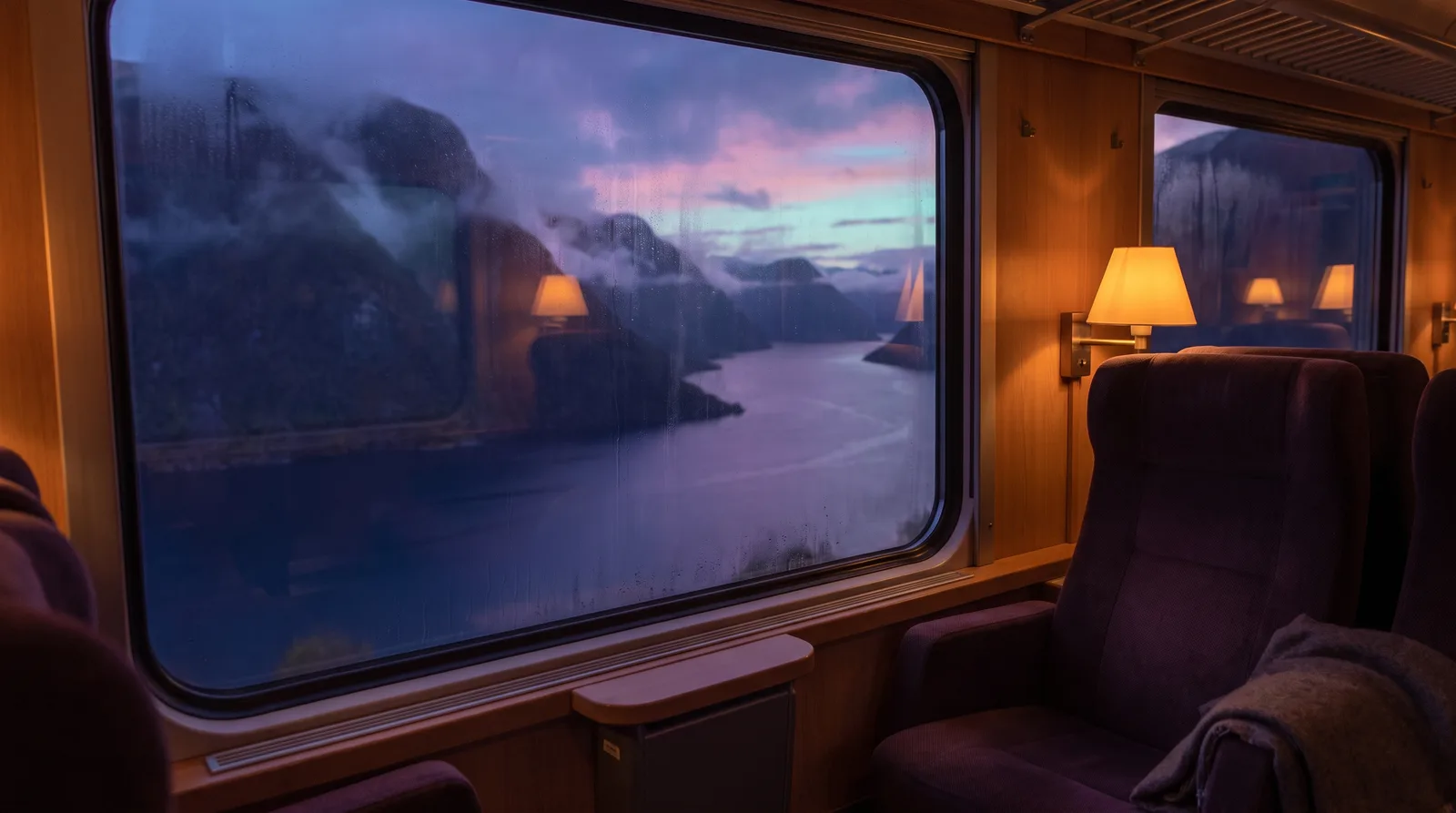
In November 2009, Norway's public broadcaster NRK marked the centenary of the Bergen railway by doing something television is never supposed to do. It mounted cameras on a train and broadcast the entire journey from Bergen to Oslo, all seven hours of it, uncut. No presenter, no plot, no music swelling at the summit. Mountains arrived and slid away. Tunnels swallowed the picture and returned it. And Norwegians, in their hundreds of thousands, sat down and watched, some of them from beginning to end. The broadcaster, braced for ridicule, found it had invented a genre instead. They called it slow TV, sakte-TV, and the name was not an apology. It was the entire point.
A nation watching a boat
Emboldened, NRK went longer. In 2011 it broadcast the Hurtigruten coastal ferry's voyage up the Norwegian coast in real time: 134 hours, five and a half days, continuously. People lined the fjords to wave at the cameras. Viewers dipped in at breakfast and found the ship still faithfully steaming north at midnight. Later came an evening of firewood burning, a night of live knitting, salmon swimming upstream. Foreign journalists arrived expecting an eccentric joke and went home unsettled by how watchable it all was. The productions have since been imitated in many countries, because whatever need they answer turns out not to be Norwegian. It is human.
Why nothing happening is exactly the point
Ordinary television is an attention machine, and it has grown relentlessly better at its job. Cuts arrive every few seconds. Storylines withhold and tease. Everything on screen has been engineered so that looking away costs you something. This is thrilling in small doses and quietly exhausting as a diet, because it keeps the viewer's brain in a state of perpetual light vigilance: track this, anticipate that, do not miss the next thing.
Slow TV deletes the machinery. Nothing is withheld, so there is nothing to anticipate. Nothing important can be missed, because nothing important is coming. The picture changes constantly, a coastline is never still, yet none of the change demands you. You can look away, make tea, come back, and the train is still threading the same long valley. What remains, once jeopardy is removed, is something television rarely offers: motion without urgency, events without stakes, time passing at its actual speed.
Nothing is withheld, so there is nothing to anticipate. What remains is motion without urgency, time passing at its actual speed.
Soft fascination, through a window
Psychology has a name for what a fjord sliding past a lens offers the mind. In Attention Restoration Theory, the environmental psychologist Stephen Kaplan argued that the directed attention we spend on work, screens and self-control is a depletable resource, and that it recovers in the presence of soft fascination: stimuli interesting enough to hold the eye but gentle enough to ask nothing of it (Kaplan, 1995, Journal of Environmental Psychology). Clouds, water, foliage and passing landscape are his canonical examples. A seven-hour train window is soft fascination administered intravenously.
This is why slow TV does not behave like ordinary viewing. It behaves like sitting at a window, which humans have done for as long as there have been windows, and finds effortless. The landscape does the moving; attention merely rests upon it. That the window happens to be broadcast changes little, except that a nation gets to sit at it together, which viewers of the Hurtigruten voyage described as its own strange comfort: thousands of strangers, all watching the same unhurried ship, none of them anxious about the ending.
The honesty of real time
There is also something quietly radical in slow TV's refusal to compress. Everything else on a screen edits life into highlights, which teaches the watching brain that unedited time is dead air, something to be skipped. Slow TV insists otherwise. It plays the tunnels as faithfully as the summits. In doing so it retrains, gently, an expectation that modern media has bent out of shape: that the world should arrive pre-condensed, and that the long middles of things are a defect. Sit with the broadcast for an hour and the long middles begin to feel less like waiting and more like the substance itself, which is, after all, how a life mostly consists.
How to watch slowly
You do not need Norwegian state television to borrow the effect. You need unedited slowness, and the discipline to let it be boring for the first ten minutes while your expectations recalibrate.
- Choose footage with no cuts and no commentary: a train window, a harbour, a fireplace, a long river passage. The absence of editing is what signals safety to the attention system.
- Dim the room and put the phone beyond reach. Slow TV multitasked is merely wallpaper; the calm arrives only when it is the sole thing asked of the eyes.
- Let it run past the restless phase. The first minutes feel empty because your attention is still braced for cuts that never come. The settling that follows is the point.
- Stop when you are calm, not when it ends. Slow TV has no ending worth waiting for, which is precisely its gift.
This, in miniature, is what Feelsy's autoplay mode is built on: slow textures that drift and pour without a single cut, edit or destination, the visual grammar of the train window compressed into a phone screen. I think of it as pocket slow TV for the minutes when the day tightens: three minutes of uncut motion, sometimes paired with the 4-7-8 breathing exercise, in place of the feeds that cut every second and a half. The screen is not the enemy, it turns out. The editing is.
The lesson of the seven-hour train
When historians of attention look back at this era, I suspect the Bergen broadcast will look less like a novelty and more like a protest. A nation with every fast thing available chose, in numbers no one predicted, seven uncut hours of weather and rail. The appetite it revealed has not gone anywhere: for time at its own speed, for windows rather than feeds, for the deep and unfashionable pleasure of watching something that does not need us to keep watching. The train reaches Oslo either way. We are permitted, occasionally, to simply ride.
Feelsy is a wellness product, not medical advice. If stress, anxiety or sleep problems persist, please speak with a qualified professional.
References
- Kaplan, S. (1995). The restorative benefits of nature: Toward an integrative framework. Journal of Environmental Psychology, 15(3), 169-182.
Frequently Asked Questions
What is slow TV?
Slow TV is a genre of television that broadcasts an ordinary event in full, in real time, with no cuts, presenters or plot. It began in 2009 when Norway's public broadcaster NRK aired the entire seven-hour train journey from Bergen to Oslo, and it grew to include a 134-hour coastal ferry voyage, a night of firewood burning and live knitting. The slowness is deliberate: it is television built for resting attention rather than gripping it.
Why do people find slow TV relaxing?
Because it offers constant, gentle motion with no urgency attached. Nothing is withheld, so there is nothing to anticipate, and nothing important can be missed. Psychologists call this kind of stimulus soft fascination: interesting enough to hold the eye, gentle enough to ask nothing of it, which is the state in which tired, overworked attention recovers. Watching it is closer to sitting at a train window than to ordinary viewing.
What was the first slow TV programme?
The genre is generally dated to November 2009, when the Norwegian broadcaster NRK marked the centenary of the Bergen railway by airing the full seven-hour train journey from Bergen to Oslo, minute by minute and uncut. It drew a far larger audience than anyone predicted and led to longer broadcasts, including a five-and-a-half-day ferry voyage along the Norwegian coast in 2011.
How is slow TV different from having the TV on in the background?
Background television is usually fast, edited content that you half-ignore, which still tugs at attention with every cut and raised voice. Slow TV works the opposite way: it is unedited and unhurried, and it rewards being actually watched. The calm comes from giving the eyes one slow thing rather than from ignoring many fast things, so it works best in a dim room with the phone out of reach.
Can watching slow TV help with anxiety?
Many people use it that way as a wind-down practice. Uncut, low-stakes motion such as a coastline or a fireplace lets the attention system stand down from the vigilance that fast editing trains into it, and pairing it with slow breathing deepens the effect. It is a wellness habit rather than a treatment, and persistent anxiety deserves a professional's care.

About the author
Contributing writer
Eleonor writes about contemplative traditions, attention and the cultural history of calm. She has spent two decades collecting the rituals humans use to slow down, from zazen halls to hammams, and translating them for modern, screen-lit lives.
Feel it for yourself.
Feelsy turns reading about calm into practising it. Two minutes of a slow texture is often the whole difference.


Related reading
 Ancient Wisdom
Niksen: The Dutch Art of Doing Nothing (and Why Your Brain Needs It)
Niksen is the Dutch art of doing nothing: no phone, no goal, no guilt. What idle moments actually do for a busy brain, and how to practise niksen daily.
 Visual Meditation
Why Watching Fire Is So Calming
Why is watching fire so relaxing? The science of flames, flicker and fireside calm, and how to borrow the campfire effect from a screen on an ordinary night.
 Visual Meditation
In Defense of Staring Out the Window
Staring out the window isn't wasted time. The science of soft fascination and attention restoration, and why your brain needs unfocused minutes.
 Visual MeditationNew
Highway Hypnosis: Why You Can't Remember the Last Ten Miles
You arrive at your exit with no memory of driving there. Highway hypnosis is real and common: here's the science of the road trance and how to use it safely.
 Visual Meditation
Why the Northern Lights Mesmerise Us: Aurora Watching as Visual Meditation
What causes the northern lights, why the aurora feels so calming to watch, and how to turn sky watching into a simple visual meditation practice.
 Visual Meditation
Blue Mind: Why Being Near Water Calms the Brain
What blue mind theory says about why oceans, lakes and rivers soothe us: the research on blue space, water's pull on the eye, and how to use it daily.