Sufi Whirling: Why the Dervishes Spin
Sufi whirling looks like a dance but is a moving meditation. The history of the whirling dervishes, what spinning does to the brain, and what the turn teaches.
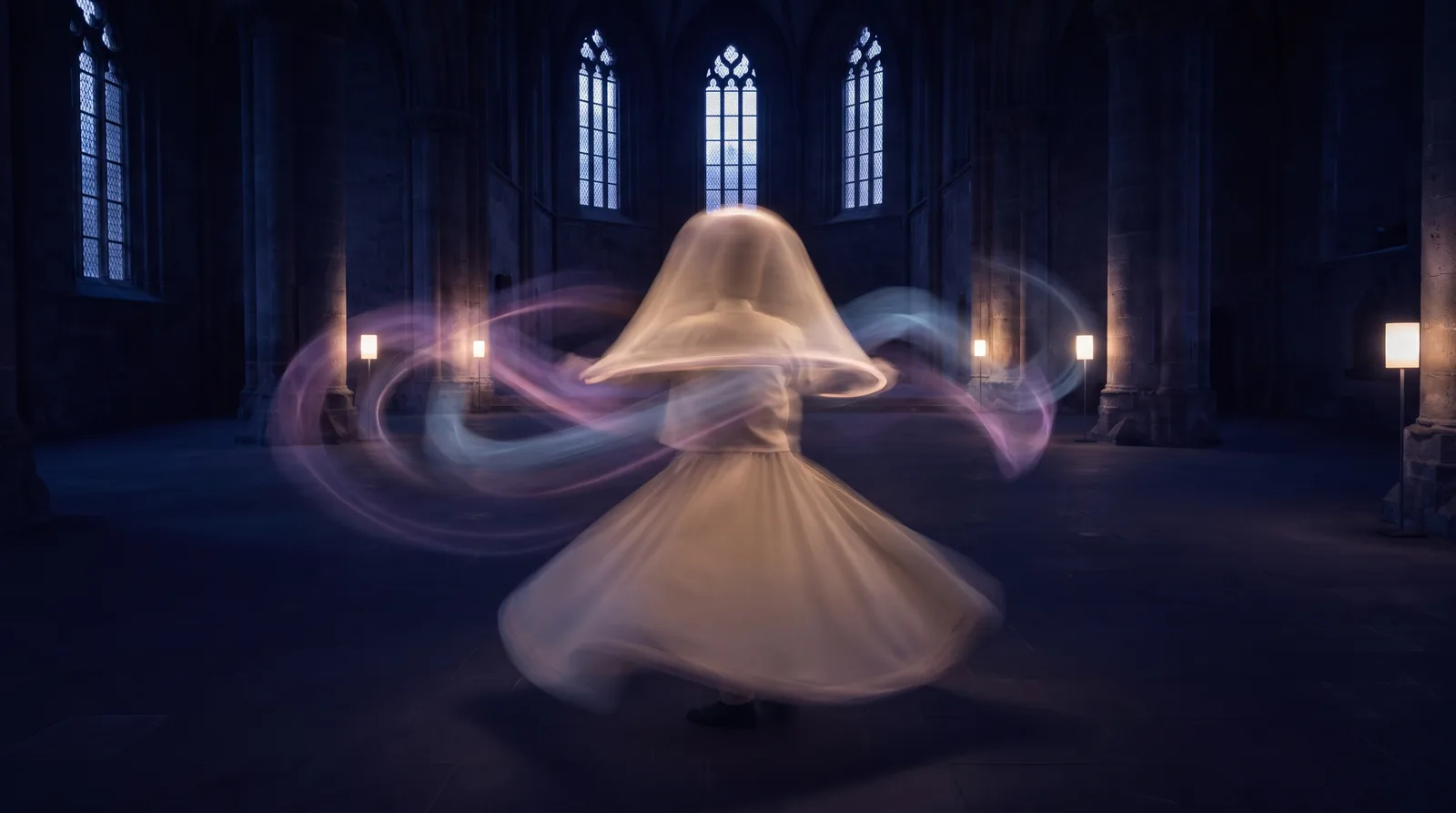
In a dim hall in Konya, in central Turkey, a man in a white skirt and a tall camel-hair hat unfolds his arms and begins to turn. He turns on his left foot, anticlockwise, his right hand open to the sky and his left tilted towards the earth, and he keeps turning, not for a chorus or a scene change but for ten minutes, twenty, sometimes longer, his face settled into an expression you would expect to find on someone asleep. Around him a dozen others do the same, white skirts flaring into perfect rotating bells. To watch the sema, the ceremony of the whirling dervishes, is to watch something that looks like dance behave like prayer. The obvious question follows anyone who sees it: why spin?
A ceremony born of grief
The practice belongs to Sufism, the mystical current within Islam, and its story begins with a loss. In the thirteenth century the poet and scholar Jalaluddin Rumi, living in Konya, met a wandering mystic named Shams of Tabriz, and the friendship remade him; when Shams vanished, almost certainly murdered, Rumi's grief poured out as poetry and as movement. He turned, by the accounts that have come down to us, around a pillar in his garden, reciting verses as he circled. What began as one man's mourning became a discipline. After Rumi's death in 1273 his followers formed the Mevlevi order, which formalised the turning into the sema: a structured ceremony of music, poetry and rotation that has been performed, with interruptions, for some seven and a half centuries since.
The point was never spectacle. In the Mevlevi understanding, the whirling is a form of dhikr, remembrance of God, and the ceremony enacts a journey: the soul turning towards truth, abandoning the self, and returning to the world changed, ready to be of service. The dervish does not spin to leave the earth. He spins, as the tradition has it, in order to come back more kindly.
Reading the costume
Everything the dervish wears is a sentence in a longer argument about the ego. The tall honey-coloured hat, the sikke, represents the tombstone of the self. The black cloak in which the dervishes enter represents the grave, or the worldly self, and the moment they cast it off to reveal the white skirts beneath is a small enacted death and rebirth; the white tennure itself is read as a shroud. Even the posture is a text. The right palm turns upward to receive, the left palm turns down to give, so that the turning body becomes a conduit, passing what it is given along to the world while keeping nothing. The dervish revolves around his own heart, and the whole company revolves around the hall, planets around a sun, in a cosmology you can watch.
The dervish turns so that something in him can finally stand still.
What spinning does to a brain
Anyone who has turned in circles as a child knows the immediate cost: the world lurches, the stomach follows, and you fall over laughing into the grass. Dervishes do not fall over. Years of daily turning appear to teach the vestibular system, the inner ear's balance apparatus, a profound tolerance, and the training may leave deeper marks still. One small brain-imaging study compared long-practising whirling dervishes with people who do not whirl, and found structural differences in the dervishes' cortex, including in regions involved in motion perception and in the default mode network, the circuitry of self-referential thought, alongside their altered experience of vertigo (Cakmak, Ekinci, Heinecke, & Çavdar, 2017, Frontiers in Human Neuroscience). Ten dervishes is a very small sample, and such findings are preliminary, but the suggestion is a lovely one: that decades of practised turning may reshape not just balance but the brain's relationship to dizziness itself.
The technique matters too. Dervishes keep the eyes soft and unfocused rather than spotting a fixed point as ballet dancers do, they turn at a steady unhurried tempo, and they anchor on the left foot while the right pushes, a rhythm that becomes as automatic as walking. Repetition does what repetition always does in contemplative practice: it hands the body a task so complete and so rhythmic that the usual commentary of the mind has nothing left to manage, and quiets.
Motion as a door to stillness
This is the paradox the sema shares with every moving meditation, and it is worth sitting with. Walking meditation slows the step until walking becomes attention; a mantra repeats one phrase until language becomes rhythm; the labyrinth folds a long journey into a small garden. Sufi whirling takes the same wager to its extreme: give the body the most disorienting motion available, perfect it until it costs nothing, and discover that the centre of a spinning world is the quietest place in it. The still point is not found by stopping. It is found by turning so evenly that stillness appears at the axis, the way the centre of a spinning wheel does not move.
Borrowing the turn without the spin
I do not recommend that you clear the furniture and whirl; without training, you will simply meet your vestibular system's objections at speed. But the principles underneath the sema travel well, and you can borrow them tonight:
- Choose one repetitive, rhythmic motion and let it be complete: slow walking, swaying gently while standing, even stirring or kneading. The motion should be easy enough to need no thought and regular enough to occupy the body.
- Give the eyes a soft, unfixed focus rather than a target. The dervish's unfocused gaze is half the quiet; a hard stare keeps the analytical mind on duty.
- Let something turn for you. Watching steady rotation can lend a little of the same settling. A few minutes with one of Feelsy's slowly revolving textures, the kaleidoscopic ones especially, with autoplay letting the motion simply continue, is the armchair version of watching the skirts flare.
- Anchor the rhythm to breath. The ceremony is carried by music and recitation; at home, a slow counted pattern such as the 4-7-8 exercise, which Feelsy will pace for you, gives the turning mind the same steady pulse to rest on.
None of this is the sema, any more than humming is Gregorian chant. The ceremony belongs to its tradition, and if it ever passes through your city, performed by those who practise it as devotion rather than display, it rewards the visit. But the insight at its centre is portable and surprisingly practical: the mind does not always settle by being made to sit still. Sometimes it settles because the body has been given one perfect, endless, circular thing to do, and at the centre of all that motion, unexpectedly, there is rest.
Feelsy is a wellness product, not medical advice. If stress, anxiety or sleep problems persist, please speak with a qualified professional.
References
- Cakmak, Y. O., Ekinci, G., Heinecke, A., & Çavdar, S. (2017). A possible role of prolonged whirling episodes on structural plasticity of the cortical networks and altered vertigo perception: The cortex of Sufi whirling dervishes. Frontiers in Human Neuroscience, 11.
Frequently Asked Questions
What is Sufi whirling?
Sufi whirling is a moving meditation practised within Sufism, the mystical current of Islam, most famously by the Mevlevi order founded by followers of the poet Rumi in thirteenth-century Konya. In the ceremony, called the sema, dervishes rotate steadily on the left foot with the right palm turned up and the left turned down, as a form of remembrance of God rather than a performance.
Why do whirling dervishes not get dizzy?
Years of daily practice teach the inner ear's balance system a deep tolerance for rotation. Dervishes also turn at a steady, unhurried tempo with soft, unfocused eyes, which is less provocative to the vestibular system than fast or erratic spinning. One small brain-imaging study of long-practising dervishes found structural differences in motion-perception regions of the cortex, suggesting the training may leave lasting marks, though the sample was small.
What does the whirling dervish costume mean?
Each element is symbolic. The tall camel-hair hat represents the tombstone of the ego, the black entry cloak represents the grave or worldly self, and casting it off to reveal the white skirt beneath enacts a death and rebirth, with the white garment read as a shroud. The right palm faces up to receive and the left faces down to give, so the turning body passes blessing on rather than keeping it.
Is Sufi whirling a dance?
It looks like one, but within the tradition it is prayer and meditation, not performance. The sema is a structured ceremony of music, poetry and rotation that enacts the soul's journey towards truth and back to the world in service. Staged shows for visitors exist, but practitioners draw a clear line between devotion and display.
Can anyone try whirling meditation?
Untrained spinning mostly delivers dizziness, so it is not the practical place to start. The portable principles are rhythm, repetition and soft focus: a slow repetitive motion such as unhurried walking or gentle swaying, an unfixed gaze, and a steady breathing pattern together give the mind the same kind of complete, circular task that lets it settle.

About the author
Contributing writer
Eleonor writes about contemplative traditions, attention and the cultural history of calm. She has spent two decades collecting the rituals humans use to slow down, from zazen halls to hammams, and translating them for modern, screen-lit lives.
Feel it for yourself.
Feelsy turns reading about calm into practising it. Two minutes of a slow texture is often the whole difference.


Related reading
 Ancient Wisdom
Walking Meditation: The Art of Going Nowhere Slowly
Walking meditation turns an ordinary walk into practice. How kinhin works, what research says about mindful walking, and a simple way to begin today.
 Ancient Wisdom
Mantra Meditation: Why Repeating One Word Quiets the Mind
What a mantra actually does to a busy mind: the science of repetition, how to choose a word, and a simple way to practise mantra meditation tonight.
 Ancient Wisdom
Walking the Labyrinth: An Ancient Cure for a Divided Mind
Why walking a labyrinth calms the mind when ordinary walks cannot: one path, no decisions, an ancient practice you can even trace with a finger.
 Ancient WisdomNew
Ataraxia: The Ancient Greek Art of an Untroubled Mind
Ataraxia is the ancient Greek word for an untroubled mind, prized by Epicureans, Stoics and Sceptics alike. Here is what it means and how they reached it.
 Ancient WisdomNew
Ma: The Japanese Art of Negative Space
Ma is the Japanese concept of negative space: the pause, the gap, the emptiness that gives everything else meaning. Here is how to invite more of it into a day.
 Ancient Wisdom
Negative Visualisation: The Stoic Habit of Imagining Loss
Negative visualisation, the Stoic practice of briefly imagining losing what you have, sounds grim but works as a gratitude exercise. Here is how to do it well.