Walking the Labyrinth: An Ancient Cure for a Divided Mind
Why walking a labyrinth calms the mind when ordinary walks cannot: one path, no decisions, an ancient practice you can even trace with a finger.
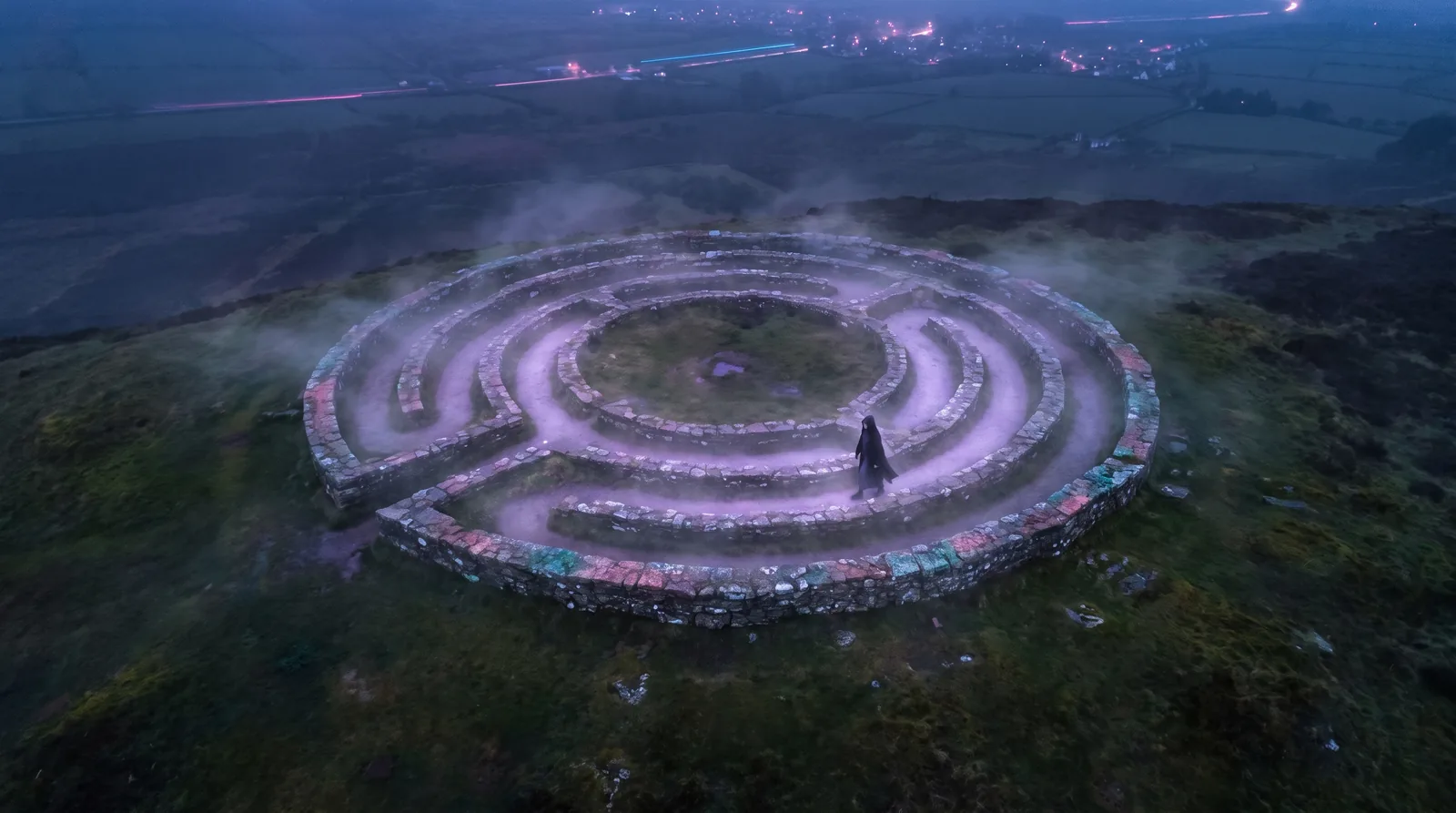
Set into the nave floor of Chartres Cathedral, about an hour south-west of Paris, is a circle of pale stone nearly thirteen metres across, laid down around the year 1200. Eleven concentric rings, one path, winding with perfect indirection from the edge to a six-petalled rose at the centre. Medieval pilgrims who could not make the journey to Jerusalem are said to have walked it as a substitute pilgrimage, some reportedly on their knees, the winding stone standing in for the winding road. Eight centuries later, people still queue on certain days to walk it, and versions of it have quietly multiplied through hospital gardens, university quadrangles, retreat centres and public parks. Something about this odd, slow, circular walk keeps being rediscovered, and the reason turns out to be wonderfully specific.
A labyrinth is not a maze
The two words have blurred together in everyday English, but the traditions they name are opposites. A maze is a puzzle: branching corridors, false turnings, dead ends, a design whose entire purpose is to lose you and make you work to be found. A labyrinth, in the classical sense, is unicursal: a single path, no branches, no decisions, folding back and forth upon itself until it delivers you, unfailingly, to the centre. You cannot take a wrong turn in a labyrinth. You cannot be lost in one. A maze is a test of the mind; a labyrinth is a rest for it, and that distinction is the entire practice.
A maze is a puzzle to be solved. A labyrinth is a puzzle already solved: all that remains is to walk it.
Why one path changes everything
Consider what an ordinary walk asks of you. Which route, which crossing, mind the cyclist, check the phone, is that rain. Navigation is cheap for the brain but it is not free, and on the days when you are most in need of a walk, even small decisions land like invoices. The labyrinth removes every one of them. The path decides; you merely place one foot after the other and let the turns come. What remains is the body's metronome, the swing and fall of walking, with nowhere to steer and nothing to optimise. Walkers often describe the same arc: a few busy minutes at the entrance, the mind still issuing bulletins, then a gradual downshift as the turns repeat, and somewhere in the middle rings a silence that feels less achieved than granted. It is close cousin to formal walking meditation, but with the training wheels built into the ground: the labyrinth holds the discipline so you do not have to.
What the research suggests
The evidence here is young, modest and honestly labelled. Labyrinth walking entered the nursing and complementary-therapy literature in the early 2000s, and exploratory work such as Sandor and Froman's study in the Journal of Holistic Nursing examined its effects on stress and relaxation, part of a wider effort to measure what walkers had long reported: lowered tension, a quieter pulse of thought, a sense of having set something down (Sandor & Froman, 2006). These are small studies of a gentle practice, not clinical trials of a treatment, and it would be dishonest to dress them as more. But the practice costs nothing, carries no risk beyond the walking itself, and has an eight-hundred-year queue of satisfied customers; few relaxation techniques can say the same.
The three movements
Modern labyrinth guides often teach the walk in three movements, and the structure is worth borrowing even if you hold it lightly. The way in is release: with each turn, let the day's cargo grow a little heavier to carry and set pieces of it down along the path. The centre is receiving: arrive, stand or sit, and simply stay a while; there is no test here, and nothing is required to happen. The way out is return: the same path in reverse, walked as re-entry, carrying whatever quiet you found back towards the door of ordinary life. Three movements, one path, no wrong way to do it.
Finding one, or making one
Labyrinths are more common than most people suspect; once you begin looking, they surface in cathedral floors, hospice gardens, school courtyards and municipal parks, and online labyrinth directories let you search by city. If none is near, the practice scales down with perfect grace.
- Search a public labyrinth directory for your town; churches, hospitals and universities are the most frequent keepers.
- Draw your own with chalk on a driveway or rope on grass; a simple three-circuit spiral is enough, since the only requirement is a single path.
- Use a finger labyrinth: a palm-sized carved or printed pattern traced slowly with a fingertip, long used in hospitals for people who cannot walk far, and quietly effective at a desk.
- Print a paper labyrinth and trace it with a pen in the evening, treating the line as the path and the tracing as the walk.
The finger versions reveal what the practice really is: not exercise but guided attention, a track for the mind laid down in advance so that, for once, it does not have to choose its own route. I keep a pocket version of the same principle on my phone for train platforms and waiting rooms: one of Feelsy's slow textures on autoplay, the eye following a path it does not have to plan, which is the labyrinth's gift translated into light. However you come to it, on stone, on paper or on screen, the invitation is identical: one path, no decisions, and the unfamiliar luxury of being unable to take a wrong turn.
Feelsy is a wellness product, not medical advice. If stress, anxiety or sleep problems persist, please speak with a qualified professional.
References
- Sandor, M. K., & Froman, R. D. (2006). Exploring the effects of walking the labyrinth. Journal of Holistic Nursing, 24(2), 103-110.
Frequently Asked Questions
What is the difference between a labyrinth and a maze?
A maze is a puzzle with branching paths, false turnings and dead ends, designed to lose you. A classical labyrinth is unicursal: a single path with no branches that leads unfailingly to the centre and back. You cannot take a wrong turn in a labyrinth, and that absence of decisions is exactly what makes walking one so restful.
How do you walk a labyrinth?
There is no wrong way, but a traditional structure has three movements: release on the way in, setting down the day's concerns with each turn; receiving at the centre, where you pause for as long as you like; and return on the way out, carrying the quiet back with you. Walk at whatever pace feels natural and let the path do the steering.
What is a finger labyrinth?
A finger labyrinth is a palm-sized version of the same single-path pattern, carved in wood or printed on paper, which you trace slowly with a fingertip instead of walking. Long used in hospitals for people who cannot walk far, it offers the same guided, decision-free attention at a desk or bedside.
Is labyrinth walking religious?
Labyrinths have deep roots in religious settings, most famously the early thirteenth-century pavement labyrinth at Chartres Cathedral, walked as a substitute pilgrimage. But the practice itself requires no belief: modern labyrinths in hospitals, parks and universities are walked by people of every persuasion as a simple moving meditation.
Where can I find a labyrinth near me?
They are more common than most people suspect. Online labyrinth directories let you search by city, and the most frequent keepers are churches, cathedrals, hospitals, hospices and university campuses. If none is nearby, you can chalk a simple spiral on a driveway or use a finger labyrinth; a single unbranching path is the only requirement.

About the author
Contributing writer
Eleonor writes about contemplative traditions, attention and the cultural history of calm. She has spent two decades collecting the rituals humans use to slow down, from zazen halls to hammams, and translating them for modern, screen-lit lives.
Feel it for yourself.
Feelsy turns reading about calm into practising it. Two minutes of a slow texture is often the whole difference.


Related reading
 Ancient Wisdom
Walking Meditation: The Art of Going Nowhere Slowly
Walking meditation turns an ordinary walk into practice. How kinhin works, what research says about mindful walking, and a simple way to begin today.
 Ancient Wisdom
The Zen Garden: Why Raking Gravel Stills the Mind
What a zen garden is and why it calms: the history of karesansui, the perception science of Ryoan-ji, and a way to practise dry-garden attention at home.
 Ancient Wisdom
Sand Mandalas and the Art of Letting Go
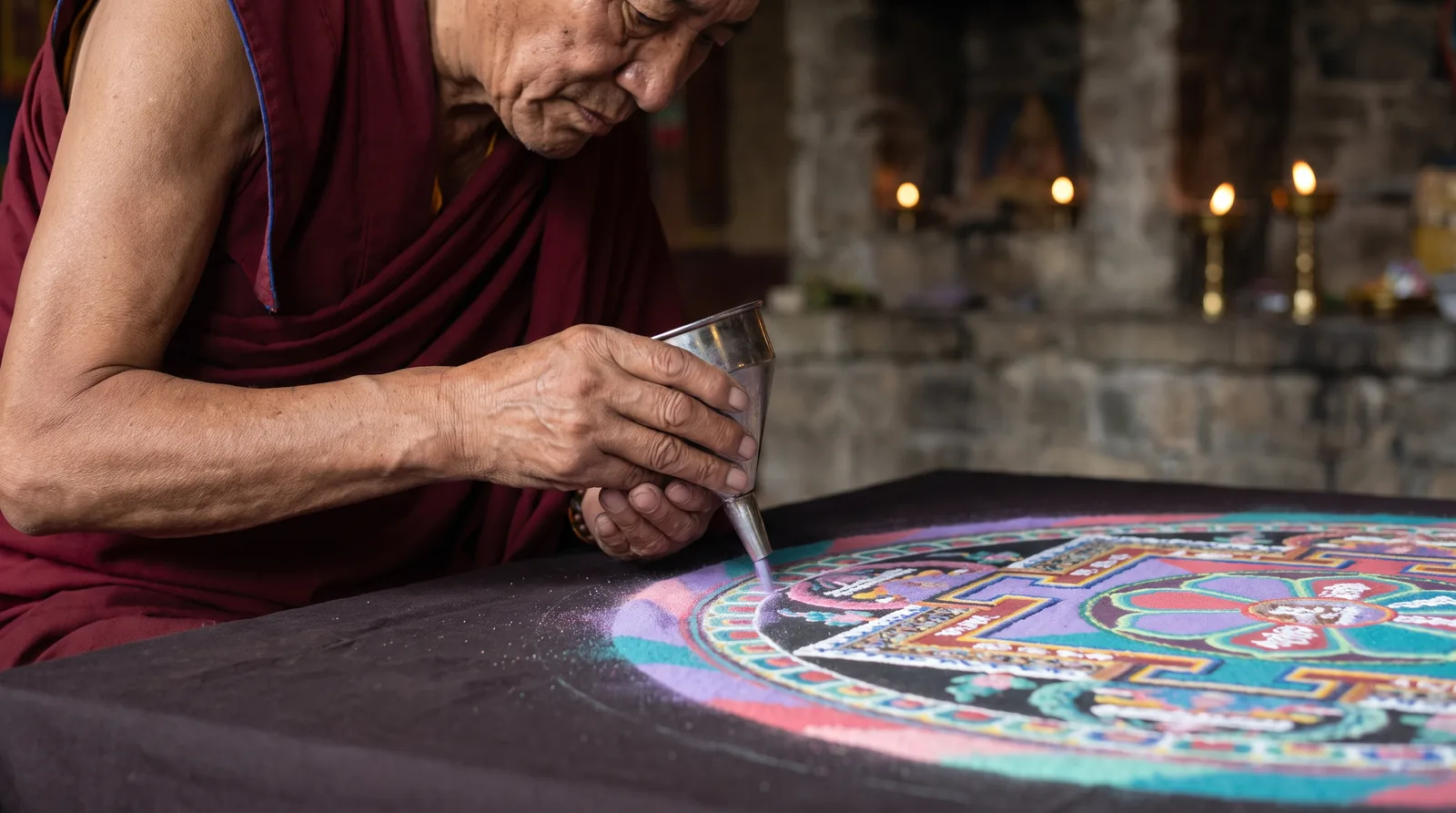
Tibetan monks spend days building an intricate sand mandala, then sweep it away. What the ritual teaches about impermanence, process and why watching can be meditation.
 Ancient Wisdom
Döstädning: The Gentle Swedish Art of Death Cleaning
What Swedish death cleaning really means: the calm philosophy of döstädning, how it differs from ordinary decluttering, and how to begin at any age.
 Ancient Wisdom
How to Start a Gratitude Journal You Will Actually Keep
How to start a gratitude journal that actually helps: what the research found, why most lists go stale, and the very old art of counting blessings.
 Ancient Wisdom
Haiku as Meditation: Seventeen Syllables of Attention
How writing haiku trains attention: why the tiny form works like meditation, what noticing small moments does for wellbeing, and how to write your first.