What Happens at a Silent Retreat? An Honest Guide
What actually happens at a silent retreat: the daily rhythm, the difficult middle days, what research suggests about the benefits, and how to prepare.
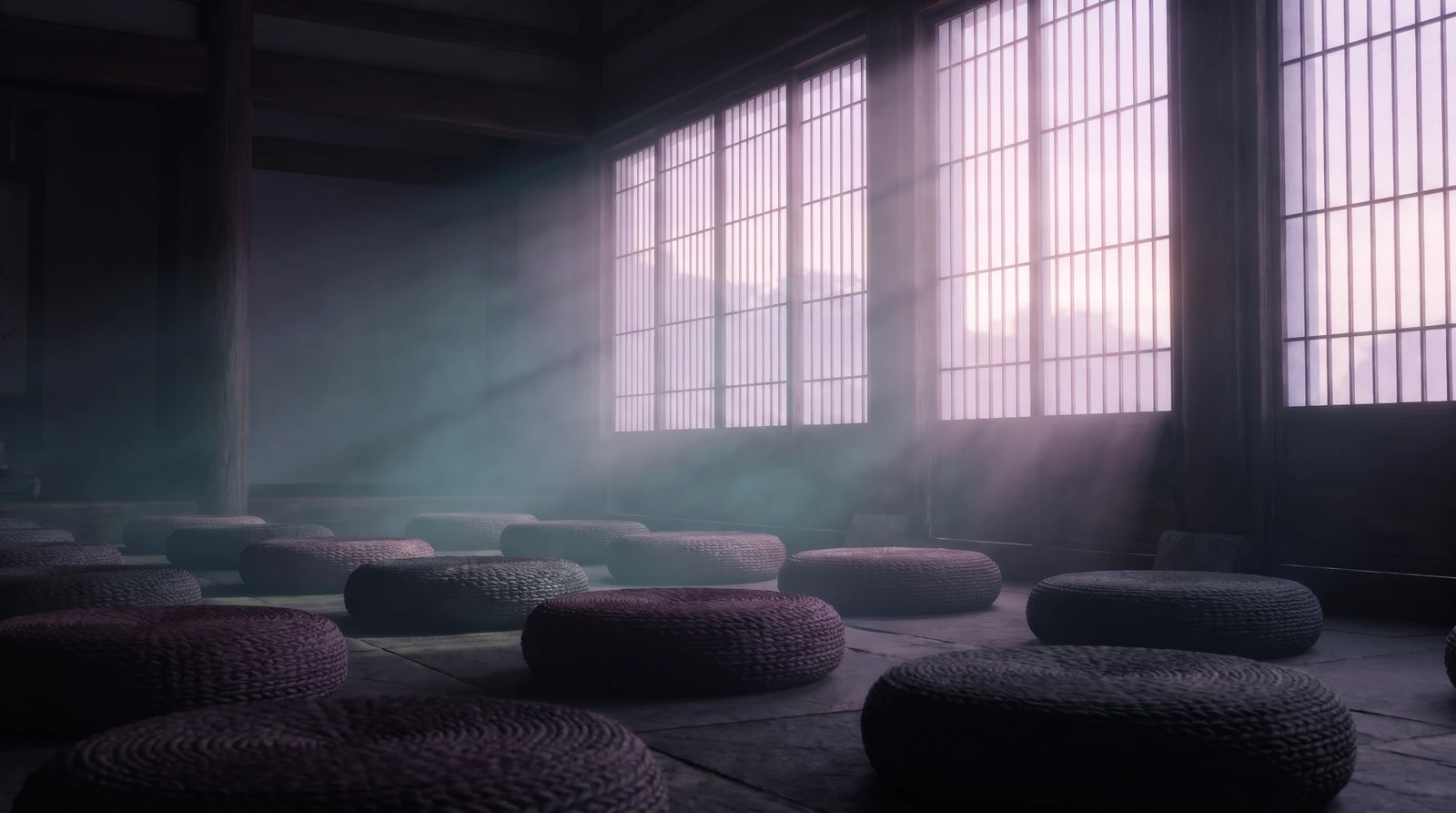
Somewhere in your circle there is probably someone who has done it: gone away for a weekend, or ten days, and said nothing at all. They come back with a particular look, part sheepish, part lit from within, and when you ask what happened they struggle to tell you, which is fitting, because the whole point was that nothing was said. The silent retreat has quietly become one of the most sought-after experiences in contemporary contemplative life, and also one of the most misunderstood.
This is a guide for the curious: what a silent retreat actually involves, hour by hour, what tends to happen inside the mind when conversation is taken away, what the research suggests, and how to find out whether silence suits you before committing a week of your life to it.
What a silent retreat actually is
A silent retreat is a stretch of days, anywhere from a weekend to ten days or longer, spent in a residential centre under an agreement the traditions call noble silence: no talking, and usually no phones, no reading, no writing and no eye contact games either. The silence is not a punishment. It is a removal of the usual outlets, so that attention, with nowhere else to go, finally turns towards its own workings.
The format varies with the lineage. Vipassana centres in the tradition of S. N. Goenka run famously rigorous ten-day courses. Zen monasteries hold sesshin, intensive periods built around seated meditation. Christian monasteries have received silent guests for centuries, and secular mindfulness centres now offer gentler weekend versions with optional teacher meetings. What they share is the architecture: simple lodging, simple food, a fixed schedule, and the agreement that nobody will fill the air.
A day inside the silence
Most retreats run to a timetable that would have impressed a Victorian headmistress. A typical day looks something like this:
- Wake before dawn, often around 5 or 5.30am, to a bell rather than an alarm.
- Alternating periods of seated meditation and slow walking meditation, usually 30 to 45 minutes each, through the morning.
- Meals taken in silence, eaten slowly, often the most vivid sensory experience of the day.
- A rest period after lunch, more alternating sits and walks through the afternoon.
- An evening talk by a teacher, the one voice you will hear, followed by a final sit and an early night.
Written down, it looks austere. Lived, it has a strange spaciousness. With no conversations to manage and no feeds to check, the day stops being a corridor you rush through and becomes a sequence of rooms you actually inhabit. Tea tastes of something. Walking across a courtyard becomes an event. The nervous system, denied its usual diet of input, begins to settle into rhythms most of us have not felt since childhood.
The difficult middle
It would be dishonest to sell the silence as bliss. Nearly every retreat account, ancient or modern, describes the same arc: a first day of novelty and relief, then a stretch, often days two and three, when the mind rebels. Without distraction, everything you have been successfully not thinking about arrives at once. Old arguments replay themselves. To-do lists bloom like algae. Some people feel bored to the point of fury; others meet waves of sadness they did not know they were carrying.
The silence does not create the noise. It simply turns the lights on in a room that was always this full.
Teachers tend to treat this stage as the real beginning of the retreat. The instruction is not to fight the weather but to watch it: thoughts and feelings arise, carry on alarmingly, and then, if you decline to feed them, pass. For many people this is the first direct evidence they have ever had that their inner storms are survivable, and that discovery, more than any blissful sit, is what they bring home.
What the research suggests
Retreats are hard to study, since the people who book them are hardly a random sample, but the evidence that exists is encouraging. A systematic review and meta-analysis of traditional meditation retreats found moderate improvements across measures of anxiety, depression and stress following retreat participation (Khoury et al., 2017, Journal of Psychosomatic Research). A study following experienced meditators through a one-month retreat found improvements in wellbeing that were linked to non-attachment, the growing ability to hold experience lightly rather than gripping it (Montero-Marin et al., 2016, Frontiers in Psychology).
The honest caveats: most studies are small, few have strong control groups, and effects tend to fade without ongoing practice. A retreat is better understood as an immersion course than a cure, a concentrated taste of what a daily practice builds slowly.
Who should think twice
A long silent retreat is an intense experience, and intensity is not for every season of a life. Someone in the middle of an acute mental health crisis, fresh grief or major upheaval may find days of unstructured inner time overwhelming rather than clarifying, and most reputable centres say as much in their application forms. If you are in doubt, speak to a professional who knows you before booking, start with a single day rather than ten, and choose a centre with teachers available for one-to-one check-ins. There is no prize for maximal austerity.
How to rehearse silence at home
The good news is that silence scales down beautifully. Before committing to a week, try a silent morning: phone off, no reading, no podcasts, just breakfast, a slow walk and an hour of sitting quietly with whatever arrives. Notice how loud the first twenty minutes feel, and whether something softens after that.
A small anchor helps. Traditional retreats give the eyes and hands a focus through walking and breath; at home, a few rounds of 4-7-8 breathing can mark the threshold into quiet, and a slow visual texture in Feelsy, left to drift on autoplay, gives restless attention somewhere gentle to rest without breaking the silence with words or feeds. If a silent hour at home leaves you curious rather than merely relieved it is over, that is a reasonable sign the longer version may have something for you.
The retreat's secret, in the end, is not that silence is magical. It is that most of us have never actually met a day without commentary, and meeting one changes what we think a mind is for.
Feelsy is a wellness product, not medical advice. If stress, anxiety or sleep problems persist, please speak with a qualified professional.
References
- Khoury, B., Knäuper, B., Schlosser, M., Carrière, K., & Chiesa, A. (2017). Effectiveness of traditional meditation retreats: A systematic review and meta-analysis. Journal of Psychosomatic Research, 92, 16–25.
- Montero-Marin, J., et al. (2016). Psychological effects of a 1-month meditation retreat on experienced meditators: The role of non-attachment. Frontiers in Psychology, 7, 1935.
Frequently Asked Questions
What happens at a silent retreat?
You live for several days in a residential centre under an agreement of noble silence: no talking, and usually no phones, reading or writing. Days follow a fixed timetable of seated meditation, slow walking meditation and silent meals, beginning before dawn and ending early, with an evening talk from a teacher as the only voice you hear.
How long should my first silent retreat be?
Shorter than you think. A single silent day or a weekend retreat is a far kinder introduction than a ten-day course, and many secular centres offer exactly that. Trying a silent morning at home first, with your phone off and no reading or podcasts, tells you a great deal about how you respond to unstructured quiet before you commit.
Are silent retreats good for anxiety?
Research is cautiously encouraging: a meta-analysis of traditional meditation retreats found moderate improvements in anxiety, depression and stress after participation. The honest caveats are that studies are small and benefits fade without ongoing practice, so a retreat works best as an immersion that kick-starts a daily habit rather than a one-off cure.
Is a silent retreat difficult?
The middle days usually are. Most accounts describe a rebellion around day two or three, when the mind, denied distraction, surfaces everything it has been avoiding: old arguments, to-do lists, unexpected sadness. Teachers treat this as the real start of the retreat, and learning to watch these storms pass rather than fight them is the core skill people take home.
Can I do a silent retreat at home?
Yes, in miniature. Choose a morning, turn the phone off, skip reading and podcasts, and move slowly through breakfast, a walk and an hour of quiet sitting. A few rounds of 4-7-8 breathing can mark the start, and a slow visual texture left drifting on a screen gives the eyes a gentle anchor. If the quiet leaves you curious rather than merely restless, a longer retreat may suit you.

About the author
Contributing writer
Eleonor writes about contemplative traditions, attention and the cultural history of calm. She has spent two decades collecting the rituals humans use to slow down, from zazen halls to hammams, and translating them for modern, screen-lit lives.
Feel it for yourself.
Feelsy turns reading about calm into practising it. Two minutes of a slow texture is often the whole difference.


Related reading
 Ancient Wisdom
Vipassana Meditation: A Beginner's Guide to Seeing Clearly
What vipassana meditation is, how insight practice differs from other techniques, and how to begin observing breath and sensation at home tonight.
 ASMR
The Benefits of Silence: What Happens When the Sound Stops
Silence is not merely the absence of noise; the body treats it as an event in itself. Here is what research says quiet does for the heart and mind.
 Ancient Wisdom
Zazen for Beginners: The Zen Art of Just Sitting
What zazen is, how to practise Zen seated meditation at home, posture and breath basics, and why 'just sitting' is harder and kinder than it sounds.
 Ancient WisdomNew
Ataraxia: The Ancient Greek Art of an Untroubled Mind
Ataraxia is the ancient Greek word for an untroubled mind, prized by Epicureans, Stoics and Sceptics alike. Here is what it means and how they reached it.
 Ancient WisdomNew
Ma: The Japanese Art of Negative Space
Ma is the Japanese concept of negative space: the pause, the gap, the emptiness that gives everything else meaning. Here is how to invite more of it into a day.
 Ancient Wisdom
Negative Visualisation: The Stoic Habit of Imagining Loss
Negative visualisation, the Stoic practice of briefly imagining losing what you have, sounds grim but works as a gratitude exercise. Here is how to do it well.