Gezelligheid: The Dutch Art of Cosy Togetherness
Gezelligheid is the untranslatable Dutch word for warm, convivial cosiness shared with others. What it means, how it differs from hygge, how to invite it in.
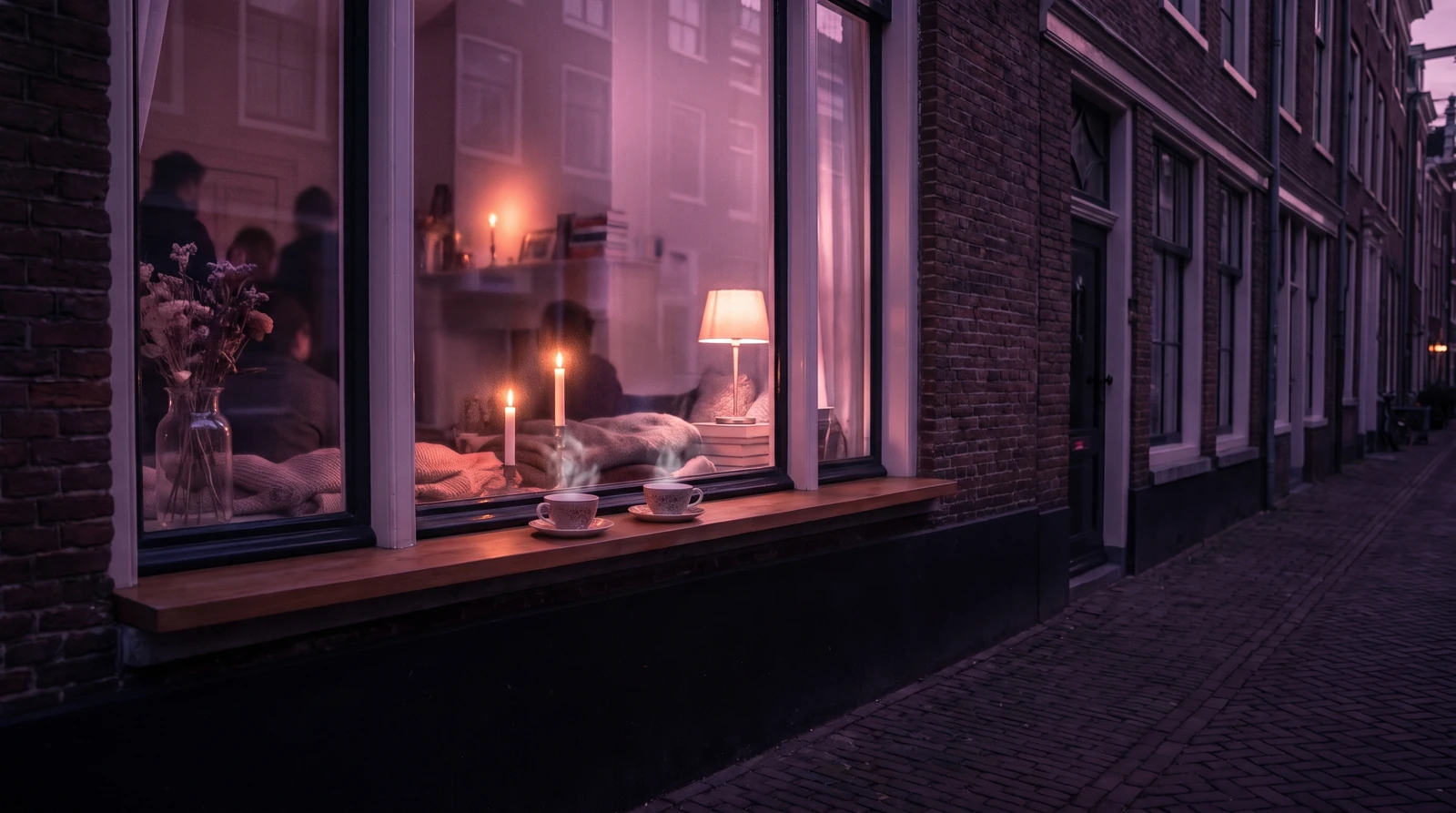
Ask a Dutch person to translate gezelligheid and you will watch a small, affectionate struggle cross their face. Cosiness, they will offer, but that is not quite it. Conviviality, perhaps, or fun, or atmosphere, but none of these survive the journey. The word, pronounced roughly heh-ZEL-ich-hide, with that soft guttural g the Dutch guard so jealously, names something the Netherlands considers close to a national virtue: the particular warmth of a place, a moment or a gathering in which everyone present feels held, included and unhurried.
A brown café with candles guttering on the windowsill is gezellig. So is a kitchen table crowded with friends who have stayed too long, a card game with grandparents, a bookshop with a cat asleep in the window. A person can be gezellig; so can an evening, a street, a conversation. And crucially, the word has teeth, because its absence is named too: ongezellig, the chill of a fluorescent waiting room, a dinner eaten over phones, a beautiful flat that somehow feels like nowhere. The Dutch did not merely name an atmosphere. They built a compass that points toward one.
Cosiness that needs company
The easiest way to grasp gezelligheid is to set it beside its famous Scandinavian cousin. Hygge, the Danish art of cosiness, can be enjoyed entirely alone: one person, one blanket, one candle, perfect contentment. Gezelligheid leans outward. Though a quiet evening can certainly be gezellig, the word's centre of gravity is social: it lives in shared tables, open doors and long conversations. Where hygge wraps a blanket around the self, gezelligheid pulls out a chair for someone else.
This distinction matters more than it first appears, because the research on what actually sustains human wellbeing keeps returning to the same unglamorous answer: the quality of our relationships. A culture that makes shared warmth a daily, named pursuit, rather than an occasional accident, has quietly institutionalised one of the most protective habits a life can have. The Netherlands reliably ranks among the happiest countries in the world, and while no single word explains such a thing, it is surely no handicap that Dutch children grow up fluent in the difference between a room that is gezellig and one that is merely furnished.
Hygge wraps a blanket around the self. Gezelligheid pulls out a chair for someone else.
The Dutch themselves have a saying that reveals how seriously the pursuit is taken: gezelligheid kent geen tijd, gezelligheid knows no time. It is the standard, smiling justification for the second pot of coffee, the train home not taken, the evening that was meant to end at nine. The phrase quietly ranks warmth above punctuality, which in a country otherwise devoted to schedules and sensible planning amounts to a philosophical position. Certain places are understood to be reliable wells of it: the brown café, so called for its wood-dark, nicotine-aged interiors, where generations have gathered under low lamps; the birthday circle, where family sit in a ring with coffee and cake for hours; the winter table after skating. None of these are spectacular. That is rather the point. Gezelligheid is what ordinary time feels like when it is kept warm.
The anatomy of a gezellig moment
Spend time among people who use the word daily and you begin to notice what it requires. Low light, first: the Dutch are devoted to lamps, candles and the amber hour, and overhead lighting is treated as a minor act of hostility. Smallness, second: gezelligheid thrives in snug rooms, corner tables and narrow houses, where proximity does half the work of intimacy. Unhurried time, third: the gezellig evening has no agenda and resists the glance at the clock. And presence, last and most fragile: a phone on the table, face up, dims a gathering as surely as a switched-on ceiling light. None of these ingredients cost anything. All of them are decisions.
Notice, too, what is absent from the list: perfection. A gezellig room is not a styled room. The candle is half burnt, the chairs do not match, the cake is shop-bought and nobody minds. Gezelligheid has a close relationship with modesty; it withers under performance. This is perhaps why the word resists marketing so well. You cannot purchase it, only convene it.
Inviting it into an un-Dutch life
You do not need a canal house. Begin with light: switch off the overhead glare after dinner and let the evening be lamplit, the single cheapest renovation a room can receive. Shrink the circle: one friend at a kitchen table generates more warmth than ten people standing in a bright room. Give gatherings a soft centre rather than a schedule, a pot of tea, a deck of cards, something gently flickering to gather around; in my flat the fireplace is played by a slow Feelsy texture drifting on the tablet against the wall, an amber loop that does what a hearth does, which is to give every eye in the room a warm place to rest between sentences. And when you find yourself inside a moment that is quietly working, name it, even just inwardly. The Dutch discovered something there: an atmosphere you can name is an atmosphere you can notice, protect and make again.
There is a certain courage in the word, too. To call an evening gezellig is to admit you wanted warmth in the first place, that cosiness shared with others is not a small or childish pleasure but one of the things a week is for. The Dutch, a famously practical people, decided centuries ago that this warmth deserved its own word and daily pursuit. The rest of us can at least borrow the pursuit.
Feelsy is a wellness product, not medical advice. If stress, anxiety or sleep problems persist, please speak with a qualified professional.
Frequently Asked Questions
What does gezelligheid mean?
Gezelligheid is a Dutch word with no exact English translation, usually rendered as cosiness, conviviality or warm atmosphere. It names the feeling of a place, moment or gathering where everyone present feels included, relaxed and unhurried: a candlelit café, a crowded kitchen table, a long evening with friends. Its adjective is gezellig, and its opposite, ongezellig, describes places or moments that feel cold and unwelcoming.
How do you pronounce gezellig?
Roughly heh-ZEL-ich, with the stress on the middle syllable. The g sounds are the soft guttural Dutch g, made at the back of the throat, a little like the ch in the Scottish word loch. The full noun gezelligheid is pronounced heh-ZEL-ich-hide.
What is the difference between gezelligheid and hygge?
Both name a cultivated cosiness, but hygge, the Danish version, can be enjoyed completely alone with a blanket and a candle, while gezelligheid leans social: its heart is shared tables, company and conversation. A quiet solo evening can be gezellig, but the word's centre of gravity is togetherness rather than solitary comfort.
How can I make my home more gezellig?
Use low, warm light after dark: lamps and candles rather than overhead fixtures. Favour small, snug corners over large bright spaces, give gatherings a soft centre to sit around, such as a pot of tea, a board game or a gentle flickering focal point, and keep phones off the table. Imperfection helps rather than hurts; gezelligheid is convened, not styled.

About the author
Contributing writer
Eleonor writes about contemplative traditions, attention and the cultural history of calm. She has spent two decades collecting the rituals humans use to slow down, from zazen halls to hammams, and translating them for modern, screen-lit lives.
Feel it for yourself.
Feelsy turns reading about calm into practising it. Two minutes of a slow texture is often the whole difference.


Related reading
 Ancient Wisdom
What Is Hygge? The Danish Art of Cosy Contentment
Hygge is the Danish art of cosy contentment: candlelight, warmth and unhurried company. Here is what it means, where it comes from, and how to practise it.
 Ancient Wisdom
What Is Fika? Sweden's Daily Coffee Ritual and the Art of the Proper Pause
Fika is Sweden's daily ritual of coffee, something sweet and a real pause. Here is what fika means, why small breaks work, and how to practise it anywhere.
 Ancient Wisdom
Sobremesa: The Spanish Art of Lingering at the Table
What sobremesa means, why Spaniards stay talking at the table long after a meal ends, and how this unhurried ritual can slow down an anxious day.
 Ancient WisdomNew
Ataraxia: The Ancient Greek Art of an Untroubled Mind
Ataraxia is the ancient Greek word for an untroubled mind, prized by Epicureans, Stoics and Sceptics alike. Here is what it means and how they reached it.
 Ancient WisdomNew
Ma: The Japanese Art of Negative Space
Ma is the Japanese concept of negative space: the pause, the gap, the emptiness that gives everything else meaning. Here is how to invite more of it into a day.
 Ancient Wisdom
Negative Visualisation: The Stoic Habit of Imagining Loss
Negative visualisation, the Stoic practice of briefly imagining losing what you have, sounds grim but works as a gratitude exercise. Here is how to do it well.