Hypnagogia: The Twilight State Between Waking and Sleep
Hypnagogia is the drifting borderland between waking and sleep, full of faces, shapes and half-dreams. What causes it, when it helps, and how to linger there.
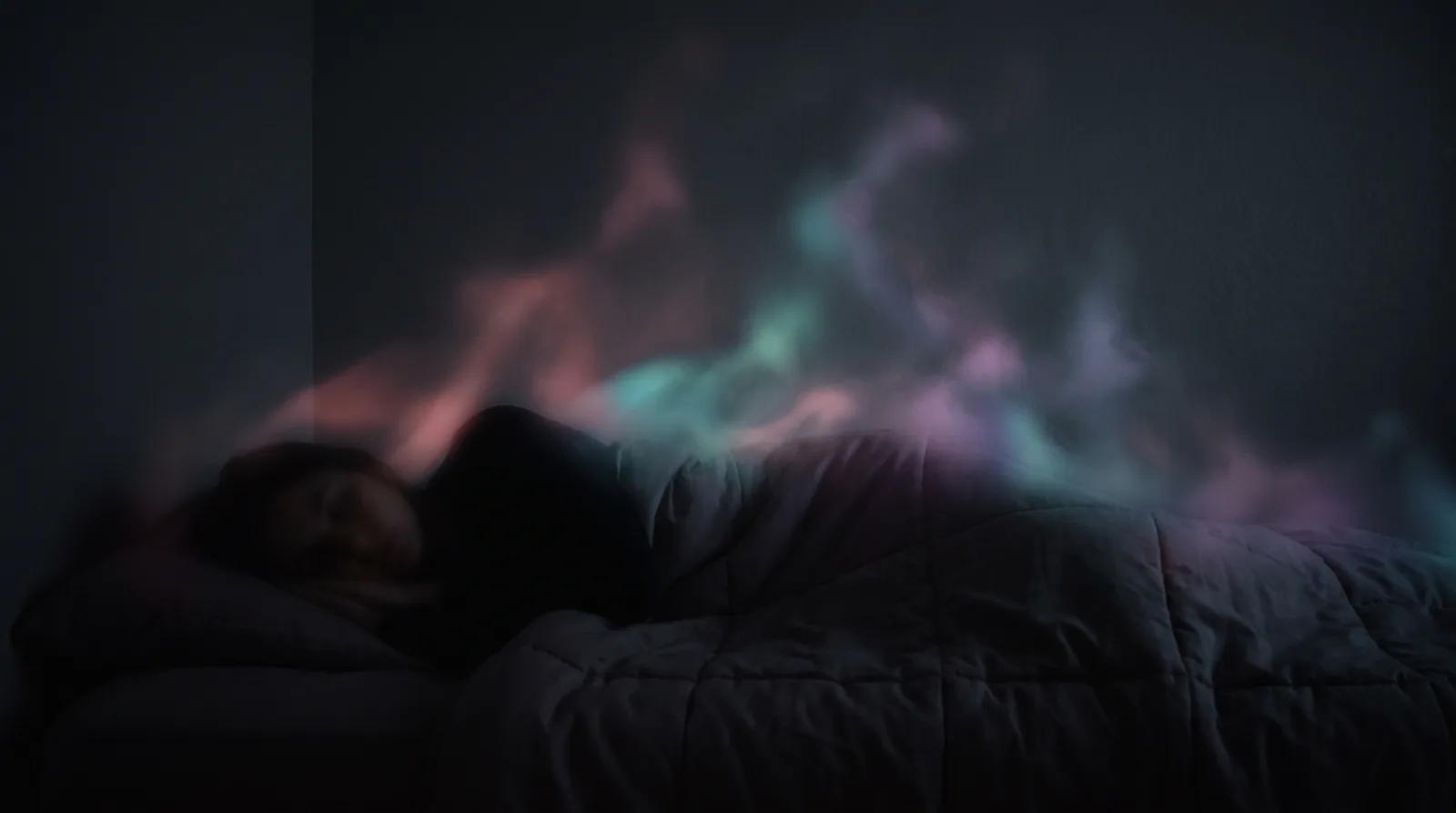
There is a country you visit every night and almost never remember. It begins a few minutes after you close your eyes, when thought starts to come loose at the edges. A sensible worry about tomorrow's meeting drifts, without announcement, into an image of a staircase. A face you have never seen assembles itself in the dark, regards you mildly, and dissolves. Someone seems to say your name, once, quite clearly, in an empty room. You are not asleep yet; you would swear to it. You are also no longer quite awake. This borderland has a proper name, hypnagogia, from the Greek for leading into sleep, and it is one of the strangest ordinary experiences a mind can have.
The anteroom of sleep
Sleep does not arrive like a switch but like a tide, and hypnagogia is the shallows. In the language of sleep science it corresponds roughly to the first stage of sleep, N1, and the drowsy minutes around it: a brief transitional state in which the brain's waking rhythms slow and fragment while pockets of alertness persist. The mind keeps producing material, as it always does, but the editor has gone home. Logic loosens first, then the sense of where your body ends, then the thread of time. Most nights you pass through in five or ten minutes and the amnesia of sleep sweeps the whole crossing away, which is why a state you have experienced thousands of times can feel, when described, like news.
What you might meet there
The furniture of hypnagogia is remarkably consistent across sleepers. Visual images are the most common: drifting geometry, landscapes that assemble and melt, and very often faces, vivid and unfamiliar, watching without menace. Sounds come too, usually brief ones; a knock, a snatch of music, a voice saying a single word or your own name, convincing enough that people sometimes answer. The body contributes sensations of floating, tipping or gentle falling, and occasionally the famous hypnic jerk, that whole-body twitch that arrives just as you let go, which we have written about separately. Half-thoughts carry on underneath it all, growing steadily more surreal, so that you can catch yourself reasoning with perfect sincerity about something that does not exist. None of this is dreaming proper, which belongs mostly to later, deeper passages of the night. It is thought becoming dream, caught midway.
Hypnagogia is the mind thinking in pictures just before it stops thinking at all.
Dalí's key and the science that proved him right
Artists found this country long before science mapped it. Salvador Dalí liked to doze upright in a chair holding a heavy key over a metal plate on the floor; as sleep took him, his grip would loosen, the key would clang against the plate, and he would wake with the strange imagery of the threshold still in hand, ready to paint. Thomas Edison is said to have napped the same way with steel balls. For a century this was charming anecdote. Then a team of sleep researchers in Paris tested it properly: they gave people a series of number puzzles containing a hidden shortcut, then let them doze in a chair holding a cup that would wake them as it fell. Those who drifted into the first stage of sleep for even a minute before waking were nearly three times as likely to discover the hidden rule afterwards as those who stayed awake, and the advantage vanished in those who sank on into deeper sleep (Lacaux et al., 2021, Science Advances). There appears to be a genuine creative sweet spot at the threshold, exactly where Dalí propped his key: deep enough for ideas to recombine, shallow enough to bring them back.
Is hypnagogia dangerous?
In itself, no. Hypnagogic imagery is a normal feature of the sleeping brain's descent, not a glitch in it, and seeing faces or hearing your name at the edge of sleep does not mean anything is wrong. It is worth distinguishing from sleep paralysis, its frightening cousin, in which a person wakes unable to move, often with a sense of presence or pressure; that experience involves waking into a still-dreaming body and tends to feel distressing in a way ordinary hypnagogia does not. The threshold images, by contrast, are usually emotionally neutral, even dull, and are forgotten within minutes. If hallucinations at sleep onset are frequent, frightening, or arrive alongside overwhelming daytime sleepiness, that pattern is worth describing to a doctor, since it can occasionally accompany sleep disorders. For everyone else, the faces in the dark are just the brain powering down its lights one room at a time.
How to linger at the threshold
Most sleep advice is about getting through this state as fast as possible. But the crossing itself can be one of the gentlest parts of a day, and learning to notice it has a practical benefit: attention to drifting imagery is attention that is not available for rehearsing tomorrow. The method is mostly subtraction. Lie down in a dark, quiet room a little before you need to be asleep, settle the body, and instead of pursuing thoughts, watch for the first images the way you would watch for fish rising in a pond at dusk. Do not grab at them; observation at this depth is light-fingered or it is nothing. If the evening mind is too loud to let go, give it a runway first. A few minutes with a slow, dark texture in Feelsy, the sound low and autoplay carrying it so there is nothing to decide, brings the visual system most of the way down, and the app's 4-7-8 breathing exercise lengthens the exhale, which is the body's own signal that the descent can begin. Then the screen goes dark, the eyes close, and the first staircase assembles itself out of nothing.
You can also, if you like, try the painter's trick in miniature: settle into a chair in the drowsy early afternoon with something in your hand, and let the threshold wake you. What you bring back will probably not be a masterpiece. It may only be the solution to something you had stopped working on, or a strange image, or nothing but the pleasant sensation of having visited the shallows and returned. The country was there all along, every night of your life. It costs nothing to look around on the way through.
Feelsy is a wellness product, not medical advice. If stress, anxiety or sleep problems persist, please speak with a qualified professional.
References
- Lacaux, C., Andrillon, T., Bastoul, C., Idir, Y., Fonteix-Galet, A., Arnulf, I., & Oudiette, D. (2021). Sleep onset is a creative sweet spot. Science Advances, 7(50).
Frequently Asked Questions
What is hypnagogia?
Hypnagogia is the transitional state between waking and sleep, corresponding roughly to the first stage of sleep and the drowsy minutes around it. As the brain's waking rhythms slow, thought loosens into imagery: drifting shapes, faces, brief sounds and floating sensations. Nearly everyone passes through it every night, though sleep usually erases the memory of the crossing.
What are hypnagogic hallucinations?
They are the images and sensations that arise at sleep onset: unfamiliar faces, dissolving landscapes, geometric patterns, a voice saying a word or your name, and feelings of floating or falling. They are a normal feature of the brain's descent into sleep. If they are frequent, frightening, or paired with severe daytime sleepiness, that pattern is worth mentioning to a doctor.
Is hypnagogia the same as sleep paralysis?
No. Hypnagogia is the ordinary drift into sleep and its imagery is usually neutral and quickly forgotten. Sleep paralysis involves waking while the body is still in sleep's muscle shutdown, often with a frightening sense of presence or pressure on the chest. The two happen at the sleep border but feel very different, and ordinary hypnagogia is nothing to fear.
Why do I see faces when falling asleep?
Faces are among the most commonly reported hypnagogic images. As the brain disengages from the outside world, its visual system keeps generating material, and face-processing circuitry is so well practised that faces assemble easily out of that background activity. The faces are typically unfamiliar, emotionally neutral and gone within moments, and seeing them is normal.
Can hypnagogia boost creativity?
There is evidence it can. In a Paris study, people who dozed just into the first stage of sleep while holding an object that woke them as it fell were nearly three times as likely to spot a hidden shortcut in a puzzle than those who stayed awake, and the benefit disappeared with deeper sleep. Salvador Dalí used the same trick, napping with a key that clattered to the floor and woke him at the threshold.

About the author
Contributing writer
Eleonor writes about contemplative traditions, attention and the cultural history of calm. She has spent two decades collecting the rituals humans use to slow down, from zazen halls to hammams, and translating them for modern, screen-lit lives.
Feel it for yourself.
Feelsy turns reading about calm into practising it. Two minutes of a slow texture is often the whole difference.


Related reading
 Sleep
Hypnic Jerks: Why You Twitch Awake Right as You Fall Asleep
That full-body jolt just as you drift off has a name: the hypnic jerk. Here's why sleep starts happen, what makes them worse, and how to calm them down.
 Sleep
Sleep Paralysis: Why You Wake Up Frozen (and What's Actually Happening)
Why you wake up unable to move, where the shadowy figure comes from, and what actually helps: the science of sleep paralysis, minus the demons.
 Breath & Body
Why You Get Your Best Ideas in the Shower
Why do your best ideas show up in the shower? The science of mind wandering explains it, and how to build more idea-friendly moments into your day.
 Sleep
Falling Back: A Survival Guide for the End of Daylight Saving Time
Clocks fall back this weekend, and the free hour is slightly fake. What the end of daylight saving time really does to your sleep, and how to land it well.
 Sleep
The Best Alarm Sound to Wake Up To, According to Research
Harsh beeping may be making your mornings worse. What research says about the best alarm sound to wake up to, and how to choose one your brain won't fight.
 Sleep
Can You Learn While You Sleep? What the Science Actually Says
Sleep learning is an old dream and mostly a myth, but not entirely. What research really shows about learning, memory and your sleeping brain.