Sleep Pressure: Why You Get Sleepy (and How to Use It)
Sleep pressure is the slow buildup of adenosine that makes you sleepy the longer you're awake. How it works, how caffeine hijacks it, and how to use it tonight.
By Kurt Woleret
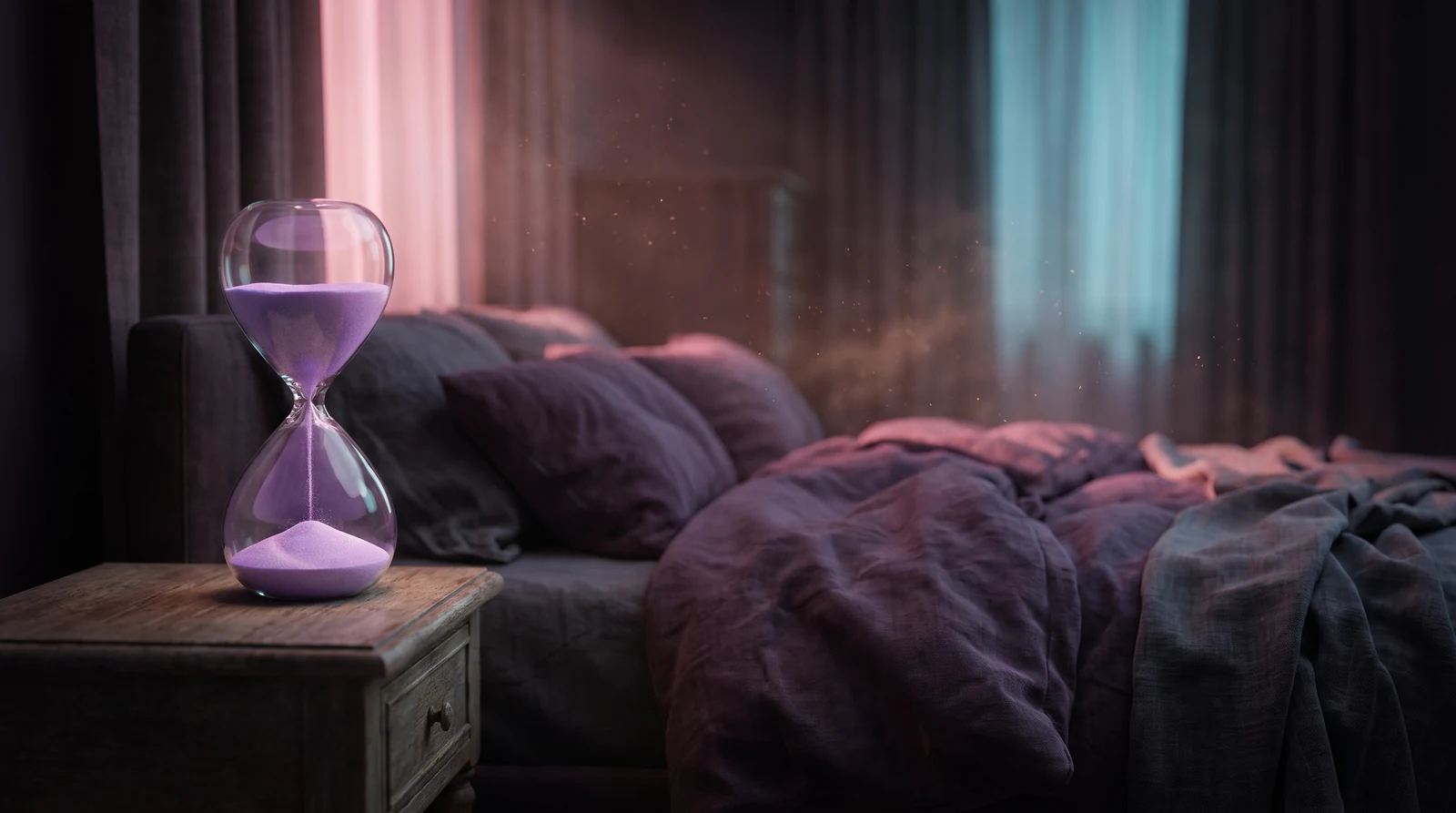
Here's a question nobody asks until 2am: why do you get sleepy at all? Not tired, not burned out, just plain sleepy, the eyelids-have-opinions kind. It turns out your brain runs a meter. It starts at zero when you wake up and climbs every hour you stay awake, and when it's high enough, sleep stops being optional. Scientists call it sleep pressure, and once you understand how the meter works, a bunch of confusing things about your own sleep suddenly make sense. Why naps can wreck your night. Why coffee at 4pm feels free and costs you at midnight. Why you can't fall asleep early just because you have an early flight.
I'm a skeptic by trade, so let me say upfront: this isn't a wellness metaphor. Sleep pressure is one of the better-mapped systems in sleep science, and you can feel it working in your own skull on any given Tuesday.
The two dials that decide when you sleep
The classic model of sleep, proposed by the researcher Alexander Borbély back in 1982, says your sleepiness at any moment is set by two independent dials (Borbély, 1982, Human Neurobiology). Dial one is your circadian rhythm, the internal clock that tracks time of day and makes you alert in the morning and drowsy at night regardless of what you've been doing. Dial two is sleep pressure, officially called Process S, which doesn't care what time it is at all. It only cares how long you've been awake. Sixteen hours awake means high pressure. Two hours awake means almost none.
Good sleep happens when both dials line up: clock says night, pressure says full. Bad sleep is usually one dial fighting the other. Jet lag is clock wrong, pressure right. A too-late nap is pressure wrong, clock right. The 9pm couch crash followed by the wide-awake 11pm bedtime? You spent your pressure on the couch and showed up to bed broke.
Adenosine, the sandman with a chemistry degree
So what actually is the pressure? The leading answer is a molecule called adenosine. While you're awake, your brain burns fuel, and adenosine piles up as a kind of metabolic exhaust. The more hours awake, the more adenosine sitting on receptors in the brain regions that regulate arousal, and the heavier your head gets. In a well-known set of experiments, researchers showed adenosine rising in the brains of animals kept awake and falling again during recovery sleep, behaving exactly like the sleep-pressure meter the models predicted (Porkka-Heiskanen et al., 1997, Science). Sleep, in this view, is partly a janitorial shift: the night crew clears the adenosine, the meter resets, and you wake up with a clean gauge.
This is also the entire business model of caffeine. Caffeine doesn't give you energy. It parks in the adenosine receptors so the real molecule can't dock, which means the pressure is still building, you just can't read the meter. When the caffeine wears off, all that accumulated adenosine hits at once. That's the crash, and it's why an afternoon espresso can push your bedtime back even when you swear you're immune.
Caffeine doesn't erase sleep pressure. It just covers the gauge while the tank keeps filling.
Why you can't bank sleep in advance
Sleep pressure explains one of the more annoying facts of adult life: you cannot pre-sleep. Going to bed at 8:30 before a brutal Thursday doesn't work, because at 8:30 your pressure isn't high enough to buy you a full night. You lie there, meter half full, negotiating with the ceiling. The system only runs one direction. You can pay down the debt after the fact, which is what weekend lie-ins are, but you can't make deposits ahead of time.
It also explains the second wind. Stay up past your usual bedtime and your circadian dial swings back toward alertness in the early morning hours even though your pressure is enormous. The two dials disagree, and for a few weird hours the clock wins. Anyone who's done an all-nighter knows the 5am surge. It isn't energy. It's your internal clock insisting it's nearly morning while the adenosine piles up behind the dam.
How to make the meter work for you
You can't control sleep pressure directly, but you can stop sabotaging it. A few moves that follow straight from the mechanics:
- Wake up at the same time daily. Your wake time is when the meter resets, so a consistent start means the pressure peaks at a consistent bedtime. Sleeping in until 11 on Sunday is why Sunday night is awful.
- Set a caffeine curfew. Caffeine has a half-life of roughly five to six hours, so a 4pm coffee is still blocking your meter at 10pm. Noon-ish is a safer last call if your nights are fragile.
- Keep naps short and early. Twenty minutes before 3pm skims a little pressure off the top. Ninety minutes at 5pm drains the tank you needed for the night.
- Don't go to bed on a half-full meter. If you're not sleepy, staying up another thirty minutes beats lying in bed teaching your brain that the mattress is a worry bench.
The last hour: let the pressure do the work
Here's the part people get backwards. Once your pressure is high, falling asleep isn't a skill you perform, it's an outcome you stop blocking. The usual blocker is mental arousal: the inbox replay, the rent math, the argument you're winning in the shower tomorrow. High adenosine can't compete with a brain that's actively generating stress chemistry. So the last hour is about getting out of the way. Dim the lights, drop the screens that demand decisions, give your eyes something slow and pointless to rest on. I keep Feelsy on the nightstand for exactly this: a slow-moving texture on autoplay, sound low, and its guided 4-7-8 breathing exercise when my head is still in deadline mode. It's not magic. It's just not stimulation, and at 11pm that's the whole job. The pressure was always going to win. You're just clearing the room so it can.
Feelsy is a wellness product, not medical advice. If stress, anxiety or sleep problems persist, please speak with a qualified professional.
References
- Borbély, A. A. (1982). A two process model of sleep regulation. Human Neurobiology, 1(3), 195–204.
- Porkka-Heiskanen, T., Strecker, R. E., Thakkar, M., Bjørkum, A. A., Greene, R. W., & McCarley, R. W. (1997). Adenosine: a mediator of the sleep-inducing effects of prolonged wakefulness. Science, 276(5316), 1265–1268.
Frequently Asked Questions
What is sleep pressure?
Sleep pressure is your brain's built-in drive to sleep that grows with every hour you stay awake. It's driven largely by adenosine, a byproduct of brain activity that accumulates during waking hours and makes you progressively sleepier. Sleep clears the adenosine and resets the pressure, which is why you wake up alert after a good night.
How does caffeine affect sleep pressure?
Caffeine blocks the brain receptors that adenosine normally binds to, so you stop feeling the sleepiness even though the adenosine keeps building. When the caffeine wears off, the accumulated pressure hits at once, which is the classic crash. Since caffeine takes five to six hours to drop by half, an afternoon coffee can still delay sleep at night.
Why can't I fall asleep early even when I'm exhausted the next day?
Falling asleep requires enough accumulated sleep pressure, and that only builds with hours spent awake. Going to bed well before your usual time means the pressure meter is only half full, so your body isn't ready regardless of how much you want the sleep. You can't bank sleep in advance; you can only avoid draining the pressure with late naps and late caffeine.
Do naps ruin sleep pressure?
Only when they're long or late. A nap releases some of the adenosine pressure you've built up, so a 90-minute nap at 5pm can leave too little pressure for a normal bedtime. A short nap of around twenty minutes before mid-afternoon skims a little off the top without draining the tank you need at night.
What's the fastest way to fall asleep when sleep pressure is high?
Stop blocking it. High sleep pressure loses to an aroused mind, so the last hour should remove stimulation rather than add effort: dim lights, no decision-heavy screens, and something slow and undemanding for the eyes or a paced breathing pattern like 4-7-8. With the arousal gone, the accumulated pressure does the rest on its own.

About the author
Contributing writer
Kurt is a New York based writer covering the practical science of stress, sleep and focus. He is the resident sceptic of the Journal: if a technique cannot survive a crowded subway commute and a deadline week, he is not interested in it.
Feel it for yourself.
Feelsy turns reading about calm into practising it. Two minutes of a slow texture is often the whole difference.


Related reading
 Sleep
Sleep Cycles, Explained: What Actually Happens Every 90 Minutes
What a sleep cycle actually is, how long one really lasts, why deep sleep front-loads your night, and how to time your alarm so mornings hurt less.
 Sleep
How Late Is Too Late for Coffee? Your Caffeine Cutoff, Explained
Caffeine six hours before bed can still cut an hour of sleep. What the research says about your last-cup cutoff, half-lives, and smarter timing.
 Sleep
The Coffee Nap: Why Drinking Coffee Before a Nap Actually Works
A coffee nap means drinking caffeine right before a 20-minute nap. It sounds backwards, but the timing is the trick. Here's the science and how to do it.
 Sleep
Falling Back: A Survival Guide for the End of Daylight Saving Time
Clocks fall back this weekend, and the free hour is slightly fake. What the end of daylight saving time really does to your sleep, and how to land it well.
 Sleep
The Best Alarm Sound to Wake Up To, According to Research
Harsh beeping may be making your mornings worse. What research says about the best alarm sound to wake up to, and how to choose one your brain won't fight.
 Sleep
Can You Learn While You Sleep? What the Science Actually Says
Sleep learning is an old dream and mostly a myth, but not entirely. What research really shows about learning, memory and your sleeping brain.