How Late Is Too Late for Coffee? Your Caffeine Cutoff, Explained
Caffeine six hours before bed can still cut an hour of sleep. What the research says about your last-cup cutoff, half-lives, and smarter timing.
By Kurt Woleret
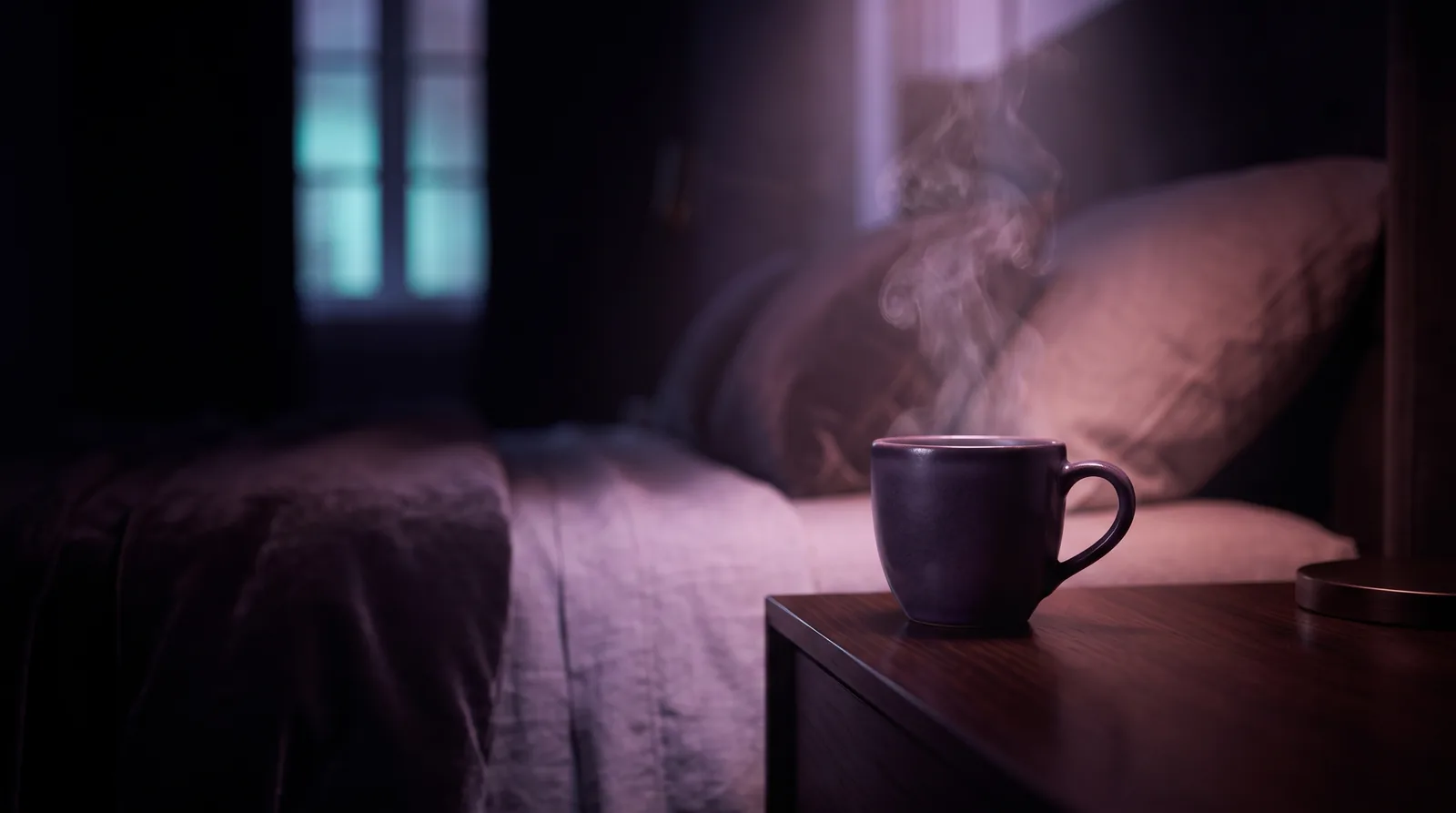
New York runs on a simple economic principle: there is always a coffee cart within a hundred feet of your problems. Which is how, during one memorable deadline week, I found myself ordering a large cold brew at 4:45 p.m. and then lying in bed at 1 a.m., wide awake, doing forensic accounting on my own afternoon. The question I should've asked at the cart is the one everybody asks eventually: how late is too late? Turns out sleep science has an unusually specific answer, and it's earlier than you want it to be.
The six-hour experiment
The classic study here is refreshingly blunt. Researchers gave people a 400 mg dose of caffeine, roughly the ballpark of a large coffee shop coffee, at three different times: right at bedtime, three hours before, and six hours before. Then they measured what happened, both with sleep monitors and with the sleepers' own reports (Drake et al., 2013, Journal of Clinical Sleep Medicine). The bedtime and three-hour doses wrecked sleep, no surprise. The interesting result was the six-hour dose: it still cut objectively measured sleep by more than an hour. And here's the part that should worry you: the six-hour group didn't report their sleep as much worse. The damage didn't register. They just lost the hour quietly, which means your own sense of 'coffee doesn't affect me' is exactly the instrument you can't trust.
What caffeine is actually doing in there
Quick mechanism check, because it explains everything else. All day long, a molecule called adenosine accumulates in your brain as a byproduct of being awake; it's the meter running on your wakefulness, and as it builds, it binds to receptors that make you feel sleepy. Caffeine works by impersonation: it's shaped just right to sit in those receptors without activating them, so the sleepiness signal can't get through. Note what it doesn't do: it doesn't erase the adenosine. The meter keeps running the whole time; the readout is just blocked. That's why late caffeine is such a specific kind of sabotage. You fall asleep eventually, because exhaustion wins on points, but with the blocker still circulating, the deep, slow-wave portion of the night gets thinned out. You logged eight hours and got six and change of quality, and you'll blame the mattress.
Half-life math, minus the mysticism
Caffeine has a half-life of roughly five to six hours in the average adult, meaning that if you drink a 200 mg coffee at 3 p.m., you've still got about 100 mg on board at 9 p.m., and around 50 mg at 3 a.m. Fifty milligrams is half an espresso, administered to your brain in the middle of the night. The word 'average' is doing heavy lifting in that sentence, though. How fast you clear caffeine is largely down to a liver enzyme called CYP1A2, and people vary enormously: fast metabolizers shrug off an afternoon cup, slow metabolizers feel a lunchtime coffee at midnight. Oral contraceptives can roughly double the half-life. Pregnancy stretches it dramatically. Some medications slow it; smoking, weirdly, speeds it up. So the six-hour rule from the study is a floor, not a personalized prescription. If you suspect you're on the slow end, and 'I fall asleep fine but sleep shallow' is a decent hint, your cutoff belongs earlier.
Caffeine rarely keeps you from falling asleep. It keeps you from sleeping deep, and then it lies about it.
So when's the actual cutoff?
Here's how I'd translate the evidence into a rule you'll actually follow. Count backward from your usual bedtime, not from some aspirational one. At minimum, stop six hours out: that's the line where the study still found an hour of damage, so treat it as the border of known trouble. If you sleep badly and don't know why, try eight to ten hours out for two weeks and see what changes; for a 10:30 p.m. bedtime that means the last real coffee lands around lunch. Dose matters as much as clock time. An afternoon espresso at 75 mg is a different creature from a 20-ounce cold brew that can quietly carry 300 mg. And decaf isn't zero, it's usually 2 to 15 mg a cup, which is fine for almost everyone but worth knowing if you're chain-drinking it at 9 p.m. like it's herbal tea.
The sneaky sources
Coffee is at least honest about what it is. The afternoon ambushes come from everywhere else:
- Cold brew and nitro: concentration varies wildly, and 250 to 350 mg in a large cup is common.
- Tea and matcha: gentler per cup, 30 to 70 mg, but they stack fast across an afternoon of refills.
- Chocolate: a real bar of dark chocolate in the evening can land 20 to 60 mg, which is a weak espresso you ate.
- Pre-workout powders and energy drinks: often 150 to 300 mg, frequently consumed at exactly the wrong hour.
- Some sodas and over-the-counter painkillers: check the label, caffeine hides in both.
Replacing the ritual, not just the drug
The hardest part of moving your cutoff isn't chemistry, it's that the 4 p.m. coffee was never really about caffeine. It's a permission slip: a reason to stand up, leave the desk, and not be reachable for six minutes. Kill the coffee without replacing the break and you'll relapse by Thursday. So keep the walk to the cart and order nothing, or make the world's most ceremonial cup of peppermint tea. My own replacement is stupider and works better: six minutes of a Feelsy texture running on autoplay, slime folding over itself in slow motion, plus one round of the 4-7-8 breathing exercise. Same reset, zero milligrams. The afternoon slump it's papering over, by the way, is usually a sleep debt problem or a circadian dip, and it responds better to a ten-minute walk in daylight than to another cup. And if you're currently deep in the late-coffee lifestyle, taper instead of quitting cold: shift the cutoff 30 minutes earlier every few days, swap the last cup to half-caf, then decaf. Your head will thank you for skipping the withdrawal headache, and your 1 a.m. self will finally stop doing forensic accounting.
Feelsy is a wellness product, not medical advice. If stress, anxiety or sleep problems persist, please speak with a qualified professional.
References
- Drake, C., Roehrs, T., Shambroom, J., & Roth, T. (2013). Caffeine effects on sleep taken 0, 3, or 6 hours before going to bed. Journal of Clinical Sleep Medicine, 9(11), 1195-1200.
Frequently Asked Questions
How many hours before bed should I stop drinking coffee?
A study gave people 400 mg of caffeine at bedtime, three hours before bed, and six hours before bed, and found that even the six-hour dose still cut objectively measured sleep by more than an hour (Drake et al., 2013). Treat six hours as the floor for known trouble, and if you sleep poorly without knowing why, try pushing your cutoff to eight to ten hours before bedtime for two weeks.
Why doesn't caffeine keep me from falling asleep but still ruins my sleep quality?
Caffeine works by blocking adenosine, a molecule that builds up all day and signals sleepiness, but it doesn't erase the adenosine itself, it just blocks the signal while the meter keeps running. This means you can eventually fall asleep once exhaustion wins, but with caffeine still circulating, the deep, slow-wave portion of your sleep gets thinned out even if the hours logged look fine.
Why does caffeine affect some people so much more than others?
Caffeine has an average half-life of roughly five to six hours, but how fast an individual clears it depends heavily on a liver enzyme called CYP1A2, which varies enormously between people. Oral contraceptives can roughly double the half-life, pregnancy stretches it dramatically, some medications slow it further, and smoking speeds it up, so the six-hour rule is a general floor rather than a personal prescription.
What are some sneaky sources of caffeine besides coffee?
Cold brew and nitro coffee can carry 250 to 350 mg per large cup, while tea and matcha run gentler at 30 to 70 mg but add up across refills. Dark chocolate can contribute 20 to 60 mg in the evening, pre-workout powders and energy drinks often have 150 to 300 mg, and some sodas and over-the-counter painkillers hide caffeine too, so it's worth checking labels.
What can I do instead of an afternoon coffee if I want to cut my caffeine intake?
Since the afternoon coffee is often really a permission slip for a short break rather than about the caffeine itself, replacing just the drug without replacing the break tends to fail. A better approach is swapping in something equally ritualistic, like a short walk, a slow calming activity, or a few minutes of a breathing exercise, and tapering your cutoff time earlier by about 30 minutes every few days rather than quitting cold.

About the author
Contributing writer
Kurt is a New York based writer covering the practical science of stress, sleep and focus. He is the resident sceptic of the Journal: if a technique cannot survive a crowded subway commute and a deadline week, he is not interested in it.
Feel it for yourself.
Feelsy turns reading about calm into practising it. Two minutes of a slow texture is often the whole difference.


Related reading
 Sleep
SleepHow to Fall Asleep Faster: Sound, Light and Ritual
Falling asleep is a skill, not a stroke of luck. Here is how sound, light and a 15-minute ritual can quiet a racing mind and shorten the trip to sleep.
 Sleep
SleepWhy You Wake Up at 3 AM (and How to Get Back to Sleep)
Waking at 3 AM isn't a curse or a sign something's broken. Here's the sleep science behind those small-hours wake-ups, and what actually gets you back down.
 Sleep
SleepDoes Screen Time Before Bed Really Wreck Your Sleep?
Phones before bed: sleep villain or overblown? What the research on screens, blue light and melatonin actually shows, and what to do that isn't 'never look at a screen.'
 SleepNew
Night Owl vs Early Bird: The Science of Chronotypes
Night owl or early bird isn't a personality flaw or a virtue. It's a chronotype. Here's what the science says about your body clock and how to work with it.
 SleepNew
How to Wake Up Early (Without Hating Your Life)
Want to become a morning person? Here's how to wake up early using light, timing and consistency, based on what circadian science actually shows.
 Sleep
SleepCan't Sleep? Why Getting Out of Bed Is the Counterintuitive Fix
Lying awake trying harder is the one thing that makes insomnia worse. Here's the 20-minute rule, the science of stimulus control, and how to use it.