Why Bioluminescence Is So Mesmerising: The Sea's Living Light
Glowing waves stop us mid-sentence and slow the breath. Here is what makes the sea shine at night, and why watching living light calms the nervous system.
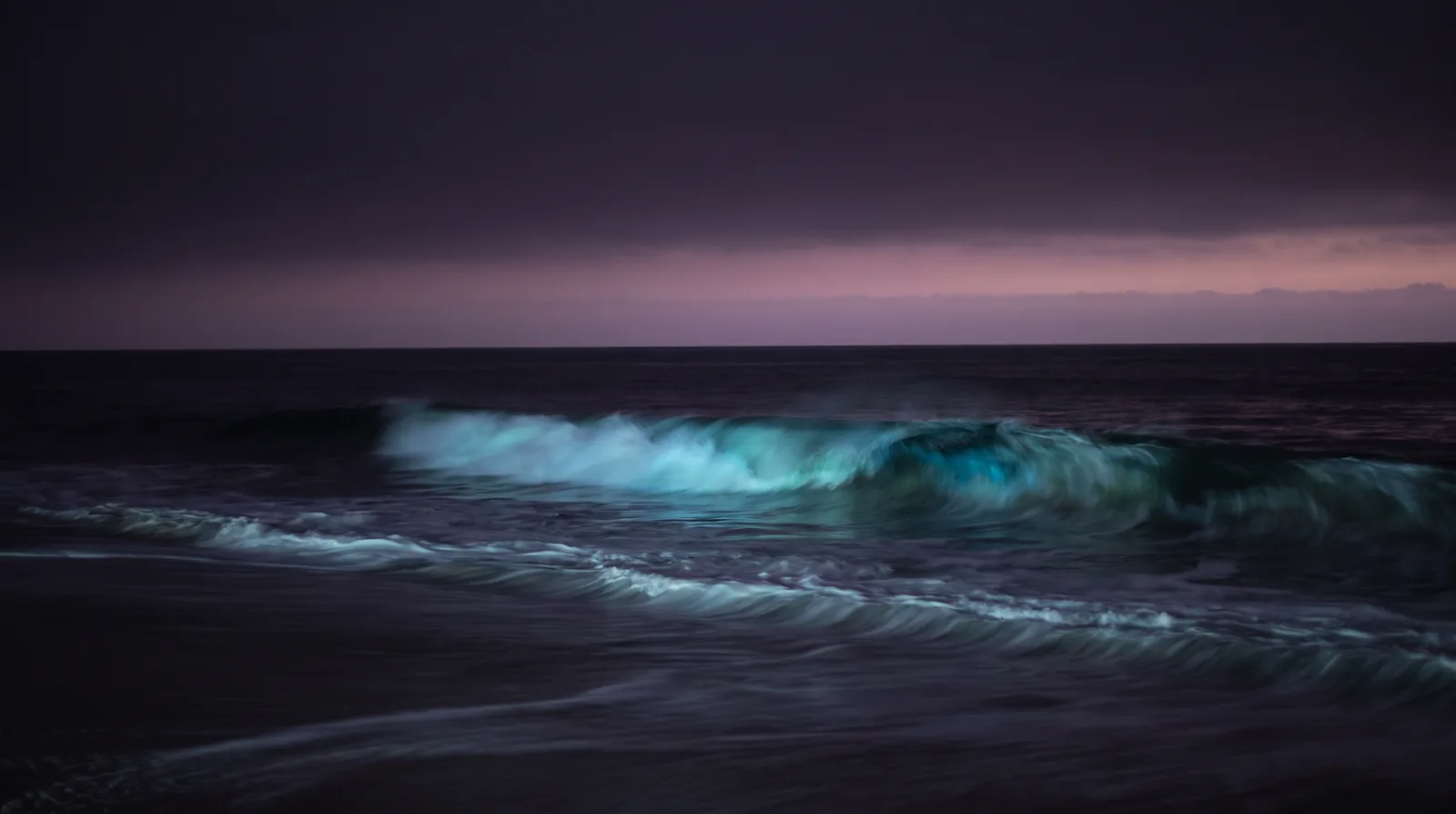
There are people who have travelled across the world for it and stood on a dark beach at midnight, waiting. Then a wave turns over and the water lights from within, a spill of cold blue-green fire that brightens, trembles and is gone. Almost everyone who sees bioluminescence for the first time does the same three things: they go quiet, they reach for someone's arm, and they forget, for a little while, everything they were thinking about. That forgetting is worth examining. Few sights on Earth empty the mind quite so thoroughly, and the reasons say a great deal about what our attention actually wants.
What makes the sea glow
The light is alive. Most glowing tides are made by dinoflagellates, single-celled plankton that produce a flash of light when the water around them is disturbed. A wave, a paddle, a swimmer's hand, even a fish passing beneath the surface will set them off, which is why the glow traces motion so faithfully: every crest outlined, every footstep in wet sand printed briefly in light. The flash is thought to work as a burglar alarm, startling the plankton's predators and summoning bigger hunters to deal with them.
So the beautiful shimmer is, in fact, a conversation in light happening at a scale too small to see, billions of tiny organisms each answering the touch of the water. Knowing this does not diminish the sight. It deepens it. You are watching the ocean become briefly legible, motion translated into glow.
Rarity, darkness and the conditions of wonder
Part of the spell is circumstance. Bioluminescence asks things of us that almost nothing else in modern life asks. It appears only in darkness, so you must be somewhere genuinely dark, away from streetlights and screens, eyes adjusted, pupils wide. It cannot be summoned, so you must wait. And it rewards stillness, because the calmer you become, the more of the night you notice.
In other words, the conditions for seeing the glow are the conditions of meditation: darkness, patience, quiet, attention resting lightly on one patch of world. The sea does not care whether you arrive stressed. But you cannot really watch it stressed, and so, wave by wave, you stop being so.
The glow cannot be summoned, only waited for. That is half of what it teaches.
Water, light and the resting mind
Psychologists have long noticed that water holds a privileged place in what we find restorative. In one well-known study, researchers showed people over a hundred photographs of natural and built scenes with varying amounts of water, and found that scenes containing water drew consistently higher ratings for preference, positive feeling and perceived restorativeness than comparable scenes without it (White et al., 2010, Journal of Environmental Psychology). We seem to be built to relax near water, whether or not we ever get in.
Bioluminescence layers a second calming ingredient on top: light that moves slowly, softly and unpredictably within a dark field. The eye follows it without effort, the way it follows embers or snowfall. Attention is held but never gripped. Nothing flashes at you; everything glows away from you. It is stimulation with all the urgency removed, which is close to a definition of visual rest.
Soft fascination in its purest form
Watching a glowing tide, you experience attention without effort: the scene is interesting enough to hold the eye and gentle enough to ask nothing of it. The mind, relieved of steering duty, wanders and settles, wanders and settles. People report the same dissolving of mental chatter beside campfires and aquariums, but the glowing sea may be the purest case, because it adds rarity and darkness to slowness and shine. You cannot check anything, optimise anything or hurry anything. You can only watch.
There is also the small, useful humiliation of scale. The glow is made by creatures thousands to a litre, each invisible on its own, and the sea that carries them does not know you are watching. Awe of this quiet kind, the sense of standing at the edge of something vast and indifferent and beautiful, is reliably good for us; it shrinks the worries that felt enormous an hour earlier to their true size. People walk back up the beach from a glowing tide noticeably quieter than they walked down, and not only because it is late.
How to watch, and where
Glowing water is unpredictable, which is part of its charm, but it favours warm, calm seas, moonless nights and the darker months of plankton blooms. Bays in Puerto Rico, the Maldives, Tasmania, California and the west coast of Ireland are all known for it. If you find yourself near a dark coastline at night, walk the tide line and drag a slow foot through the wet sand; if the plankton are in, your steps will answer in light.
Give it time. Let your eyes adjust for a full twenty minutes, keep the phone in a pocket, and breathe out longer than you breathe in. Even if the sea stays dark, you will have spent half an hour doing the rarest thing in your week: standing still in the dark, watching water, asking for nothing.
Bringing the glow indoors
Most nights there is no ocean to hand, and this is where the digital versions earn their keep. The qualities that make bioluminescence so restful, slow luminous motion inside a dark field, soft colour, a rhythm that answers touch, are exactly the qualities a good visual meditation is built from. In Feelsy, textures that ripple and bloom under your fingertip work on the same principle as the glowing tide: motion translated into light, at a pace the nervous system reads as safe. Set it to autoplay in a dark room, and let the eye do what it did on the beach.
The sea will still be better. It always is. But the practice is the same one: darkness, slowness, a little living light, and you, finally, just watching.
Feelsy is a wellness product, not medical advice. If stress, anxiety or sleep problems persist, please speak with a qualified professional.
References
- White, M., Smith, A., Humphryes, K., Pahl, S., Snelling, D., & Depledge, M. (2010). Blue space: The importance of water for preference, affect, and restorativeness ratings of natural and built scenes. Journal of Environmental Psychology, 30(4), 482–493.
Frequently Asked Questions
What causes the ocean to glow at night?
Most glowing tides are produced by dinoflagellates, single-celled plankton that flash with light when the water around them is disturbed. A wave, a hand or a footstep in wet sand triggers the glow, which is why it traces motion so faithfully. The flash is thought to act as a defence, startling the plankton's predators and attracting larger hunters to deal with them.
Why is watching bioluminescence so calming?
It combines several ingredients the resting mind loves: darkness, slowness, soft unpredictable light and water. Research has found that people rate scenes containing water as more restorative than comparable scenes without it, and glowing waves add gentle luminous motion that holds the eye without gripping it. The conditions it demands, stillness, patience and adjusted eyes, are essentially the conditions of meditation.
Where can you see bioluminescence?
Glowing water favours warm, calm seas, moonless nights and periods of plankton bloom. Well-known spots include bays in Puerto Rico, the Maldives, Tasmania, California and the west coast of Ireland. If you are near a dark coastline at night, walk the tide line and drag a slow foot through wet sand; if the plankton are present, your steps will light up.
Can you get the same calming effect without an ocean?
You can practise the same kind of attention indoors. The restful qualities of a glowing tide are slow luminous motion in a dark field, soft colour and a rhythm that responds to touch, and a well-made digital texture works on the same principle. Watching one in a dark room, breathing out longer than you breathe in, exercises the same soft, effortless attention as the beach.

About the author
Contributing writer
Eleonor writes about contemplative traditions, attention and the cultural history of calm. She has spent two decades collecting the rituals humans use to slow down, from zazen halls to hammams, and translating them for modern, screen-lit lives.
Feel it for yourself.
Feelsy turns reading about calm into practising it. Two minutes of a slow texture is often the whole difference.


Related reading
 Visual Meditation
Blue Mind: Why Being Near Water Calms the Brain
What blue mind theory says about why oceans, lakes and rivers soothe us: the research on blue space, water's pull on the eye, and how to use it daily.
 Visual Meditation
Why the Northern Lights Mesmerise Us: Aurora Watching as Visual Meditation
What causes the northern lights, why the aurora feels so calming to watch, and how to turn sky watching into a simple visual meditation practice.
 Visual Meditation
Why Watching Ocean Waves Calms the Mind
Why the sea calms the mind: the science of wave rhythm, blue space and shoreline sound, and how to borrow the ocean's stillness far from any coast.
 Visual MeditationNew
Zentangle: The Meditative Drawing Practice Anyone Can Learn
Zentangle turns simple repeated pen strokes into a calming ritual. Learn how the method works, why structured drawing soothes anxiety, and how to begin tonight.
 Visual Meditation
Why Ink Blooming in Water Is So Mesmerizing
A drop of ink unfurls underwater like slow smoke, and you cannot look away. The science and the old floating-ink arts behind one of the calmest sights there is.
 Visual Meditation
Highway Hypnosis: Why You Can't Remember the Last Ten Miles
You arrive at your exit with no memory of driving there. Highway hypnosis is real and common: here's the science of the road trance and how to use it safely.