Why Islamic Geometric Patterns Calm the Eye
From the Alhambra to a mosque ceiling, Islamic geometric patterns hold attention without exhausting it. How star-and-polygon design works, and why order soothes.
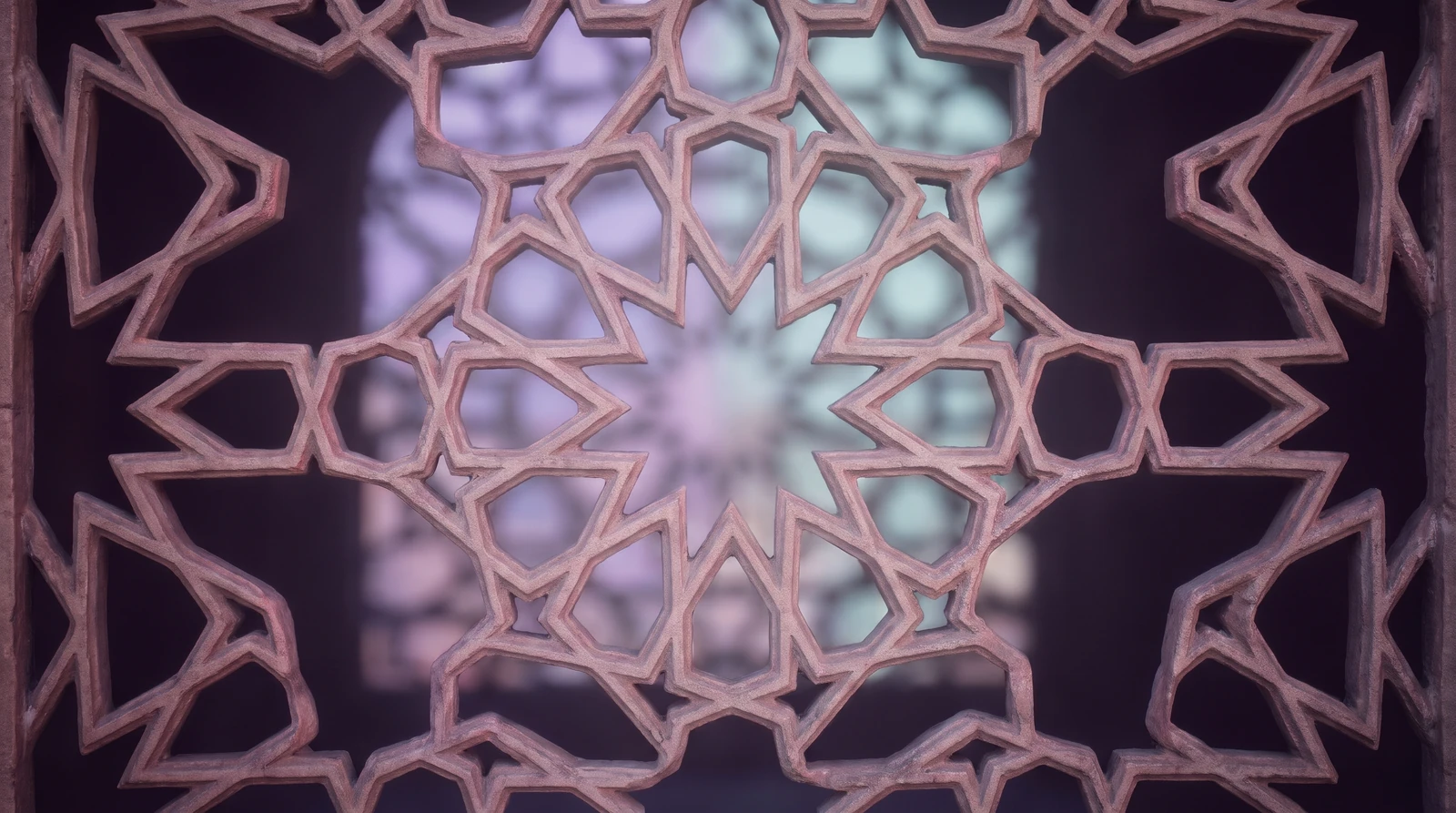
Stand in the Court of the Lions at the Alhambra, or under the dome of the Sheikh Lotfollah Mosque in Isfahan, and something odd happens to your attention. The surfaces around you are extraordinarily busy: thousands of tiles, stars inside polygons inside larger stars, pattern climbing every wall. By the logic of the modern attention economy, this should feel like visual noise. Instead, visitors consistently describe the opposite: stillness, absorption, a slowing of the pulse. The eye is fully occupied and completely at rest, both at once.
That paradox is not an accident of old buildings. It is the result of one of the most sophisticated visual traditions humans have produced, and it has something precise to teach anyone interested in how looking can calm the mind.
A tradition of pure pattern
Across much of Islamic art, especially in sacred architecture, artists favoured abstraction over figurative images. Out of that preference grew an immense vocabulary of geometric ornament: the star-and-polygon compositions known as girih, the cut-tile mosaics called zellige in the Maghreb, the pierced stone and wooden screens that turn light itself into pattern. From Córdoba to Samarkand, craftsmen spent centuries refining designs built from nothing but circles, lines and their intersections.
The basic method is disarmingly simple. With a compass and straightedge you divide a circle, connect the divisions, and let stars and polygons emerge from the crossings. A unit repeats, edge to edge, and suddenly a small construction becomes a field that could, in principle, continue forever. The tenth-century Brethren of Purity, an influential circle of scholars, wrote that studying geometry trains the mind to move from appearance to underlying structure. The patterns were understood, from early on, as something closer to contemplation than decoration.
Order with just enough surprise
Why does this kind of surface soothe rather than overwhelm? The art historian Ernst Gombrich devoted a whole book, The Sense of Order, to the psychology of decorative pattern, and his central observation fits girih perfectly: perception is an active process that constantly predicts what comes next, and ornament plays a game with those predictions. Too much regularity and the eye glides off, bored. Too much chaos and the eye gives up, stressed. The great patterns sit in between: regular enough that the eye always has a handhold, rich enough that there is always another relationship to discover (Gombrich, 1994).
Islamic geometric design is a masterclass in that balance. A ten-pointed star announces the rule; the lattice around it hides variations, half-stars at the borders, larger symmetries that only appear when you step back. Recent perceptual research has begun to study exactly this, asking how viewers detect the order in these patterns and why hard-but-comprehensible structure holds attention so comfortably (Cromwell, 2021). The pattern keeps rewarding inspection without ever threatening it. Nothing lunges. Nothing flashes. Nothing asks you to act.
The eye is fully occupied and completely at rest, both at once. That is the whole trick, and it is a deep one.
A visual language built for contemplation
It matters that so much of this pattern lives in spaces built for prayer and reflection. The designs reward precisely the kind of looking those spaces invite: unhurried, repeated, open-ended. Where a figurative painting tells you a story and finishes, a girih panel has no beginning, no end and no single focal point. You can rest your gaze anywhere and the pattern receives it. In that sense the tradition anticipated, by many centuries, what we now call visual meditation: attention held softly by structured, non-demanding stimulation.
It is the same family of experience as watching a mandala, a kaleidoscope or slow symmetrical motion on a screen. Feelsy's kaleidoscope textures are, quite consciously, descendants of this lineage: rotating star symmetries that give the eye a handhold and then let it rest, with layered sound doing the same work for the ears.
How to look slowly at a pattern
You can turn any rich geometric pattern, a tiled wall, a printed textile, a photograph of the Alhambra, a looping kaleidoscope, into a short contemplative exercise.
- Settle your gaze on one star or motif near the centre of the pattern and breathe slowly for three or four cycles.
- Let your eyes follow one line outward and notice where it travels: how it becomes the edge of a neighbouring shape, then returns.
- Soften your focus and take in the whole field at once, letting the larger symmetries surface on their own.
- When a thought pulls you away, come back to your chosen star. Five minutes is plenty.
What you are practising is not art history. It is the oldest skill in the contemplative toolbox: resting attention on something that is ordered, safe and quietly inexhaustible, and letting the body take the hint.
Feelsy is a wellness product, not medical advice. If stress, anxiety or sleep problems persist, please speak with a qualified professional.
References
- Gombrich, E. H. (1994). The Sense of Order: A Study in the Psychology of Decorative Art (2nd ed.). Phaidon Press.
- Cromwell, P. (2021). Looking at Islamic patterns I: The perception of order. PsyArXiv preprint.
Frequently Asked Questions
What are Islamic geometric patterns?
They are an immense vocabulary of abstract ornament developed across the Islamic world, including the star-and-polygon compositions known as girih, cut-tile zellige mosaics, and pierced screens that turn light into pattern. The designs are built with compass and straightedge from circles, lines and their intersections, and a repeating unit can extend a small construction into a field that could continue forever.
Why do busy geometric patterns feel calming instead of overwhelming?
Perception constantly predicts what comes next, and good ornament balances those predictions: too much regularity is boring, too much chaos is stressful, and the great patterns sit in between. Ernst Gombrich explored this in The Sense of Order, and Islamic star patterns are a masterclass in the balance, regular enough that the eye always has a handhold and rich enough that there is always another relationship to discover.
Were these patterns meant to be contemplative?
Largely yes. The tenth-century Brethren of Purity wrote that studying geometry trains the mind to move from appearance to underlying structure, and much of the pattern tradition lives in spaces built for prayer and reflection. A girih panel has no beginning, end or single focal point, so it rewards unhurried, repeated, open-ended looking.
How can I use a geometric pattern as a short meditation?
Settle your gaze on one star or motif, breathe slowly for a few cycles, then follow one line outward and notice where it travels. Soften your focus to take in the whole field, and return to your chosen star whenever a thought pulls you away. Five minutes with a tiled wall, a textile, a photograph or a looping kaleidoscope is plenty.

About the author
Contributing writer
Eleonor writes about contemplative traditions, attention and the cultural history of calm. She has spent two decades collecting the rituals humans use to slow down, from zazen halls to hammams, and translating them for modern, screen-lit lives.
Feel it for yourself.
Feelsy turns reading about calm into practising it. Two minutes of a slow texture is often the whole difference.


Related reading
 Visual Meditation
What Is Visual Meditation? The Complete Guide
Visual meditation rests your attention on slow, pleasing motion so calm happens almost on its own. Here is how it works, what the research says, and how to practise it in three minutes.
 Ancient Wisdom
Ancient Practices for Modern Calm: A World Tour
Humans have engineered calm for thousands of years. A tour through Zen, pranayama, hammam culture, forest bathing and the ancestors of visual meditation.
 ASMR
ASMR, Explained: What Science Says About the Tingles
ASMR is more than a trend. Here is what the tingles are, who feels them, and what studies have measured about their effects on heart rate, mood and calm.
 Visual Meditation
The Doorway Effect: Why You Forget What You Came For
You walk into the kitchen and the reason evaporates. The doorway effect is real, studied, and surprisingly useful for understanding how attention works.
 Visual Meditation
Apricity: The Forgotten Pleasure of Winter Sun
Apricity is a forgotten English word for the warmth of the sun in winter. Here is why a few minutes of low winter sunlight can soften the darkest months.
 Visual Meditation
Momijigari: The Japanese Art of Autumn Leaf Viewing
Momijigari is the old Japanese tradition of travelling to see autumn leaves. Here is why fiery foliage calms the mind, and how to practise it anywhere.