Why the Northern Lights Mesmerise Us: Aurora Watching as Visual Meditation
What causes the northern lights, why the aurora feels so calming to watch, and how to turn sky watching into a simple visual meditation practice.
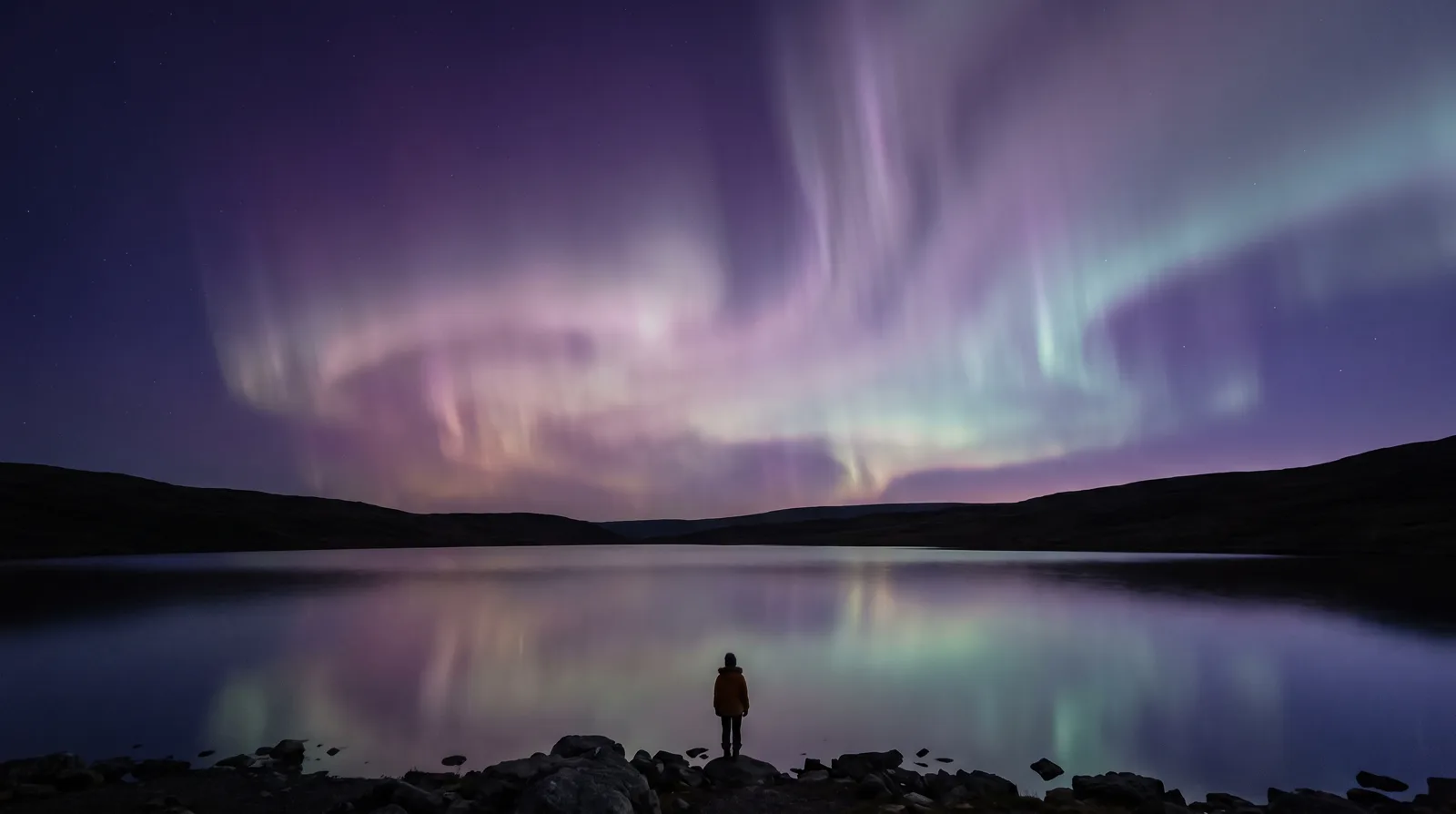
People do strange things for the northern lights. They fly across oceans, drive hours beyond the last streetlight, and stand in a frozen field at two in the morning, faces tilted upward, waiting. When the aurora finally arrives, something curious happens: the talking stops. A crowd of strangers falls quiet together, and for ten or twenty minutes nobody checks a phone. It is one of the few spectacles left that reliably silences us.
That silence is worth examining. The aurora is not loud, not fast, not dramatic in any conventional sense. It is a slow rearrangement of light. And yet it holds human attention more completely than almost anything we have built to compete with it. Understanding why turns out to be a small education in how calm actually works.
What is actually happening up there
The lights begin with the sun. Our star constantly sheds a stream of charged particles called the solar wind, and when a gust of it reaches Earth, our planet's magnetic field catches the particles and funnels them toward the poles. There, roughly a hundred kilometres up and higher, they collide with the thin gases of the upper atmosphere. Each collision nudges an oxygen or nitrogen molecule into an excited state, and as the molecule settles back down it releases a tiny pulse of light. Billions of these pulses, stacked into sheets along the lines of the magnetic field, become the curtains we see from the ground.
The colours are a chemistry lesson written across the sky. Oxygen tends to glow green at lower altitudes and a rarer red much higher up; nitrogen contributes blues and purples along the fringes. The rippling, curtain-like motion traces the geometry of the magnetic field itself, wavering as the solar wind gusts against it. When you watch an aurora, you are watching the invisible architecture of the planet made briefly visible.
Knowing this does not diminish the experience. If anything it deepens it. The lights are a conversation between a star and a planet, conducted in a medium older than eyes, and you happen to be standing underneath it.
Awe and the small self
Psychologists who study awe describe it as the feeling that arrives when we meet something vast, something that does not fit our existing frames and forces the mind to stretch. In an influential paper, Dacher Keltner and Jonathan Haidt argued that awe has two essential ingredients: perceived vastness, and the need to accommodate an experience that our ordinary categories cannot quite hold (Keltner and Haidt, 2003, Cognition and Emotion). The aurora is almost a laboratory-pure example. It is enormous, it is unpredictable, and nothing in daily life prepares you for the scale of it.
Later research found that awe does something gently paradoxical to the self. In a series of studies, Paul Piff and colleagues showed that experiences of awe produce what they call the small self: a sense that one's own concerns have shrunk against a larger backdrop, accompanied by more generous behaviour toward others (Piff et al., 2015, Journal of Personality and Social Psychology). People who had just stood beneath towering trees behaved measurably more helpfully than people who had stared at a building.
This is, I think, the secret of the silence that falls over aurora watchers. The lights do not relax us the way a warm bath relaxes us. They resize us. The inbox, the argument, the undone errand: all of it is still there, but it has been returned to scale, a small thing under a very large sky.
The aurora does not relax you the way a warm bath does. It resizes you: a small self under a very large sky.
Why slow light holds the gaze
There is a second ingredient besides awe, and it is humbler: the aurora moves at exactly the pace that attention finds restful. It is what environmental psychologists call soft fascination, the effortless attention we give to clouds, firelight and falling snow. The curtains drift, brighten, dissolve and reform, always varied and never sudden. The eye has somewhere to go at every moment, yet nothing demands a reaction. Your attention is fully occupied and completely unburdened at the same time, which is precisely the state in which the body decides it is safe to let its guard down.
This is the same mechanism that makes visual meditation work. The stimulus does the holding, so the mind does not have to. Anyone who has struggled to sit in silent meditation, eyes closed, thoughts clamouring, will recognise how different it feels to have something soft to watch.
How to practise aurora watching
If you are lucky enough to stand under the lights, a little intention turns a spectacle into a practice. The steps are almost embarrassingly simple.
- Settle your body first. Plant your feet, drop your shoulders, and let your breath lengthen for a few cycles before you look up.
- Choose one curtain or ribbon and follow it, the way you would follow a single dancer on a crowded stage.
- When the display changes, let your gaze be led rather than darting. The aurora rewards a patient eye.
- Notice the moment you stop narrating. The practice has started working when you realise you have not thought in words for a while.
There is no goal beyond that. You are not trying to photograph the peak moment or to feel any particular emotion. You are lending your attention to the sky and letting it be resized.
When the sky will not cooperate
Here is the quiet difficulty: most of us live at the wrong latitude, under clouds and streetlights, and the aurora keeps its own calendar. A practice cannot depend on a once-in-a-decade holiday. Happily, the mechanism does not require the real thing. What calms us is slow, luminous, endlessly varied motion against darkness, and that can be carried in a pocket.
This is much of what we reach for in Feelsy's flowing textures: ribbons of colour that drift and fold against a dark ground, particle fields that fall like slow snow, motion that never startles. A few minutes of watching, perhaps paired with the built-in 4-7-8 breathing exercise, offers a domesticated version of the same soft fascination. It will not resize you the way the real aurora does; nothing on a screen will. But as a nightly practice, a small window of slow light before sleep, it keeps the muscle of restful attention in use between encounters with the actual sky.
And when you do finally stand in that frozen field, you will find you already know how to watch.
Feelsy is a wellness product, not medical advice. If stress, anxiety or sleep problems persist, please speak with a qualified professional.
References
- Keltner, D., & Haidt, J. (2003). Approaching awe, a moral, spiritual, and aesthetic emotion. Cognition and Emotion, 17(2), 297–314.
- Piff, P. K., Dietze, P., Feinberg, M., Stancato, D. M., & Keltner, D. (2015). Awe, the small self, and prosocial behavior. Journal of Personality and Social Psychology, 108(6), 883–899.
Frequently Asked Questions
What causes the northern lights?
The northern lights begin with the solar wind, a stream of charged particles shed by the sun. Earth's magnetic field catches these particles and funnels them toward the poles, where they collide with oxygen and nitrogen in the upper atmosphere, roughly a hundred kilometres up and higher. Each collision makes a molecule release a tiny pulse of light, and billions of these pulses stacked along the magnetic field lines form the glowing curtains we see.
Why are the northern lights green, red and purple?
The colours come from the gases doing the glowing. Oxygen tends to produce green light at lower altitudes and a rarer red much higher up, while nitrogen contributes blues and purples along the fringes of the display. The curtain-like rippling traces the shape of Earth's magnetic field as the solar wind gusts against it.
Why do the northern lights feel so calming to watch?
Two things are happening at once. The aurora triggers awe, which researchers describe as the feeling of meeting something vast that our ordinary categories cannot hold, and studies have linked awe to a sense of the small self, where personal worries shrink against a larger backdrop. At the same time, the aurora moves with the slow, varied, never-sudden motion that attention finds effortlessly restful, so the eye stays occupied while the body lets its guard down.
Can watching the aurora count as meditation?
Yes, with a little intention. Settle your body first, choose a single curtain of light and follow it patiently, let your gaze be led rather than darting, and notice the moment you stop narrating in words. That is the same soft fascination that visual meditation relies on: the stimulus holds your attention so the mind does not have to.
What if I cannot see the northern lights where I live?
Most people live at the wrong latitude, and the aurora keeps its own calendar, but the calming mechanism does not require the real thing. Slow, luminous, endlessly varied motion against darkness produces the same soft fascination, whether that is firelight, falling snow, or flowing textures on a screen such as Feelsy's drifting ribbons and particle fields. A few minutes of slow watching, paired with unhurried breathing, keeps the habit of restful attention alive.

About the author
Contributing writer
Eleonor writes about contemplative traditions, attention and the cultural history of calm. She has spent two decades collecting the rituals humans use to slow down, from zazen halls to hammams, and translating them for modern, screen-lit lives.
Feel it for yourself.
Feelsy turns reading about calm into practising it. Two minutes of a slow texture is often the whole difference.


Related reading
 Visual Meditation
Why Stargazing Calms the Mind: The Science of Awe
Why looking at the night sky quiets an anxious mind: the research on awe and the small self, and how to practise stargazing without a telescope.
 Visual Meditation
Why Starling Murmurations Are So Mesmerising: The Sky Turned Liquid
Thousands of starlings wheel as one and the evening sky turns liquid. Here is the science of murmurations, why they mesmerise us, and how to watch one well.
 Visual Meditation
What Is Visual Meditation? The Complete Guide
Visual meditation rests your attention on slow, pleasing motion so calm happens almost on its own. Here is how it works, what the research says, and how to practise it in three minutes.
 Visual MeditationNew
Highway Hypnosis: Why You Can't Remember the Last Ten Miles
You arrive at your exit with no memory of driving there. Highway hypnosis is real and common: here's the science of the road trance and how to use it safely.
 Visual Meditation
Blue Mind: Why Being Near Water Calms the Brain
What blue mind theory says about why oceans, lakes and rivers soothe us: the research on blue space, water's pull on the eye, and how to use it daily.
 Visual Meditation
Why Autumn Leaves Calm the Mind: The Quiet Art of Leaf-Peeping
Why do autumn leaves make us feel calm and a little wistful? The psychology of leaf-peeping, soft fascination and letting go, plus how to practise it.