Why Cleaning Videos Are So Satisfying, According to Science
Power washing, carpet scraping, soap cutting: why does watching other people clean feel this good? The psychology of cleaning videos as a visual reset.
By Kurt Woleret
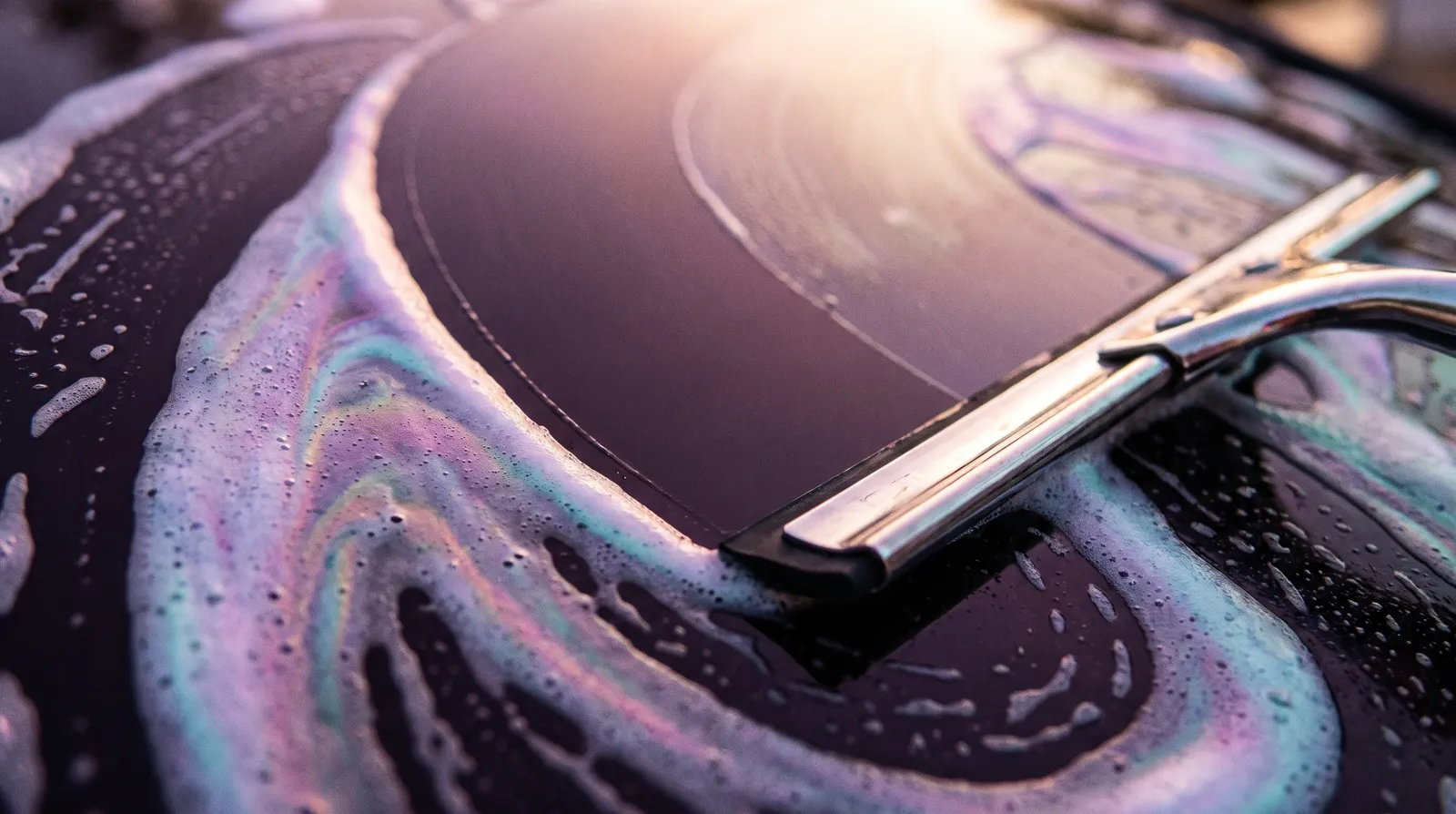
Last Tuesday at 1 a.m. I watched a man in Ohio power wash a driveway for forty minutes. My own sink had dishes in it. This is the paradox of cleaning videos, and if the algorithm has ever served you a carpet being scraped back to life or a rug rinsed until the water runs clear, you know the pull. Hundreds of millions of views, entire careers built on grime removal. Why does watching someone else clean feel this good, while our own chores feel like chores? Turns out psychology has some real answers.
Your brain loves a before-and-after
Cleaning videos are transformation machines. Dirty thing becomes clean thing, in one continuous shot, with zero ambiguity. Your brain is fundamentally a prediction engine, and these videos let it predict perfectly: the power washer will move left, the stripe will appear, order will advance. Every pass is a tiny promise kept. Compare that to the rest of your day, where you answer thirty emails and the inbox somehow gets fuller. A driveway that goes from black to beige in straight lines offers something modern work almost never does: visible, irreversible, finished progress.
The genre's rise makes sense once you see it that way. Cleaning content exploded over the past few years into a full ecosystem: power washing channels, carpet rescue operations, hotel housekeeping timelapses, restock-and-organize clips where every container clicks into place. Different surfaces, same contract. You will see a defined mess, you will see it end, and nobody will ask anything of you in between. In an attention economy built on cliffhangers and outrage, a genre whose entire promise is resolution is almost radical.
A power washer removes grime in clean straight lines. Your to-do list should be so lucky.
Mess is a low-grade stressor
There's also a reason the dirty half of the video itches. Our environments get under our skin more than we admit. In a study by Saxbe and Repetti in Personality and Social Psychology Bulletin, researchers had people give tours of their own homes, then tracked their mood and cortisol, a stress hormone, over days. People who described their homes as cluttered or full of unfinished projects showed more depressed mood over the day and less healthy cortisol patterns than those who described their homes as restful. Disorder isn't neutral background. It's a quiet tax.
Order, meanwhile, does things to us too. Vohs and colleagues showed in Psychological Science that people working in a tidy room made healthier choices and were more generous than people in a messy one. So when you watch chaos turn into order on a screen, you're watching an environment shift from the stressful category to the restful one, without lifting a finger. You get the arrival without the labor. Of course it feels good. It's the cheapest renovation on earth.
Why watching sometimes beats doing
Here's the part nobody wants to say out loud: watching is often more relaxing than doing, and there's a decent reason. Your own cleaning is riddled with decisions and incompleteness. Where do these cables even go? Is this shirt donate or keep? The video version has none of that friction. It's pure motion and outcome, which makes it effortless to watch, the same soft, easily-held attention that makes rain, aquariums, and slow slime folds so restful. Cleaning content is oddly satisfying content wearing rubber gloves.
That's also why these videos work as a legitimate micro-reset and not just a guilty pleasure. Two minutes of watching smooth, predictable transformation gives your overworked directed attention a place to sit down. This is precisely the principle Feelsy is built on: slow textures being pressed, folded, and smoothed, with soft sound, and autoplay so you're not hunting for the next clip when the calm was the whole point. Same soothing loop, minus the ads for degreaser.
There's a vicarious kick in it too. Watching competent hands do skilled work is its own quiet pleasure, the same reason people watch woodturning or watch a barista pour without ever planning to do either. The washer operator knows exactly where the next stripe goes. You get to borrow that certainty for a few minutes. In a week where nothing you touch feels finished, borrowing someone else's finished thing is not the worst coping strategy available. It might be the most honest one on your feed.
Using it on purpose
A few field notes on making this work for you instead of on you. Use cleaning videos as a deliberate two-minute break, not an accidental ninety-minute one. The satisfaction is front-loaded, and the fortieth driveway does less for you than the first. Second, try the watch-then-do trick: one video as a warm-up, then set a timer and give your own counter ten minutes. The video primes the transformation itch, and your own before-and-after, however small, pays better than any stranger's driveway. And at bedtime, pick your motion carefully. Pressure washing has a jackhammer's soundtrack. If the goal is winding down, quieter transformations, or a silent slow texture, will land you softer.
None of this needs to be optimized, though. Sometimes a guy in Ohio erases a decade of grime in four minutes and you feel your shoulders drop an inch. That's a fine deal. The wellness industry charges considerably more for considerably less. Watch your driveway video, take the shoulder drop, and go to bed. Your dishes will still be there in the morning. Mine were.
Feelsy is a wellness product, not medical advice. If stress, anxiety or sleep problems persist, please speak with a qualified professional.
References
- Saxbe, D. E., & Repetti, R. (2010). No place like home: Home tours correlate with daily patterns of mood and cortisol. Personality and Social Psychology Bulletin, 36(1), 71-81.
- Vohs, K. D., Redden, J. P., & Rahinel, R. (2013). Physical order produces healthy choices, generosity, and conventionality, whereas disorder produces creativity. Psychological Science, 24(9), 1860-1867.
Frequently Asked Questions
Why are cleaning videos so satisfying to watch?
They deliver perfect, predictable transformation: dirty becomes clean in one continuous, unambiguous arc. Your brain is a prediction engine, and each pass of the power washer is a small promise kept, which modern work rarely offers. You also watch an environment move from the stressful category to the restful one without doing any of the labor yourself.
Does clutter really affect stress levels?
Research suggests it does. In a study where people gave tours of their own homes, those who described their homes as cluttered or full of unfinished projects showed more depressed mood across the day and less healthy patterns of the stress hormone cortisol than people who described their homes as restful. Disorder acts like a quiet background tax on your mood.
Are cleaning videos good for relaxation?
Used deliberately, yes. Their smooth, predictable motion invites the same effortless attention that makes rain, aquariums, and slow textures restful, so a couple of minutes can work as a genuine reset for an overworked mind. The satisfaction is front-loaded, though, so a planned two-minute break beats an accidental ninety-minute scroll.
Why do I watch cleaning videos instead of cleaning?
Because watching strips out everything that makes your own cleaning effortful: the decisions, the incompleteness, the cables with no home. The video is pure motion and outcome, so you get the arrival without the labor. A useful trick is watch-then-do: let one video prime the transformation itch, then set a ten-minute timer for your own counter.
Are cleaning videos good to watch before bed?
Pick the quiet ones. The transformation itself is calming, but pressure washers and vacuums have harsh, motor-heavy soundtracks that work against winding down. Slower, softer transformations, or silent slow visuals like textures being smoothed and folded, give you the same settling effect and land you closer to sleep.

About the author
Contributing writer
Kurt is a New York based writer covering the practical science of stress, sleep and focus. He is the resident sceptic of the Journal: if a technique cannot survive a crowded subway commute and a deadline week, he is not interested in it.
Feel it for yourself.
Feelsy turns reading about calm into practising it. Two minutes of a slow texture is often the whole difference.


Related reading
 ASMR
ASMRThe Quiet Pleasure of Oddly Satisfying Videos
Why are oddly satisfying videos so satisfying? The psychology of perfect fits, clean sweeps and slow swirls, and how to turn watching into meditation.
 ASMR
ASMRWhy Slime Videos Are So Satisfying
There is a real reason your shoulders drop when you watch slime being folded and poked. A look at ASMR, soft fascination and the design of satisfying motion.
 ASMR
ASMRUnintentional ASMR: Why a Stranger Folding Towels Puts You to Sleep
The calmest videos online were never trying to relax you. Here's what unintentional ASMR is, why old how-to footage works so well, and how to find your triggers.
 Visual MeditationNew
Highway Hypnosis: Why You Can't Remember the Last Ten Miles
You arrive at your exit with no memory of driving there. Highway hypnosis is real and common: here's the science of the road trance and how to use it safely.
 Visual Meditation
Why the Northern Lights Mesmerise Us: Aurora Watching as Visual Meditation
What causes the northern lights, why the aurora feels so calming to watch, and how to turn sky watching into a simple visual meditation practice.
 Visual Meditation
Blue Mind: Why Being Near Water Calms the Brain
What blue mind theory says about why oceans, lakes and rivers soothe us: the research on blue space, water's pull on the eye, and how to use it daily.