Why Fractals Calm the Mind: The Quiet Mathematics of Ferns and Coastlines
Ferns, clouds and coastlines share a repeating geometry called fractals. Here is why nature's self-similar patterns soothe the eye, and how to use them.
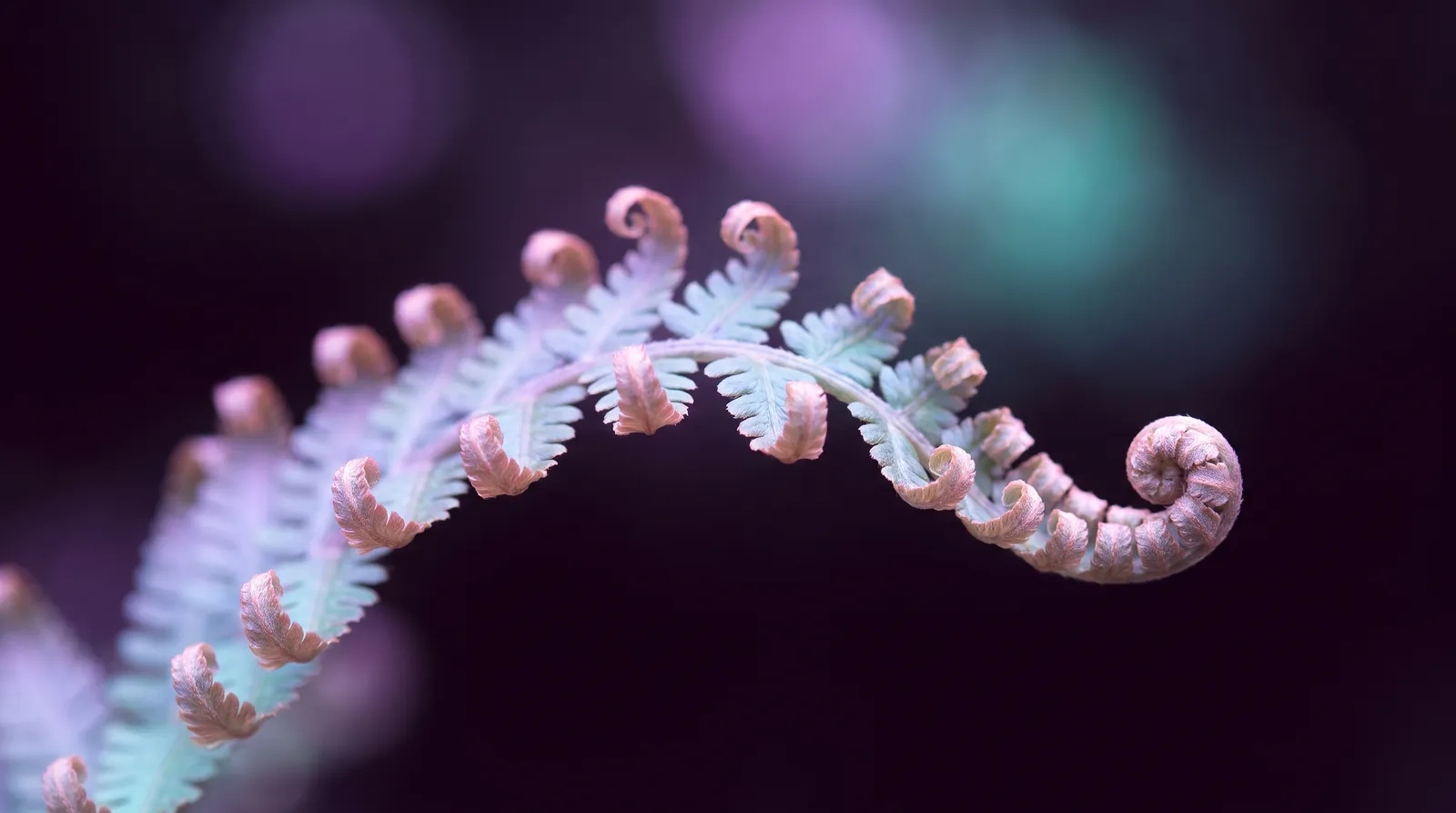
Stand before a fern and look closely at a single frond. It is, you will notice, a small fern in its own right: each leaflet repeats the shape of the whole, and each leaflet of the leaflet repeats it again, down to the edge of what the eye can resolve. Coastlines do the same trick at a grander scale, and so do clouds, river deltas, the branching of an oak against a winter sky, the crackle of glaze on an old teacup. Mathematicians call these patterns fractals: shapes that repeat their own structure at different scales. The rest of us mostly call them beautiful, and feel, without quite knowing why, that they are restful to look at.
That feeling turns out not to be a private eccentricity. Over the past few decades, researchers have been measuring what happens to the human body when it looks at fractal patterns, and the results suggest that our sense of visual peace has a geometry to it. This is a subject close to my heart, because it explains something I have long suspected: that certain kinds of looking are themselves a form of rest.
What a fractal actually is
The word was coined by the mathematician Benoit Mandelbrot in the 1970s, from the Latin fractus, meaning broken. A fractal is a pattern whose parts echo the whole. Cut a branch from a tree and it resembles a small tree; magnify a stretch of coastline on a map and the wiggles look much like the wiggles of the whole coast. This property is called self-similarity, and nature is saturated with it, because growth and erosion both work by repeating simple processes over and over at every scale.
Mathematicians describe the visual density of a fractal with a number called the fractal dimension, written D. A pattern with a low D, close to 1, is sparse and simple, like a lone winding river. A pattern with a high D, close to 2, is dense and intricate to the point of visual noise. In between sits a middle register: textured but legible, complex but composed. Hold that thought, because it is where the story becomes interesting.
Fractal fluency: an eye raised in forests
The physicist Richard Taylor and his collaborators have spent years studying how people respond to fractal imagery, from forest canopies to the poured paintings of Jackson Pollock. Their proposal, sometimes called fractal fluency, is that human vision developed amid the fractal scenery of the natural world, and so processes such patterns with unusual ease. The visual system, met with the branching of trees or the ragged edges of clouds, finds itself on home ground. It knows this language; it reads it without effort.
That ease appears to be measurable. In work on physiological responses to fractal art and architecture, Taylor reported that viewing mid-range fractal patterns, with a fractal dimension between roughly 1.3 and 1.5, was associated with reduced physiological stress, as though the body itself relaxed its posture in front of the right kind of complexity (Taylor, 2006, Leonardo). Later work with Branka Spehar developed the fractal fluency account in detail, linking the sparkle of aesthetic pleasure we take in these patterns to how smoothly the visual system processes them (Taylor and Spehar, 2016, in The Fractal Geometry of the Brain).
It is worth saying plainly what this research does and does not claim. It does not say that staring at a fern will dissolve your troubles. It says that some patterns ask less of the eye than others, and that the mid-range fractals of the natural world seem to sit in a visual sweet spot where interest is high and effort is low. Restfulness, in other words, is not the absence of stimulation. It is stimulation of a kind the eye was built for.
A fern is not asking to be understood. It is asking to be followed, frond by frond, until the follower forgets to be anyone in particular.
Why the middle register soothes
Think of the two extremes. A blank wall offers the eye nothing: attention, finding no purchase, slides back inward towards its worries. A city intersection offers too much: signage, motion, glare, every element demanding a decision. Mid-range fractal scenery does neither. It gives attention a gentle occupation with no stakes attached. The pattern is predictable enough to be reassuring, since each scale echoes the last, yet varied enough that the gaze keeps moving, tracing branches, following edges, wandering without ever getting lost.
This is, I suspect, why so many of the world's instinctive calming behaviours are really fractal-gazing in disguise. Watching a fire is watching flames fork and re-fork. Watching waves is watching foam scatter into self-similar lace. Cloud watching, forest walking, staring at the crazed surface of a frozen puddle: all of it is the eye grazing on the middle register. Our ancestors did not know the mathematics, but they built their resting places, their gardens and their sacred art in it all the same.
How to practise fractal gazing
You can make deliberate use of this, and it requires no training whatsoever. The practice is simply looking, done slowly and with a little intention. Choose a natural pattern and let your eyes travel it for two or three minutes: begin with the whole, then follow one branch to its smaller branches, then smaller still, then drift back out to the whole again. Moving between scales like this seems to me the heart of the practice; it gives the mind a staircase to walk instead of a treadmill to run.
- Outdoors: tree canopies against the sky, fern banks, lichen on stone, frost on a car roof, the branching of bare hedges in winter.
- At home: the grain of wooden furniture, a head of romanesco broccoli, steam curling from a cup, the veins of a houseplant leaf held up to the light.
- On a screen: slow footage of clouds, waves or smoke, or the drifting textures in Feelsy, whose swirling and folding patterns live naturally in that mid-range register of ordered complexity.
If you use a screen, let it be a slow one. The point is not spectacle but graze: a pattern that changes at the pace of weather rather than the pace of advertising. I sometimes leave Feelsy's autoplay mode running in the evening the way one leaves a fire burning, not to watch it exactly, but to have somewhere unhurried for the eyes to settle between thoughts.
The pattern that lets you stop
There is a small philosophical consolation hiding in all this. We tend to assume that calming the mind means emptying it, and most of us fail at emptiness within seconds. Fractal gazing suggests a kinder route: do not empty the mind, occupy it gently. Give the eye a pattern tuned to its own history, and the rest of the machinery quietens on its own, the way a dog settles once it has been given something to hold.
The fern was never trying to teach us anything. But four hundred million years of patient repetition have made it, quite by accident, one of the best teachers of rest we have. Look closely, then more closely still. Somewhere between the frond and the leaflet, the week loosens its grip.
Feelsy is a wellness product, not medical advice. If stress, anxiety or sleep problems persist, please speak with a qualified professional.
References
- Taylor, R. P. (2006). Reduction of physiological stress using fractal art and architecture. Leonardo, 39(3).
- Taylor, R. P., & Spehar, B. (2016). Fractal fluency: An intimate relationship between the brain and processing of fractal stimuli. In The Fractal Geometry of the Brain. Springer.
Frequently Asked Questions
What is a fractal, in simple terms?
A fractal is a pattern that repeats its own structure at different scales, a property called self-similarity. A branch resembles a small tree, a leaflet of a fern resembles the whole frond, and a magnified stretch of coastline looks much like the whole coast. The term was coined by the mathematician Benoit Mandelbrot in the 1970s, and nature is full of fractals because growth and erosion repeat simple processes at every scale.
Why are fractals calming to look at?
Research on fractal fluency suggests human vision developed amid the fractal scenery of the natural world, so it processes these patterns with unusual ease. Work by the physicist Richard Taylor found that viewing mid-range fractal patterns, with a fractal dimension between roughly 1.3 and 1.5, was associated with reduced physiological stress. These patterns occupy attention gently: predictable enough to reassure, varied enough to keep the gaze moving.
Where can I find calming fractal patterns in everyday life?
Tree canopies, ferns, clouds, waves, fire, lichen on stone, frost, wood grain, romanesco broccoli and curling steam are all everyday fractals. Watching fire or waves is essentially fractal gazing in disguise. On a screen, slow footage of clouds or smoke, or drifting slime and fluid textures, offers the same mid-range visual complexity, provided it moves at an unhurried pace.
How do you practise fractal gazing?
Choose a natural pattern and let your eyes travel it slowly for two or three minutes. Begin with the whole shape, follow one branch down to its smaller branches, then drift back out to the whole again. Moving between scales gives the mind a gentle occupation with no stakes attached, which is far easier than trying to empty the mind of thoughts.

About the author
Contributing writer
Eleonor writes about contemplative traditions, attention and the cultural history of calm. She has spent two decades collecting the rituals humans use to slow down, from zazen halls to hammams, and translating them for modern, screen-lit lives.
Feel it for yourself.
Feelsy turns reading about calm into practising it. Two minutes of a slow texture is often the whole difference.


Related reading
 Visual Meditation
Why Watching Ocean Waves Calms the Mind
Why the sea calms the mind: the science of wave rhythm, blue space and shoreline sound, and how to borrow the ocean's stillness far from any coast.
 Visual Meditation
Cloud Watching: The Easiest Meditation There Is
Why drifting clouds restore tired attention when screens cannot: the science of soft fascination, and how to practise the art of looking up.
 Visual Meditation
Calming Colours: What Actually Soothes the Eye, and Why
What are the most calming colors? What research says about blue, green and lavender, why saturation matters more than hue, and how to use colour to unwind.
 Visual MeditationNew
Highway Hypnosis: Why You Can't Remember the Last Ten Miles
You arrive at your exit with no memory of driving there. Highway hypnosis is real and common: here's the science of the road trance and how to use it safely.
 Visual Meditation
Why the Northern Lights Mesmerise Us: Aurora Watching as Visual Meditation
What causes the northern lights, why the aurora feels so calming to watch, and how to turn sky watching into a simple visual meditation practice.
 Visual Meditation
Blue Mind: Why Being Near Water Calms the Brain
What blue mind theory says about why oceans, lakes and rivers soothe us: the research on blue space, water's pull on the eye, and how to use it daily.