Why Paint Mixing Videos Are So Satisfying
Why paint mixing videos feel so satisfying: the slow science of swirls and folds, what ASMR research suggests, and how to watch them as a mini meditation.
By Mei Lin
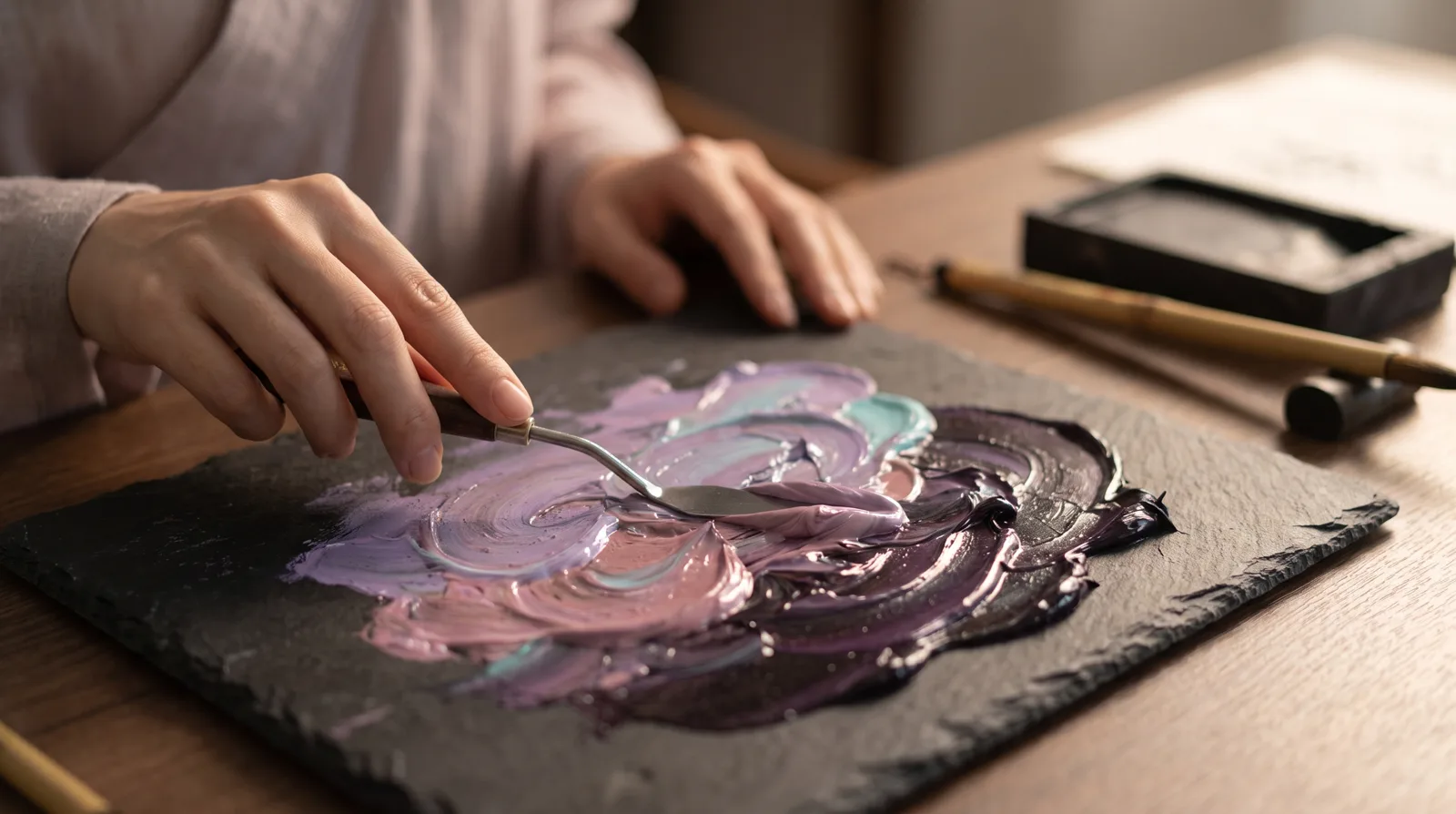
A palette knife presses into a coil of paint. The color underneath rises through the color on top, first as a streak, then as a marbled ribbon, then as something new that belongs to neither parent. Twenty seconds ago you were scrolling. Now you are watching paint the way you might watch a river, and you do not entirely know why.
Paint mixing clips are one of the quiet giants of the oddly satisfying internet. No faces, no talking, no plot. Just pigment, a knife, a slab, and the patient arithmetic of two colors becoming one. Millions of us stop for them. The interesting question is what, exactly, we are stopping for.
The moment of the fold
Watch closely and you notice the genre has a grammar. There is the press, when the knife first breaks the surface and the paint yields like something halfway between honey and clay. There is the streak, when a vein of rose opens through a field of deep violet. There is the marble, the brief chaos where both colors hold their identity in swirls. And then there is the vanish: the last thread of the old color folds under, and the mixture turns smooth, single, settled.
That final smoothness is the payoff. Researchers who study the oddly satisfying genre point to completion as its engine: an action with a visible beginning, a visible end, and nothing left over. Most of adult life is unfinished. The email thread continues, the project rolls into next quarter, the laundry regenerates. A paint mix is a task that actually ends, and your eyes get to be there when it does.
What your body does while you watch
Paint mixing sits inside a larger family of slow, gentle, close-up videos that includes ASMR, and that family has begun to attract real research. In one frequently cited study, Giulia Poerio and colleagues had people watch ASMR videos in the lab while tracking their physiology. Viewers who experience ASMR showed a notable drop in heart rate while watching, alongside increased skin conductance, a combination the authors describe as calm with a thread of gentle excitement running through it (Poerio et al., 2018, PLOS One).
Not everyone gets tingles, and paint mixing is not a classic tingle trigger anyway. That turns out to matter less than you might think. The genre's ingredients, slow hands, soft repetitive sound, close attention to a simple physical process, are the same ones the research keeps circling. You do not need a shiver down your neck to get the exhale.
Flow, borrowed from someone else's hands
There is a second thread in the research worth pulling. In the first academic study of ASMR, Emma Barratt and Nick Davis surveyed hundreds of viewers and suggested the experience resembles a flow-like state: absorbed, unselfconscious, pleasantly lost in the moment (Barratt and Davis, 2015, PeerJ). What strikes me about paint mixing is that the flow belongs first to the person holding the knife. The confidence of the strokes, the unhurried rhythm, the total absence of doubt. We watch someone who is not anxious, and for a minute we borrow their nervous system.
Two colors give up their names, and for a moment your mind gives up its list.
The old crafts knew this
None of this would surprise the crafts that came before the camera. I grew up in Shanghai around slow hands. My grandmother ground ink for calligraphy in small circles on a stone, and the moment the water turned from grey to true black had exactly the structure of a paint mixing video: patience, transformation, completion. Potters watch glaze fold into glaze. Bakers watch dark syrup ribbon into pale dough. Cooks stir sesame paste until the oil that separated overnight surrenders back into the whole.
Every one of these is a small ceremony of two things becoming one thing, performed at the speed of the hand rather than the speed of the feed. The paint mixing video did not invent the pleasure. It found a way to deliver it to people who no longer grind ink.
How to watch well
There is a difference between consuming satisfying clips and actually being satisfied by them. The difference is mostly pace and intention. A few habits help.
- Watch one thing at a time. A single mix on a full screen settles you; a grid of thumbnails is just another crowd.
- Keep the sound on, low. The soft drag of the knife is half the experience, and it gives your ears the same slow rhythm your eyes are getting.
- Breathe with the folds. Let the press of the knife cue your exhale. You will find the video pacing your breath within a minute.
- Stop at the vanish. When the mix completes and the color settles, let that be an ending rather than a doorway to forty more clips.
This is roughly the thinking behind the textures in Feelsy: creams and fluids that fold under your own finger, so the satisfaction is something you do rather than only something you watch, and an autoplay mode that strings slow scenes together at a walking pace when you would rather let your hands rest. Either way, the point is the same. One slow thing, watched fully, does more than fifty watched sideways.
The paint does not hurry. That is the whole lesson. Somewhere between the streak and the vanish, you remember that you do not always have to hurry either.
Feelsy is a wellness product, not medical advice. If stress, anxiety or sleep problems persist, please speak with a qualified professional.
References
- Poerio, G. L., Blakey, E., Hostler, T. J., & Veltri, T. (2018). More than a feeling: Autonomous sensory meridian response (ASMR) is characterized by reliable changes in affect and physiology. PLOS One, 13(6), e0196645.
- Barratt, E. L., & Davis, N. J. (2015). Autonomous Sensory Meridian Response (ASMR): a flow-like mental state. PeerJ, 3, e851.
Frequently Asked Questions
Why are paint mixing videos so satisfying?
They deliver completion, which most of adult life withholds. A paint mix has a visible beginning, a marbled middle, and a clean ending when the last streak of the old color folds under and the mixture turns smooth. Watching a task actually finish, performed by slow and confident hands, gives the mind a small, whole experience with nothing left over.
Are paint mixing videos a type of ASMR?
They belong to the same family of slow, gentle, close-up videos, though paint mixing is not a classic tingle trigger and many viewers feel no tingles at all. The ingredients are shared: unhurried hands, soft repetitive sound, and close attention to a simple physical process. You do not need to experience tingles to find the videos relaxing.
Is there any science behind satisfying and ASMR videos?
Early research suggests real effects. A study by Poerio and colleagues found that people who experience ASMR showed a notable drop in heart rate while watching ASMR videos, alongside increased skin conductance, a mix of calm and gentle excitement. An earlier survey study by Barratt and Davis described the viewing experience as a flow-like state, absorbed and pleasantly unselfconscious.
How do I get the most relaxation from satisfying videos?
Watch one clip at a time on a full screen instead of scanning a grid, keep the sound on at low volume, and let the rhythm of the hands pace your breathing, exhaling as the knife presses in. When the mix completes, treat that as a natural stopping point rather than autoplaying into an endless queue. One slow video watched fully is more settling than dozens skimmed.

About the author
Contributing writer
Mei grew up in Shanghai around tea that could not be hurried and grandmothers who considered stillness a skill. She writes about slow hands and sensory ritual: tea, calligraphy, qigong, and the quiet crafts that taught the world how to pay attention.
Feel it for yourself.
Feelsy turns reading about calm into practising it. Two minutes of a slow texture is often the whole difference.


Related reading
 ASMR
ASMRWhy Slime Videos Are So Satisfying
There is a real reason your shoulders drop when you watch slime being folded and poked. A look at ASMR, soft fascination and the design of satisfying motion.
 ASMR
ASMRThe Quiet Pleasure of Oddly Satisfying Videos
Why are oddly satisfying videos so satisfying? The psychology of perfect fits, clean sweeps and slow swirls, and how to turn watching into meditation.
 Visual Meditation
Shan Shui: Why Misty Mountain Paintings Quiet the Mind
Why Chinese landscape painting calms the mind: what shan shui is, the psychology of mist and negative space, and how to look at a painting as meditation.
 ASMRNew
Why Is Bob Ross So Relaxing? The Science of Happy Little Brushstrokes
Bob Ross has been putting people to sleep for four decades, and he'd take that as a compliment. Here's the science of why his painting videos work like ASMR.
 ASMRNew
What Is 8D Audio? The Science Behind the Spinning Sound
8D audio pans music around your head using binaural tricks. Here's how the illusion works, why it feels immersive, and whether it helps you relax or focus.
 ASMR
ASMRMisokinesia: Why Watching Someone Fidget Drives You Up the Wall
If a bouncing knee across the room hijacks your whole brain, you may have misokinesia. Here's the research on fidget sensitivity and what actually helps.