Shan Shui: Why Misty Mountain Paintings Quiet the Mind
Why Chinese landscape painting calms the mind: what shan shui is, the psychology of mist and negative space, and how to look at a painting as meditation.
By Mei Lin
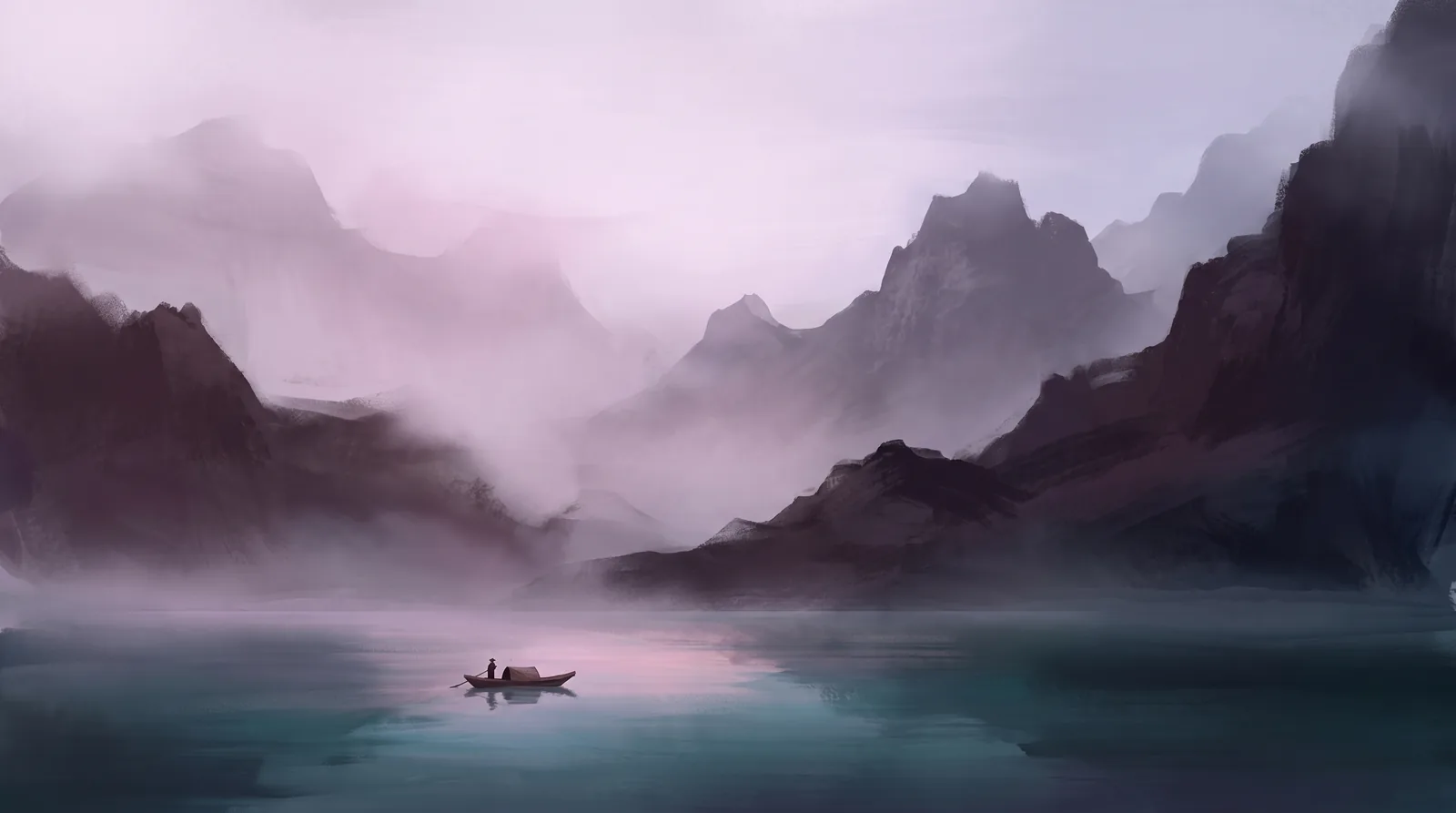
There is a painting in the Shanghai Museum I used to visit the way other people visit a relative. A hanging scroll: mountains rising out of mist, a thread of waterfall, a hut half-hidden in pines, and low in the corner, small as a grain of rice, a single figure crossing a bridge. I would stand in front of it until the guard began to notice me, and I left each time strangely rested, as if I had been somewhere with better air. It took me years to learn that this was not a private eccentricity. It was the painting working exactly as designed.
Shan shui, literally mountain-water, is the great tradition of Chinese landscape painting, a thousand years older than the word wellness and quietly aimed at the same target. These paintings were never made to document scenery. They were made as places: landscapes for the eye to enter, wander and rest in, built by artists who assumed their viewers were tired officials in crowded capitals, homesick for mountains they had no time to reach. The eleventh-century painter Guo Xi put the purpose plainly: a fine landscape painting lets a person sit by a window and still ramble among streams and peaks. It is, in other words, the oldest theory of the calming screen.
A landscape you travel, not look at
The first thing to understand about shan shui is that it is built for a moving eye. A Western landscape of the same centuries typically offers one view from one spot, as through a window. A shan shui scroll offers a journey: a path enters at the bottom, crosses water, climbs through pines, disappears behind a ridge and reappears higher, until the summits dissolve into mist near the top. Painters spoke of three kinds of distance in one picture, looking up, looking across, looking deep, and composed so the eye would drift among them without settling.
Handscrolls made the journey literal: unrolled an arm's length at a time, right to left, so the landscape passed before the viewer at the pace of their own hands, mountains arriving and departing like weather. It was slow looking, mechanically enforced. A scroll cannot be skimmed; it can only be traveled.
The psychology of mist
Why does this rest the mind? Modern attention research offers a vocabulary the painters lacked and would have enjoyed. Stephen Kaplan's influential account of restorative environments argues that mental fatigue heals in settings with particular properties: soft fascination, which holds the eye without effort; extent, the sense of a coherent world large enough to wander in; and being away, psychological distance from daily demands (Kaplan, 1995, Journal of Environmental Psychology). It reads like a commission brief for a shan shui painting. The drifting composition supplies the fascination, the layered distances supply extent, and the whole point of the genre, mountains for people trapped in cities, is being away.
Then there is the emptiness. In a mature shan shui painting a third of the silk may be bare: mist, water, sky, rendered by leaving the surface untouched. This is liu bai, leaving whiteness, and it is not unfinished business but the painting's lungs. The eye needs somewhere to rest between mountains, and the mind, offered a landscape whose gaps it must complete, settles into the quiet work of imagining rather than the noisy work of processing. Nothing in the empty regions can demand, alert or interrupt. Emptiness, it turns out, is a feature you can stare at.
The eye needs somewhere to rest between mountains; the emptiness is the painting's lungs.
How to look at a painting slowly
Any shan shui image works for this, a museum scroll, a book plate, a good reproduction on a screen. The practice takes five minutes and borrows the scroll's own logic.
- Enter at the bottom. Find where the painter lets you in, usually a path, a shore, a bridge, and begin there rather than at the summits. Paintings, like mountains, are climbed from the bottom.
- Travel the path. Let your eyes walk the route the composition offers, at walking pace, noticing where it hides and re-emerges. When your attention slips off the path, simply return to the last place you remember.
- Find the figure. Nearly every shan shui painting contains a tiny human: crossing a bridge, poling a boat, drinking tea in a hut. Find them and rest with them a while. They are you, at the correct scale.
- End in the mist. Finish by letting your gaze settle into an empty passage, mist or water or sky, and stay there for five slow breaths, imagining what the whiteness holds.
Mountains for people without mountains
I think often about how precisely the old painters anticipated our situation. They made portable landscapes for people who lived at too high a density and too fast a tempo, and prescribed slow looking as the antidote. We have simply changed materials. When the Feelsy team designs a texture that drifts like slow mist across a dark screen, with autoplay unrolling one scene into the next at handscroll pace, it is working squarely inside the shan shui tradition: a landscape with no demands in it, sized for a window, for a person who cannot get to the mountains this week.
The figure on the bridge in the Shanghai scroll never gets across. That is what I eventually understood on those visits: he is not going anywhere, and neither, for those minutes, was I. The painting does not show a journey completed. It shows a pace, and invites you to match it. A thousand years on, with our scrolls made of light, the invitation stands.
Feelsy is a wellness product, not medical advice. If stress, anxiety or sleep problems persist, please speak with a qualified professional.
References
- Kaplan, S. (1995). The restorative benefits of nature: Toward an integrative framework. Journal of Environmental Psychology, 15(3), 169–182.
Frequently Asked Questions
What is shan shui painting?
Shan shui, meaning mountain-water, is the centuries-old tradition of Chinese landscape painting, made not to document scenery but to serve as places for the eye to enter, wander and rest in. The eleventh-century painter Guo Xi said a good landscape painting lets a person sit by a window and still ramble among streams and peaks.
How is a shan shui painting meant to be looked at?
Unlike a Western landscape offering a single view from one spot, a shan shui scroll offers a journey, with a path entering at the bottom, crossing water, climbing through pines and disappearing and reappearing before the summits dissolve into mist. Handscrolls made this literal, being unrolled an arm's length at a time so the landscape passed by at the pace of the viewer's own hands.
Why does the empty space in these paintings feel restful?
The empty areas, known as liu bai or leaving whiteness, are not unfinished but function like the painting's lungs, giving the eye somewhere to rest between mountains. The mind, offered a landscape whose gaps it must complete, settles into the quiet work of imagining rather than the noisy work of processing information.
What does research say about why misty mountain scenes calm the mind?
Stephen Kaplan's account of restorative environments argues mental fatigue heals in settings with soft fascination that holds the eye effortlessly, extent, meaning a coherent world large enough to wander in, and being away, a sense of psychological distance from daily demands. Shan shui paintings supply all three through their drifting composition, layered distances, and role as mountains for people trapped in cities.
How can you practise looking at a shan shui painting slowly?
Enter the painting where the artist lets you in, usually a path, shore or bridge, then travel the route the composition offers at walking pace, returning to the last remembered spot whenever attention slips. Find the tiny human figure nearly every painting contains, rest with them, then finish by letting your gaze settle into an empty passage of mist or water for five slow breaths.

About the author
Contributing writer
Mei grew up in Shanghai around tea that could not be hurried and grandmothers who considered stillness a skill. She writes about slow hands and sensory ritual: tea, calligraphy, qigong, and the quiet crafts that taught the world how to pay attention.
Feel it for yourself.
Feelsy turns reading about calm into practising it. Two minutes of a slow texture is often the whole difference.


Related reading
 Visual Meditation
Calligraphy as Meditation: Why Slow Writing Calms a Fast Mind
Why calligraphy calms a racing mind: the science of slow writing and attention, and how to practice mindful handwriting with any pen and ten quiet minutes.
 Ancient Wisdom
Shinrin-Yoku: Why Forests Calm the Human Mind
Japan turned a walk in the woods into preventive medicine. The research behind forest bathing, what it does to stress physiology, and how to practise it without a forest.
 Visual Meditation
Guided Imagery: Meditation for Minds That Think in Pictures
Learn how guided imagery meditation works: why picturing a peaceful scene calms the body, what research shows, and how to practise it in ten minutes.
 Visual MeditationNew
Highway Hypnosis: Why You Can't Remember the Last Ten Miles
You arrive at your exit with no memory of driving there. Highway hypnosis is real and common: here's the science of the road trance and how to use it safely.
 Visual Meditation
Why the Northern Lights Mesmerise Us: Aurora Watching as Visual Meditation
What causes the northern lights, why the aurora feels so calming to watch, and how to turn sky watching into a simple visual meditation practice.
 Visual Meditation
Blue Mind: Why Being Near Water Calms the Brain
What blue mind theory says about why oceans, lakes and rivers soothe us: the research on blue space, water's pull on the eye, and how to use it daily.