Why Soap Cutting Videos Are So Satisfying
Soap cutting videos rack up billions of views. Here's the science of why crisp cuts and curling ribbons calm your brain, and how to use that effect on purpose.
By Kurt Woleret
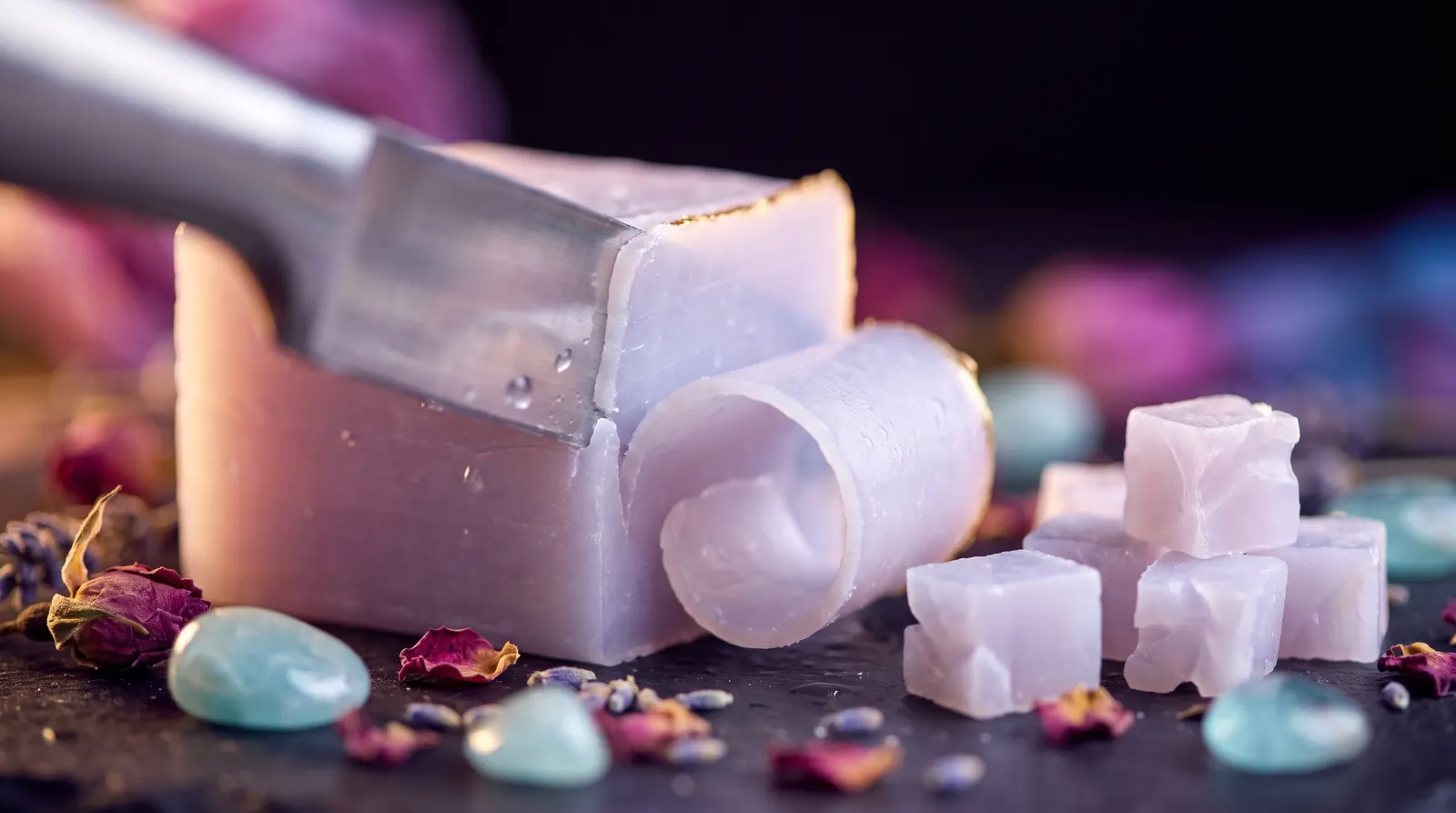
Somewhere out there, right now, a stranger is dragging a blade through a bar of soap, and two million people are watching. Not because anything happens. Because of how it happens: the crisp bite of the knife, the ribbon curling off the edge, the little cubes collapsing in a shower of clicks. I watched one on the subway last week and missed my stop. I'm not proud of it. But I am curious about it, because my brain got exactly nothing useful out of that video and still wanted another one.
So let's do what we do here: skip the mysticism and ask what's actually going on when a bar of soap getting destroyed feels better than most things on your phone.
What soap cutting actually is
The format is simple. Someone scores a bar of soap into a grid, then slices through it row by row, or shaves long curls off the side, or crushes pre-cut cubes between their fingers. The camera is close. The microphone is closer. The whole thing usually runs a few minutes and resolves the way a good sneeze does: fully.
It sits in the middle of a bigger genre researchers have started taking seriously. A media studies analysis of 'oddly satisfying' videos describes them as a sensory genre built on visual tactility: footage shot so close and so crisply that you practically feel the texture through your eyes (Nansen & Balanzategui, 2022, Convergence). Your visual system does the touching for you. That's not a metaphor. It's the design of the format.
Your brain treats watching like touching
Here's the un-mystical core of it. When you watch a knife sink into a scored bar of soap, your brain doesn't just process an image. It runs a quiet simulation of the action: the resistance, the give, the clean release. Watching careful hands do precise work recruits some of the same machinery you'd use to do the work yourself. That's why your shoulders drop when the cut goes cleanly and why a crumbly, ragged cut feels almost personally offensive.
Layer the audio on top and you've got a two-channel experience. Soap cutting is a cousin of ASMR, and ASMR isn't just vibes: in a controlled study, people who experience ASMR showed reliably lower heart rates while watching trigger videos, along with higher reported calm (Poerio et al., 2018, PLOS ONE). Not everyone gets the tingles. Plenty of people get the slowdown anyway. The crisp, close-mic'd sounds of a blade through soap hit the same trigger family as tapping and crinkling.
Your eyes do the touching, your ears confirm it, and your nervous system files the whole thing under 'safe, predictable, done.'
The completion loop
There's one more ingredient, and it's the one I'd bet on. Soap cutting videos are machines for closure. A grid gets scored, and then every square gets cut. No cliffhanger, no ambiguity, no cube left behind. Your brain loves a finished pattern the way your landlord loves the first of the month.
Most of modern life is open loops. The email thread that never resolves. The project that's 80 percent done for three weeks. The tab you're definitely going to read later. Against that backdrop, a 90-second video where a thing starts, proceeds in order, and completely finishes is weirdly medicinal. You get the neurological reward of completion without doing anything. It's junk food closure, sure. But after a deadline week, junk food closure beats no closure.
Why it works better than doomscrolling
Compare the soap video to whatever else your thumb was about to do. A news feed is unpredictable by design: outrage, joke, tragedy, ad, repeat. Your attention gets yanked around and your body keeps bracing for the next thing. Soap cutting is the opposite contract. You know exactly what's going to happen. The only suspense is how cleanly it'll happen. Predictable, slow-moving, low-stakes stimulation is roughly the description of everything that downshifts a nervous system, from watching fish to watching fire.
That's the honest pitch for the whole oddly satisfying genre: it's the rare corner of your phone that asks nothing of you and pays you anyway.
How to actually use it
If you want the effect on demand instead of at the mercy of an algorithm, a little structure helps.
- Use it as a buffer, not a binge. One or two videos between work and whatever's next. The effect is front-loaded; the fortieth video is just scrolling with extra steps.
- Headphones if you can. The sound is half the payload, and close-mic'd cutting sounds collapse into mush on a phone speaker.
- Go interactive when watching isn't enough. An app like Feelsy lets you slice, stretch and squish the texture yourself, which adds the agency that passive video can't. On restless nights, autoplay mode does the choosing so you don't have to.
- Pair it with a slow exhale. Cut, breathe out. It sounds silly. It works.
The skeptic's verdict
Is soap cutting going to fix your sleep, your focus, or your inbox? No. Is it a legitimately effective 90-second downshift that costs nothing and beats bracing your way through a feed? Yes. The research on visual tactility and on ASMR's measurable calming effects both point the same direction: this stuff isn't deep, but it's real. Sometimes the bar of soap is just a bar of soap. And sometimes it's the cheapest reset in New York.
Feelsy is a wellness product, not medical advice. If stress, anxiety or sleep problems persist, please speak with a qualified professional.
References
- Nansen, B., & Balanzategui, J. (2022). Visual tactility: 'Oddly satisfying' videos, sensory genres and ambiguities in children's YouTube. Convergence: The International Journal of Research into New Media Technologies, 28(6).
- Poerio, G. L., Blakey, E., Hostler, T. J., & Veltri, T. (2018). More than a feeling: Autonomous sensory meridian response (ASMR) is characterized by reliable changes in affect and physiology. PLOS ONE, 13(6), e0196645.
Frequently Asked Questions
Why are soap cutting videos so satisfying?
Three things stack up: your brain simulates the touch as you watch, so a clean cut feels almost like your own; the crisp, close-mic'd sounds work as ASMR-style triggers; and every video delivers total completion, with a scored grid that gets fully cut, no loose ends. Predictable, slow, low-stakes stimulation like that is exactly what helps a nervous system downshift.
Are soap cutting videos a type of ASMR?
They're close cousins. Soap cutting leans on the same trigger family as tapping and crinkling: crisp, quiet, repetitive sounds recorded up close, paired with careful hand movements. Research on ASMR has measured reliably lower heart rates in people watching trigger videos, and many viewers get that calming effect from soap cutting even if they never feel tingles.
Why does watching someone cut soap feel like touching it?
Media researchers call the effect visual tactility: footage shot so close and crisply that your visual system fills in the texture, so you practically feel the resistance and release of each cut. Your brain runs a quiet simulation of the action it's watching, which is also why a ragged, crumbly cut feels so wrong.
Do soap cutting videos help with stress?
As a short reset, yes. They won't fix underlying stress, but one or two videos work well as a buffer between a demanding task and whatever comes next, especially with headphones and a slow exhale. The effect is front-loaded, so a couple of minutes gives you most of the benefit; an hour of them is just scrolling in disguise.
Is there anything better than watching soap cutting?
If watching isn't quite enough, interactive textures add the missing ingredient: agency. Slicing, stretching or squishing a digital texture yourself, the way apps like Feelsy allow, gives you the same crisp sensory feedback plus the satisfaction of doing the cutting, which passive video can't offer.

About the author
Contributing writer
Kurt is a New York based writer covering the practical science of stress, sleep and focus. He is the resident sceptic of the Journal: if a technique cannot survive a crowded subway commute and a deadline week, he is not interested in it.
Feel it for yourself.
Feelsy turns reading about calm into practising it. Two minutes of a slow texture is often the whole difference.


Related reading
 ASMR
ASMRWhy Slime Videos Are So Satisfying
There is a real reason your shoulders drop when you watch slime being folded and poked. A look at ASMR, soft fascination and the design of satisfying motion.
 ASMR
ASMRThe Quiet Pleasure of Oddly Satisfying Videos
Why are oddly satisfying videos so satisfying? The psychology of perfect fits, clean sweeps and slow swirls, and how to turn watching into meditation.
 ASMR
ASMRASMR Triggers: A Field Guide to the Tingles
From whispers and tapping to slime and slow hands: the most common ASMR triggers, how to find yours, and why some people never feel tingles at all.
 ASMRNew
Why Is Bob Ross So Relaxing? The Science of Happy Little Brushstrokes
Bob Ross has been putting people to sleep for four decades, and he'd take that as a compliment. Here's the science of why his painting videos work like ASMR.
 ASMRNew
What Is 8D Audio? The Science Behind the Spinning Sound
8D audio pans music around your head using binaural tricks. Here's how the illusion works, why it feels immersive, and whether it helps you relax or focus.
 ASMR
ASMRWhy Paint Mixing Videos Are So Satisfying
Why paint mixing videos feel so satisfying: the slow science of swirls and folds, what ASMR research suggests, and how to watch them as a mini meditation.